

News & Resources
What Are the 4 Steps of Escalation?

The four steps of escalation from early warning signs to assault, how to spot each one, and the stage at which staff should step in.

TL;DR
The four steps of escalation are early warning signs, hostile, threatening and assaultive behaviour.
01
Act at stage 1
Early signs are the easiest to calm.
02
Options shrink
Each stage leaves fewer options.
03
Safety at stage 4
At that point, get safe and get help.
Free check: is your duty of care covered?
Start the checkThe four steps of escalation are early warning signs, hostile behaviour, threatening behaviour, and assaultive behaviour.
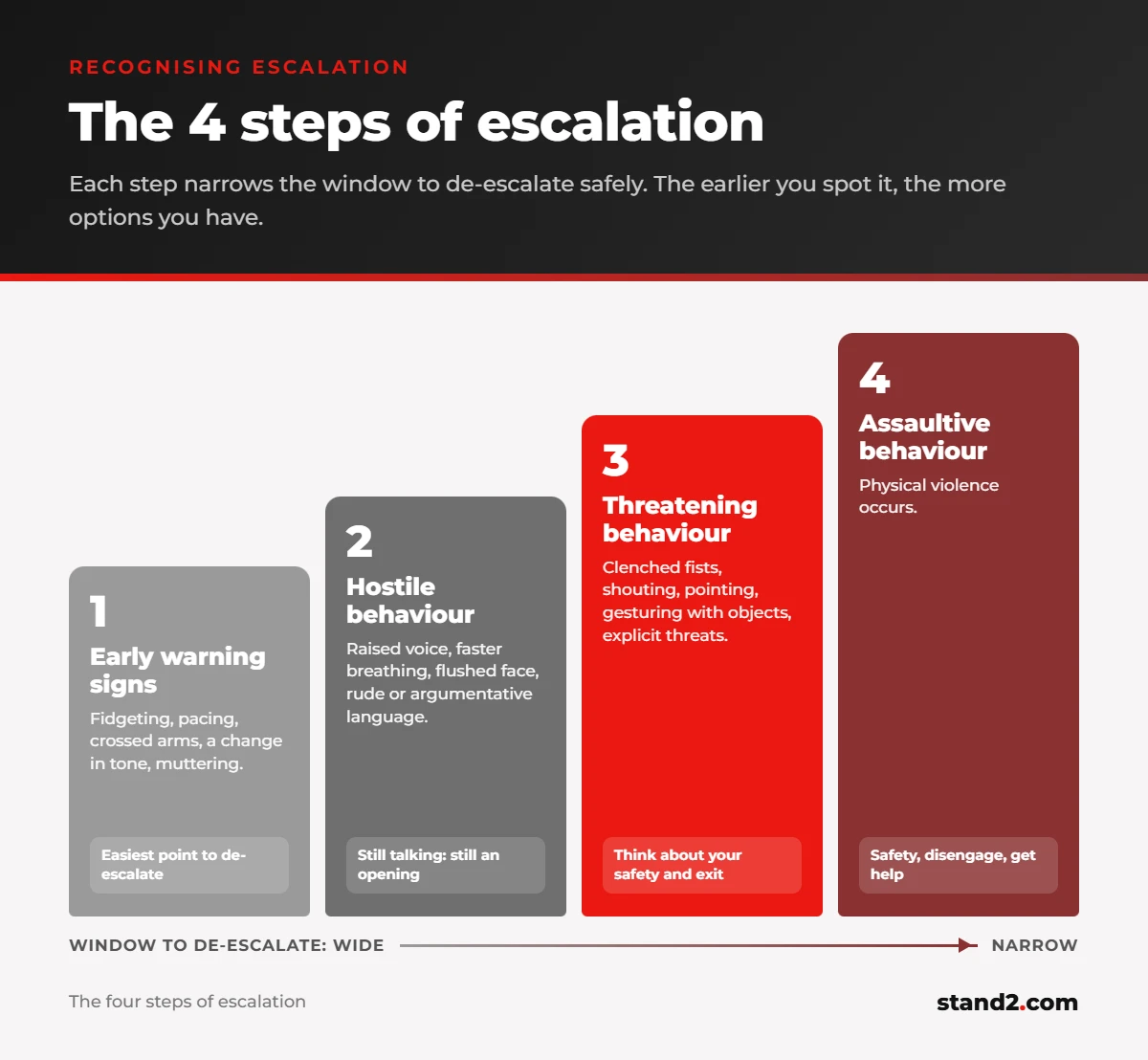
The 4 Stages Explained
Each stage represents a further narrowing of the window to de-escalate safely - the earlier a stage is recognised, the more options staff have for resolving it calmly. Escalation isn't always one-sided: the drama triangle shows how well-meant help can tip a conversation into conflict.
- Early warning signsSubtle cues that tension is building: fidgeting, pacing, crossed arms, a change in tone, or muttering. These are easy to miss if you're not looking for them, but this is the point where de-escalation is easiest and most effective.
- Hostile behaviourMore overt signs of anger: a raised voice, faster breathing, a flushed face, dismissive or rude language, an argumentative tone. The person is still communicating, which means there's still an opening to de-escalate - but it takes more skill than it did at stage 1.
- Threatening behaviourSignals that things could tip into physical aggression: clenched fists or jaw, shouting, pointing, gesturing with objects, or explicit threats. At this stage, staff should be thinking about their own safety and exit routes as much as about de-escalating. Responding safely at this point is exactly what our managing threatening behaviour training prepares frontline staff to do.
- Assaultive behaviourPhysical violence occurs. At this point, de-escalation alone is no longer the relevant response - safety, disengagement, and getting help become the priority.
Why this matters practically: the whole point of recognising these stages is catching stage 1 rather than reacting at stage 3. Staff who can spot the early, subtle signs have far more room to de-escalate calmly than staff who only notice a problem once someone's shouting. Practising a few simple de-escalation techniques makes that early window much easier to use.
Test Yourself: Can You Spot the Stage of Escalation?
Test yourself: spot the stage
Which step of escalation is this?
Your score
View De-escalation TrainingScenarios are simplified for practice. Real situations can move between steps quickly.
Once you've recognised the stage, the five steps to help deal with challenging behaviour set out what to actually do next.
It works in both directions, too: the attitude and behaviour cycle set out in Betari’s Box explains how your own response feeds back into theirs, which is why staying calm at stage 1 so often stops stage 2 arriving at all.
What Are the Stages of the Aggression Escalation Continuum?
The aggression escalation continuum is the same four-stage progression described above: early warning signs, hostile behaviour, threatening behaviour and assaultive behaviour.
Each stage leaves you with fewer options than the one before. Early warning signs can be handled with a change of tone or a little space. By the assaultive stage, the only priority is safety. Some training material uses different labels, such as "subtle changes" for the first stage or "physical aggression" for the last, but the sequence is the same.
At Which Stage of the Aggression Escalation Continuum Should Staff Become Involved?
At the first stage, while the changes are still subtle.
In the four-stage model above that's the early warning signs stage, sometimes called the subtle changes stage: fidgeting, pacing, a shift in tone, muttering. It's the least dramatic stage and the easiest to walk past, which is exactly why it gets missed.
Intervening here costs almost nothing: a check-in, a change of tone, giving someone space. Waiting until the threatening or assaultive stage means acting with fewer options, less time, and a far higher chance that whatever staff do gets read as provocation rather than de-escalation.
The rule worth training in is simple: if you've noticed something has changed, the noticing is the cue to act.
Our Level 1 De-escalation training is built specifically around catching challenging behaviour at the earliest possible stage, before it has the chance to move through these steps. In a pub or bar, that first stage often shows up as a change in a customer after a refusal or at last orders, which is why our de-escalation training for bar staff focuses on spotting it early.
For Frontline Staff
De-escalation Training
Teaches staff to spot the early warning signs and calm a situation down before it escalates. See what’s covered and how to book.
- 4 hours
- Up to 16 per trainer
- Delivered at your site
- Refresh every 3 years




 01952 928134
