

News & Resources
The Reactionary Gap: What It Is, How Far It Should Be and Why Distance Is Your Friend

The reactionary gap is the distance between you and a potential threat that gives you enough time to perceive, assess, decide and respond before that person can reach you. It is a safety buffer, not a comfort zone. On every Stand2 course we sum it up in four words: distance is your friend.
This guide explains why the reactionary gap works, how far it should be, what shrinks it, and how staff in healthcare, housing, retail, reception and lone working can keep one without looking hostile or unhelpful.
What is the reactionary gap?
The reactionary gap is the space that buys you reaction time. If someone becomes aggressive, every metre between you gives your decision-making cycle more time to run: to notice what is happening, decide what to do and act on it. Lose that space and you are left reacting to their move instead of making your own.
The idea comes from police and self-defence training, but it applies to anyone who deals with the public. A paramedic at a front door, a receptionist behind a counter and a housing officer on a doorstep all face the same problem: by the time aggression turns physical, it is too late to create space.
Why the reactionary gap matters: action beats reaction
The reactionary gap exists because action is always faster than reaction. The person who moves first has already started while you are still working out what you are seeing. To respond, your brain has to perceive the movement, recognise it as a threat, choose a response and send that instruction to your body. Each step takes time.
Hick's Law, described by the psychologist William Hick in 1952, explains part of the delay: reaction time increases with the number of possible responses. Reacting when there is only one possible response is called simple reaction time; choosing between several is called choice reaction time, and it is always slower. Someone facing an unexpected grab, with no plan and several half-formed options, reacts more slowly than someone who has already decided "if they step towards me, I step back towards the door". Training shortens reaction time by cutting the options down to one rehearsed response.
Fitts' Law, published by Paul Fitts in 1954, shows that the time needed to make an aimed movement depends on the distance to the target. At close range, a grab or a strike is short, fast and hard to miss. At a distance, the other person has to cover ground first, and covering ground is something you can see coming.
How far is the reactionary gap?
The reactionary gap is traditionally taught as roughly 6 to 10 feet, or about 2 to 3 metres, from someone who is not visibly armed. Two arm lengths is a useful starting point, because it puts the other person outside the range where they can touch you without first stepping in.
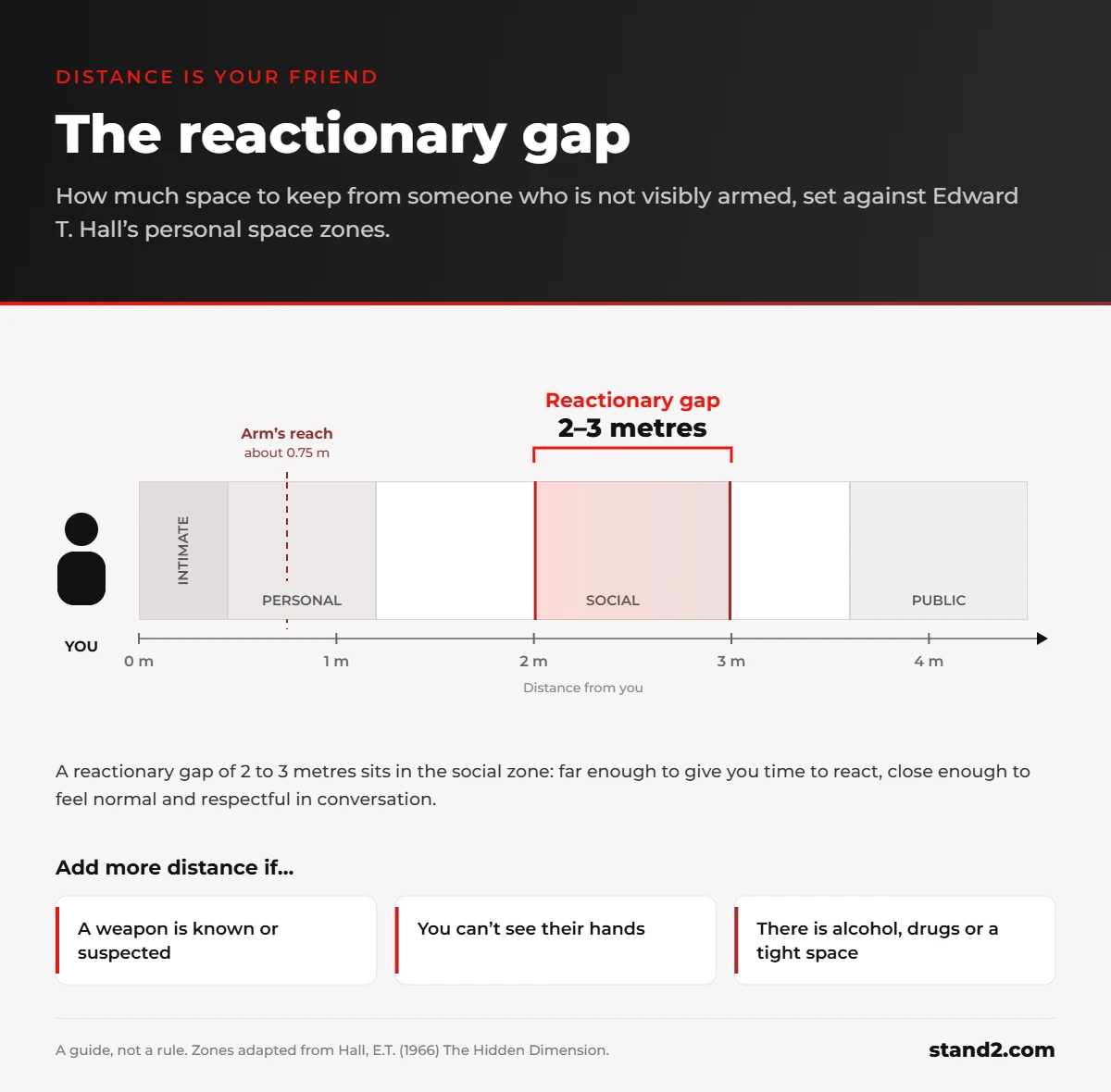
That figure is a guide, not a rule. The right distance depends on the person, the setting and whether a weapon might be involved. A reactionary gap that feels generous in a car park can disappear in a corridor, a small consultation room or a crowded shop.
Where the 21-foot rule comes from
The 21-foot rule came from a 1983 article by Dennis Tueller, a Salt Lake City police officer, published in SWAT magazine under the title "How Close Is Too Close?". Tueller timed how quickly an average adult could run 21 feet (about 6.4 metres) and found it took around one and a half seconds, roughly the time an officer needed to draw a handgun and fire. The exercise became known as the Tueller drill.
The 21-foot figure is not a law, and Tueller himself rejected the idea that it was a fixed rule. Its useful lesson for everyone else is simpler: someone with a knife or other weapon can close a surprising distance in the time it takes you to realise what is happening, so a suspected weapon needs far more space than an angry but empty-handed person.
What shrinks or widens the reactionary gap?
The reactionary gap shrinks or widens with what police training calls impact factors: features of a situation that make it higher risk. The College of Policing lists examples such as weapons, crowds, alcohol, and the relative size and build of the people involved. The table below shows the ones frontline staff meet most often.
| Factor | Why it changes the gap |
|---|---|
| A known or suspected weapon | A weapon extends reach and raises the stakes of getting it wrong, so the gap needs to be much larger. |
| Hands you cannot see | Hidden hands could be holding something. Treat them as a reason to add distance. |
| Alcohol or drugs | Intoxication makes behaviour less predictable and movements more sudden. |
| Size, speed and numbers | A larger, faster person, or more than one person, can close distance more quickly. |
| The environment | Narrow corridors, poor lighting, wet floors, clutter and blocked exits all cost you time. |
| Your own condition | Fatigue, injury, footwear, carrying equipment or sitting down all slow your first move. |
| Barriers between you | A desk, counter, table or vehicle widens the effective gap, because the other person has to go round it. |
Because these factors change minute by minute, the reactionary gap is dynamic, not static. Managing distance is a skill you keep using throughout an encounter, not a line you measure once. In an ambush-style attack, the other person deliberately closes the gap before you realise anything is wrong, which is why the earlier you notice, the better.
How stress shrinks your reaction time
Stress makes the reactionary gap more important, because adrenaline slows the part of your response that depends on thinking. Under threat, many people experience tunnel vision, where attention narrows onto the person in front of them and peripheral vision fades. Others notice auditory exclusion, clumsy hands or a moment of freezing while their brain catches up.
The College of Policing advises officers to sweep their head and glance sideways at regular intervals so they do not fixate on one person. The same habit helps anyone keep track of exits, colleagues and bystanders while they talk to someone who is angry.
The startle and flinch response
The startle and flinch response is the body's automatic protective reflex: the blink, hunch and hands-up movement that happens before you have consciously decided anything. Inside arm's length, that flinch may be the only response you have time for. Outside the reactionary gap, the flinch buys you a fraction of a second, and the distance gives you room to turn it into a step away.
Warning signs that someone is closing the gap
The clearest warning sign is someone who keeps closing the distance after you have stepped back. Once might be accidental. Twice is a pattern worth acting on. Trainers call these pre-attack indicators. Other danger cues highlighted in College of Policing guidance include clenched fists and hands rising above the waist, along with body language that does not match what the person is saying.
Spotting these cues early depends on situational awareness, which the College of Policing defines as the ability to perceive and process potential threats in the environment. The earlier you notice, the more of the gap you still have to work with. Situational awareness also feeds the dynamic risk assessment you keep making as the situation unfolds, which police officers structure using the National Decision Model.
How to keep a reactionary gap at work
Keeping a reactionary gap at work means planning your position before a conversation starts, not backing away once it has gone wrong. These habits work in most frontline settings:
- Know your exit. Before you sit or stand, check where the door is. Never let the other person end up between you and your way out.
- Use barriers. A reception counter, desk or table makes someone go round it to reach you, which gives you extra seconds.
- Stand at an angle. An angled stance looks less confrontational than squaring up, and it makes it easier to step away or turn.
- Keep your hands up and open. Open palms at chest height look calm and non-threatening, and they put your hands where they can protect you if you need them. This is often called the fence position.
- Step off line, not straight back. Backing up blindly invites a trip over a chair, kerb or bag. Move at an angle and keep looking where you are going.
- Adjust as things change. If the person stands up, raises their voice or comes closer, reset the distance straight away.
BUGEE: a police model for creating time and space
BUGEE is a mnemonic from the police Taser curriculum, quoted in College of Policing guidance, that helps officers create the time and space to assess risk and calm a situation. BUGEE stands for:
- Be prepared to back off
- Use of effective cover
- Give space and time if possible
- Early negotiation
- Evacuate the immediate area
Every step in BUGEE either keeps or widens the reactionary gap. It is a useful prompt for non-police staff too, with "cover" meaning a desk, a door or a vehicle rather than protection from gunfire.
The reactionary gap and the law
In the UK, keeping a reactionary gap does not give anyone a right to use force, and someone crossing it does not automatically justify force either. Any force used in self-defence must be reasonable in the circumstances as you honestly believed them to be, under section 3 of the Criminal Law Act 1967 and section 76 of the Criminal Justice and Immigration Act 2008. The law does not require you to retreat, but whether you could have stepped away is one of the factors a court can consider.
Employers carry duties too. The Health and Safety at Work etc. Act 1974 requires employers to protect staff so far as is reasonably practicable, and the Management of Health and Safety at Work Regulations 1999 require them to carry out a suitable and sufficient risk assessment, including the risk of work-related violence. The HSE defines work-related violence as any incident in which a person is abused, threatened or assaulted in circumstances relating to their work. Teaching staff to keep a safe distance, and designing rooms and reception areas so they can, is a practical part of meeting those duties.
Free Three-Minute Check
Are your staff protected? Check your duty of care.
Fourteen questions, scored against HSE guidance. You get a red, amber or green rating for each area and the three things to fix first. No sign-up.
The reactionary gap and de-escalation
The reactionary gap is a de-escalation tool as well as a safety tool. Giving someone space lowers their sense of threat, and a person who feels less threatened is easier to talk down. Standing too close can be the thing that tips an upset person into an aggressive one.
Proxemics, the study of personal space coined by the anthropologist Edward T. Hall, helps explain why. Hall described four zones: intimate (up to about 45cm), personal (about 45cm to 1.2m), social (about 1.2m to 3.6m) and public (beyond 3.6m). A reactionary gap of 2 to 3 metres sits in the social zone, which most people experience as normal and respectful when talking to a stranger or a professional.
Betari's Box adds the other half of the picture: your attitude affects your behaviour, and your behaviour affects theirs. Stepping into someone's space is a behaviour, and an agitated person often answers it with more aggression. Stepping back to a respectful distance, with a calm voice and open hands, sends the opposite signal.
Space matters even more for people in mental health crisis, autistic people and anyone who finds communication difficult. College of Policing advice for these situations is direct: do not get too close, and give the person plenty of space.
Isn't arm's length safer? The police counter-argument
Not everyone agrees with the traditional reactionary gap. In a 2012 article in the US policing publication Police1, an American defensive tactics instructor argued that officers would be safer at one arm's length with their hands up. In his training scenarios, officers who stood six to eight feet away tended to step backwards when a suspect reached for a weapon, and lost. Officers who stood close could move forward and control the suspect's hands.
From a policing perspective, that argument makes a fair point: distance can breed complacency. People who believe the gap protects them tend to drop their hands and relax, and a gap you are not paying attention to protects nobody.
The arm's-length approach is built for armed police officers who intend to go hands-on, control a suspect and make an arrest. A nurse, receptionist, support worker or housing officer has a different job: to stay safe and leave. For them, closing in to grab someone is the wrong goal, and distance remains the safer default. In the Thomas-Kilmann conflict model, stepping back to let someone calm down is a deliberate use of the avoiding mode, which suits situations where the risk of harm outweighs anything you could gain by standing your ground. The lesson worth borrowing from the counter-argument is to stay alert inside the gap, keep your hands up and never treat distance as a guarantee.
The reactionary gap in healthcare and the NHS
Healthcare staff often cannot keep a reactionary gap, because care means getting close: taking blood pressure, dressing a wound or helping someone stand. When the job requires you to enter the gap, other measures have to do the work distance would normally do:
- explain what you are about to do before you move closer
- approach from the side rather than head-on where possible
- keep the exit clear and position yourself nearest the door
- bring a second person for patients with a known history of aggression
- step back out of the gap as soon as the task is finished
Ambulance crews, community nurses and mental health teams face this every shift, often in someone's home, where they have no control over the layout. That is why the reactionary gap is commonly taught in healthcare conflict resolution training.
Lone workers and home visits
For lone workers, the reactionary gap includes the route to the exit. On a home visit, stay between the occupant and the door, keep your bag and keys where you can grab them, and choose a seat near the way out. If the atmosphere changes, you need to be able to leave without having to get past anyone, so keep your escape route clear at all times.
Distance is your friend: how Stand2 teaches the reactionary gap
Stand2 teaches the reactionary gap on every course, under the principle that distance is your friend. Staff learn to plan their position, read the warning signs, use barriers and exits, and reset the distance as a situation changes, through practical scenarios based on their own workplace. Our de-escalation training combines this with what to say, what to avoid and when to step back and get help.
For Customer-Facing Staff
De-escalation Training
Teaches staff what to say to an angry customer, patient or caller, what to avoid, and when to step back and get help. See what’s covered and how to book.
- 4 hours
- Up to 16 per trainer
- Delivered at your site
- Refresh every 3 years
Reactionary gap: frequently asked questions
What does reactionary gap mean?
The reactionary gap is the distance between you and a potential threat that gives you time to perceive, decide and respond before they can reach you. It exists because action is faster than reaction.
What is the distance of the reactionary gap?
The reactionary gap is usually taught as about 6 to 10 feet, or 2 to 3 metres, from someone who is not visibly armed. It is a guide rather than a rule: weapons, hidden hands, alcohol and tight spaces all mean you need more distance.
What is the reactionary gap in conflict resolution?
In conflict resolution, the reactionary gap is the safe distance staff keep from an angry or aggressive person. It gives them time to react if the situation turns physical, and the space itself often helps calm the other person down.
Is the 21-foot rule a law in the UK?
No. The 21-foot rule comes from a 1983 US police training article by Dennis Tueller and has no legal standing. In the UK, any force used in self-defence must be reasonable in the circumstances as you honestly believed them to be.
What does reactionary gap mean in the NHS?
In NHS and healthcare settings, the reactionary gap means keeping a safe distance from patients or visitors who show signs of aggression. When care requires getting close, staff explain what they are doing, keep the exit clear and step back out of the gap once the task is done.
Sources: College of Policing, Conflict management skills guidance (2020); Health and Safety Executive guidance on work-related violence; Criminal Law Act 1967, s.3; Criminal Justice and Immigration Act 2008, s.76; Management of Health and Safety at Work Regulations 1999; D. Tueller, "How Close Is Too Close?", SWAT magazine (1983); W. E. Hick (1952); P. M. Fitts (1954); E. T. Hall, The Hidden Dimension (1966).




 01952 928134
