

News & Resources
The Thomas-Kilmann Conflict Model Explained: 5 Conflict Modes and When to Use Them

TL;DR
The Thomas-Kilmann conflict model sorts the way people handle conflict into five modes: competing, collaborating, compromising, avoiding and accommodating. Each is a different mix of assertiveness and cooperativeness, and no single mode is best.
The model is a useful framework, but the research shows the TKI questionnaire doesn't reliably predict real behaviour, and the model has no axis for risk. For frontline staff facing aggression, safety has to come first.
The Thomas-Kilmann conflict model is a framework that sorts the ways people handle conflict into five modes: competing, collaborating, compromising, avoiding and accommodating.
Each mode is a different mix of two things: how much you push for your own concerns (assertiveness) and how much you try to meet the other person’s (cooperativeness). No mode is right every time. The skill is picking the one that fits the situation.
It matters because conflict at work is more common than ever. In 2025, 44% of UK workers told Acas they had experienced conflict at work in the previous 12 months, the highest level the organisation has recorded. For many of them, the conflict wasn’t with a colleague at all, but with a customer, patient or member of the public.
This guide explains how the model works, what each mode looks like in practice, what the research actually says about it, and where it needs adapting for frontline and public-facing roles.
What Is the Thomas-Kilmann Conflict Model?
The model was developed by two American management academics, Kenneth W. Thomas and Ralph H. Kilmann, and published in 1974 as the Thomas-Kilmann Conflict Mode Instrument, usually shortened to the TKI. They built it on an earlier framework, Robert Blake and Jane Mouton’s Managerial Grid from the 1960s, and simplified it into something people at any level of an organisation could pick up quickly.
It helps to separate two things that often get blurred together:
- The model is the five-mode grid itself: a way of describing and thinking about conflict behaviour.
- The TKI is the questionnaire that measures which modes a person tends to use. It has 30 pairs of statements, and for each pair you must pick one, even when neither feels quite right.
That forced-choice format was the authors’ key design decision. When people rate statements one at a time, they tend to pick whatever sounds most socially acceptable. Thomas and Kilmann paired statements of similar appeal against each other, and their 1977 research found this significantly reduced that bias compared with other conflict questionnaires of the time.
Fifty years on, the TKI is still published commercially, still used in management and leadership training, and still appears in UK healthcare research. A study of nurse shift scheduling published in Nursing Times in October 2026 used the model as its guiding framework.
The Two Dimensions: Assertiveness and Cooperativeness
The model is based on two dimensions, plotted as the two axes of a grid:
- Assertiveness: how far you try to satisfy your own concerns.
- Cooperativeness: how far you try to satisfy the other person’s concerns.
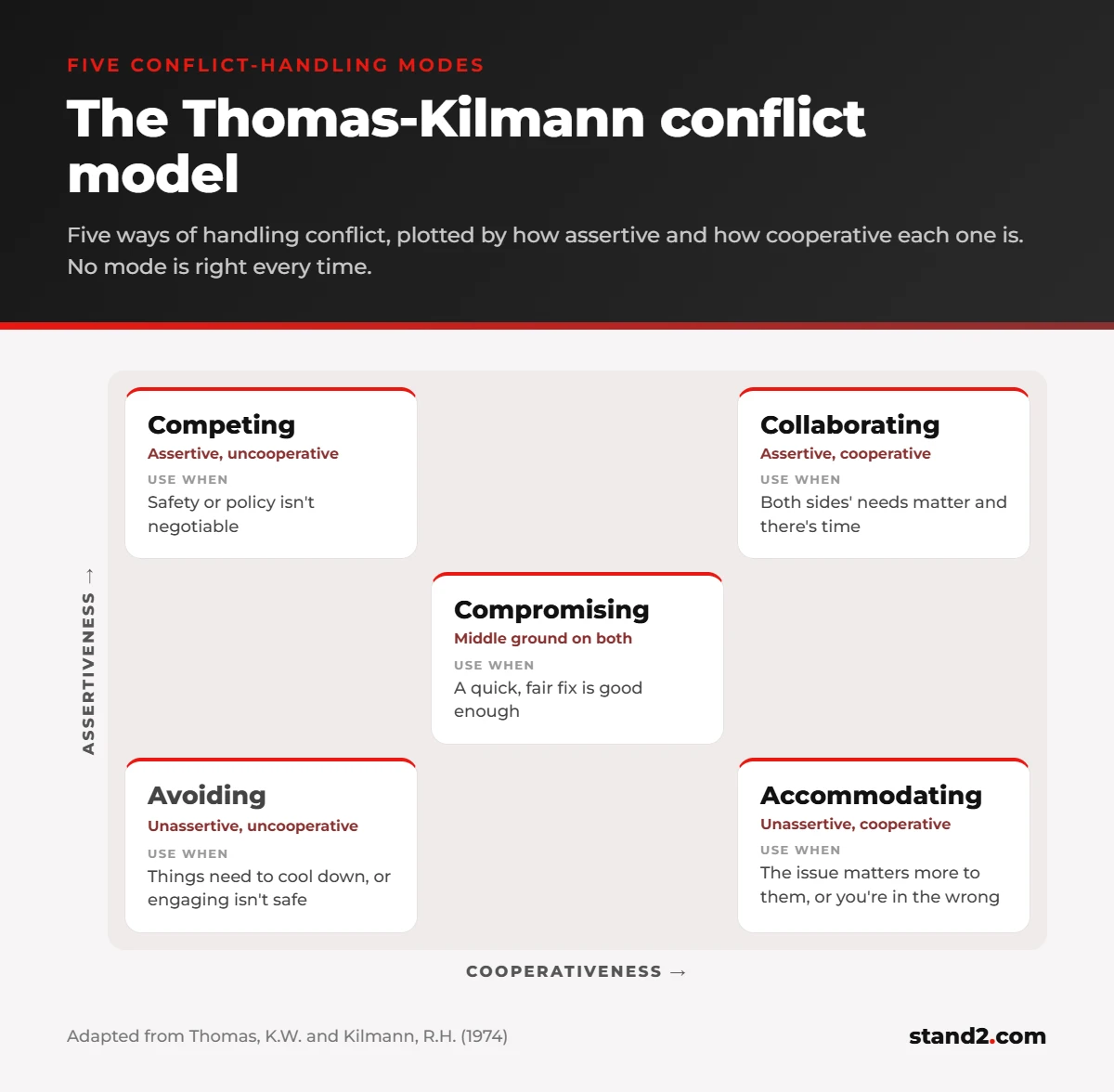
These two dimensions are independent. You can be high on both, low on both, or high on one and low on the other. Each combination gives one of the five conflict modes, with compromising sitting in the middle.
The 5 Thomas-Kilmann Conflict Modes
1. Competing (assertive and uncooperative)
Competing means pursuing your own position, using whatever influence or authority you have. It is a power-oriented mode: standing your ground, enforcing a rule, or making a call that others won’t like.
When it works: when a quick, decisive action is needed, when safety is at stake, or when you need to enforce a policy that isn’t up for negotiation.
When it backfires: when it becomes the default. Overused, competing damages relationships, shuts down information people would otherwise share, and escalates situations that could have been settled quietly.
Frontline example: a receptionist giving a clear, calm instruction (“I need you to step back from the desk, please”) when someone is leaning over the counter.
2. Collaborating (assertive and cooperative)
Collaborating means working with the other person to find a solution that fully meets both sets of concerns. It goes beyond splitting the difference: it involves digging into what each side actually needs.
When it works: when both sets of concerns are too important to trade off, when you need commitment from the other person, and when there is time to talk properly.
When it backfires: when the issue is trivial, when time is short, or when the other person isn’t able or willing to engage. Collaborating takes the most time and energy of any mode.
Frontline example: sitting down with a frustrated tenant once they have calmed down, to agree a repair plan that works for them and for the service.
3. Compromising (middle ground on both)
Compromising means finding a quick, acceptable solution that partly satisfies both sides. Each person gives something up.
When it works: when goals matter but aren’t worth the time collaboration would take, when both sides have equal power, or when you need a temporary fix under time pressure.
When it backfires: when it becomes a habit. Constant compromise can leave nobody fully satisfied and important issues never properly resolved.
Frontline example: “I can’t get you seen right now, but I can book you the first appointment tomorrow morning.”
4. Avoiding (unassertive and uncooperative)
Avoiding means not addressing the conflict at all, for now. That might be sidestepping an issue, postponing it to a better time, or withdrawing from a situation.
When it works: when the issue is minor, when emotions need time to cool, when someone else is better placed to deal with it, or when engaging carries more risk than benefit.
When it backfires: when important issues are left to fester. Avoiding is the mode most people think of as weak, but used deliberately it is often the smartest choice available. More on that below.
Frontline example: a bus driver choosing not to challenge a fare dispute with an intoxicated passenger, and reporting it instead.
5. Accommodating (unassertive and cooperative)
Accommodating means setting your own concerns aside to meet the other person’s. The opposite of competing, it can look like giving way, doing a favour or accepting someone else’s view.
When it works: when you realise you’re wrong, when the issue matters far more to them than to you, or when keeping goodwill is the priority.
When it backfires: when it’s overused. Constant accommodating builds resentment, and in public-facing roles it can teach people that aggression gets results.
Frontline example: apologising and fixing a genuine mistake straight away, rather than defending the process.
The five modes at a glance
| Mode | Assertiveness | Cooperativeness | Best used when… |
|---|---|---|---|
| Competing | High | Low | Safety or policy isn’t negotiable |
| Collaborating | High | High | Both sides’ needs matter and there’s time |
| Compromising | Medium | Medium | A quick, fair fix is good enough |
| Avoiding | Low | Low | Things need to cool down, or engaging isn’t safe |
| Accommodating | Low | High | The issue matters more to them, or you’re in the wrong |
How to Use the Thomas-Kilmann Model
The most common mistake is treating the model as a personality label: “I’m a collaborator”, “she’s an avoider”. Ralph Kilmann himself is clear that everyone is capable of using all five modes, and that nobody can be summed up by a single style. People simply get more practice with some modes than others, and lean on those out of habit.
Used properly, the model works in four steps:
- Know your default. Which mode do you reach for automatically when you’re under pressure? Most people have one or two.
- Read the situation. How important is the issue? How important is the relationship? How much time do you have? Kilmann describes eight key attributes of a conflict situation that signal which mode is likely to work best, and one of them is whether the situation is dominated by overwhelming stress.
- Choose deliberately. Pick the mode that fits the situation, not the one that feels most comfortable.
- Use it well. Kilmann’s point here is often missed: any mode, including avoiding and accommodating, can be used respectfully or badly. Competing doesn’t have to mean being rude, and avoiding doesn’t have to mean being dismissive.
Modes can also be used in sequence. A conversation might start with avoiding (letting someone vent), move to accommodating (acknowledging a fair point), and end with collaborating once everyone is calm enough to problem-solve. This is the same principle behind good conflict management training: the right response changes as the situation changes.
What the Research Says About the Thomas-Kilmann Model
The TKI is one of the most widely used conflict tools in the world, but the research behind it is more mixed than most guides admit. Here is a fair summary.
What holds up
- The forced-choice design works. The authors’ original research showed it reduced people’s tendency to choose the most socially attractive answer, compared with other conflict questionnaires.
- It compares reasonably with other tools. In the authors’ 1978 comparison of four conflict instruments, the TKI was among the more reliable, with some agreement with other measures across all five modes.
- It shows patterns at scale. A 2020 analysis by The Myers-Briggs Company of more than 460,000 people who completed the TKI between 2004 and 2019 found that men scored slightly higher on competing, and women on compromising, avoiding and accommodating. People in more senior roles avoided and accommodated less. All of these differences were small, and seniority made more difference than gender.
Where it falls short
- It doesn’t reliably predict behaviour. In a 1987 study published in the Journal of Applied Psychology, Boris Kabanoff gave the TKI to a group of MBA students, then had their actual conflict behaviour rated a year later. He found little link between their TKI scores and how they actually behaved, although some personality measures did predict it.
- Not every mode measures cleanly. A 1989 study of 603 people found that the questions for competing, compromising and collaborating grouped together as expected, but the questions for avoiding and accommodating did not, and the two-dimensional structure didn’t show up in the data. The authors also noted that much of the TKI’s validity research had relied on student samples.
- The comparison data is old and American. The current norm group, the people your scores are compared against, is 8,000 US workers who took the assessment between 2002 and 2005.
- Context changes everything. A 2022 study of nurses and physicians in Slovenian primary care found nurses mostly avoided while physicians mostly compromised. The researchers concluded that the nature of the work and the situation strongly shapes how conflict is handled.
The practical takeaway: the model is a genuinely useful way to think and talk about conflict. The questionnaire is a useful prompt for self-reflection. Neither is a reliable prediction of how someone will act when a real situation turns difficult.
The Thomas-Kilmann Model in Frontline and Public-Facing Roles
Almost everything written about the Thomas-Kilmann model assumes office conflict: two colleagues disagreeing over a project, a manager and a team member at odds over workload. That’s what it was designed for. Both people are reasonably calm, both care about the working relationship, and both want some kind of resolution.
Frontline conflict is often very different. In the 2025 NHS Staff Survey, 14.47% of staff said they had experienced physical violence from patients or the public in the past year, the highest figure in three years. Among ambulance staff, roughly half reported a violent incident. Across all workplaces in England and Wales, the Crime Survey estimated 689,000 incidents of violence at work in 2024/25.
In these situations, three of the model’s built-in assumptions start to break down.
1. It assumes the other person is thinking rationally
Collaborating and compromising both depend on the other person being able to weigh options and engage with a solution. Someone who is intoxicated, in mental health crisis, in severe pain or overwhelmed by fear often can’t do that in the moment. The HSE’s 2024/25 figures found offenders were judged to be under the influence of alcohol in around 40% of threats and 21% of assaults at work.
Researchers Doug Baumoel and Blair Trippe, who extended the model for highly hostile conflicts, make the same point: in extreme conflict, people tend to act emotionally rather than follow a rational strategy for getting what they want.
2. It assumes the relationship is positive or neutral
Baumoel and Trippe also argue that the model takes for granted that a valued relationship is a positive or neutral one. A member of the public shouting at a receptionist isn’t in a relationship with them in any meaningful sense, and may not care about it at all. That changes what accommodating and collaborating can realistically achieve.
3. It has no axis for risk
This is the biggest gap. The model asks how much you care about your concerns and how much you care about theirs. It doesn’t ask the first question frontline staff need to answer: am I safe?
Once you add risk, the modes look different:
- Avoiding becomes a safety skill. Withdrawing, creating distance and getting support isn’t weakness or poor customer service. When someone is escalating, it is often the most professional choice available. The key is doing it deliberately, safely and with a plan to report or return.
- Competing becomes clear boundary-setting. Short, firm, calm instructions are a legitimate tool when safety is at stake, as long as they’re delivered without aggression.
- Accommodating becomes de-escalation, within limits. Acknowledging frustration and fixing what can reasonably be fixed calms most situations. It stops being useful when it means breaching policy, compromising safeguarding or rewarding aggression.
- Collaborating usually comes last, not first. Problem-solving is often only possible once the person has calmed down.
Kilmann’s own guidance supports this. He lists overwhelming stress as one of the key attributes that changes which mode will work. On the frontline, high stress is often the normal state of an incident, not the exception.
The Thomas-Kilmann model is a good starting point, but frontline staff need more than a theory of conflict styles. They need to recognise early warning signs, read risk as it changes, and choose a safe response under pressure. That’s the gap de-escalation training is designed to fill.
Free Three-Minute Check
Are your staff protected? Check your duty of care.
Fourteen questions, scored against HSE guidance. You get a red, amber or green rating for each area and the three things to fix first. No sign-up.
Advantages and Disadvantages of the Thomas-Kilmann Model
Advantages
- Simple and memorable. Five modes and two dimensions are easy to learn and easy to recall under pressure.
- Non-judgemental. No mode is labelled good or bad, which makes it easier for people to reflect on their own habits honestly.
- Gives teams a shared language. Saying “I think we’re both competing here” can take the heat out of a disagreement.
- Encourages flexibility. It pushes people to widen their range rather than rely on one default.
- Well established. Fifty years of use means it is widely recognised in training, HR and healthcare.
Disadvantages
- Self-report limits. Results depend on how people see themselves, which isn’t always how they act. Kabanoff’s research suggests the gap can be significant.
- Can become a label. Used badly, it boxes people in (“that’s just my style”) rather than helping them adapt.
- Dated, US-based norms. Scores are compared with American workers from the early 2000s.
- Cultural assumptions. Some scholars argue it reflects US cultural assumptions about how conflict should be handled.
- Designed for peers, not public conflict. It doesn’t account for risk, intoxication, crisis or hostility, which makes it incomplete for frontline roles.
Taking the Thomas-Kilmann Assessment
The official TKI is a paid assessment published by The Myers-Briggs Company, which distributes it in the UK. It is also available from Kilmann Diagnostics, run by co-author Ralph Kilmann. It takes around 15 minutes and produces a profile showing which modes you use more or less than others.
You’ll find plenty of free “Thomas-Kilmann tests” online. These may be loosely based on the model, but they aren’t the TKI, haven’t been validated in the same way, and their results should be treated as a rough conversation starter at best.
Whichever version you take, remember what the research shows: your profile describes your habits, not your limits.
Quick Quiz: What's Your Go-To Conflict Mode?
Quick quiz
What's your go-to conflict mode?
Five everyday situations. Pick what you'd most likely do, not what you think you should do.
Your go-to mode
Works well when:
Watch out for:
The real skill: everyone uses all five modes. Handling conflict well means choosing the right one for the situation, and with an agitated person, that choice has to account for risk.
A quick reflection based on the Thomas-Kilmann model. It isn't the official TKI assessment.
Putting the Model Into Practice
The Thomas-Kilmann model is valuable because it reframes conflict as a set of choices rather than a fixed personality trait. Everyone can use all five modes; the real skill is choosing the right one at the right moment and using it well.
For staff who deal with frustrated, distressed or aggressive members of the public, that choice also has to account for risk. Stand2’s Managing Challenging Behaviour Training builds those skills through realistic, scenario-based practice.
For Frontline Staff
De-escalation Training
Teaches staff what to say, what to avoid and when to walk away. See what’s covered and how to book.
- 4 hours
- Up to 16 per trainer
- Delivered at your site
- Refresh every 3 years
Thomas-Kilmann Conflict Model: Frequently Asked Questions
What are the 5 conflict modes in the Thomas-Kilmann model?
Competing, collaborating, compromising, avoiding and accommodating. Each one reflects a different balance of assertiveness (meeting your own concerns) and cooperativeness (meeting the other person's).
What are the two dimensions of the Thomas-Kilmann model?
Assertiveness and cooperativeness. Assertiveness is how far you try to satisfy your own concerns. Cooperativeness is how far you try to satisfy the other person's.
Which Thomas-Kilmann mode is high on both assertiveness and cooperativeness?
Collaborating. It aims for a solution that fully meets both people's concerns, which is why it is often described as "win-win".
Which conflict mode is best?
None of them, on its own. Ralph Kilmann is clear that there is no single best mode for every situation; each works best when it fits the circumstances. Collaborating is often treated as the ideal, but it takes time and needs both people to engage. In a heated or unsafe situation, it is rarely the right place to start.
What is the difference between the Thomas-Kilmann model and the TKI?
The model is the framework of five modes on two dimensions. The TKI (Thomas-Kilmann Conflict Mode Instrument) is the 30-item questionnaire that measures which of those modes a person tends to use.
When was the Thomas-Kilmann model created?
Kenneth Thomas and Ralph Kilmann published the Thomas-Kilmann Conflict Mode Instrument in 1974, building on Blake and Mouton's Managerial Grid from the 1960s.
How do I reference the Thomas-Kilmann model?
In Harvard style, the original instrument is usually cited as: Thomas, K.W. and Kilmann, R.H. (1974) Thomas-Kilmann Conflict Mode Instrument. Tuxedo, NY: Xicom. Check your institution's referencing guide for its exact format.
Sources Referenced
- Acas (2025) How prevalent is individual conflict at work in Great Britain in 2025?
- Kilmann, R.H. and Thomas, K.W. (1977) ‘Developing a forced-choice measure of conflict-handling behavior: the MODE instrument’, Educational and Psychological Measurement, 37, pp. 309–325.
- Thomas, K.W. and Kilmann, R.H. (1978) ‘Comparison of four instruments measuring conflict behavior’, Psychological Reports, 42, pp. 1139–1145.
- Kabanoff, B. (1987) ‘Predictive validity of the MODE conflict instrument’, Journal of Applied Psychology, 72(1), pp. 160–163.
- Konovsky, M.A., Jaster, F. and McDonald, M.A. (1989) ‘Using parametric statistics to explore the construct validity of the Thomas-Kilmann Conflict Mode Survey’, Management Communication Quarterly, 3(2).
- The Myers-Briggs Company, History and Validity of the Thomas-Kilmann Conflict Mode Instrument
- Blackburn, N. (2020) Conflict Styles, Gender and Leadership. The Myers-Briggs Company.
- Delak, B. and Širok, K. (2022) ‘Physician–nurse conflict resolution styles in primary health care’, Nursing Open, 9(2), pp. 1077–1085.
- Kilmann Diagnostics, Using the Thomas-Kilmann Conflict Mode Instrument
- Baumoel, D. and Trippe, B. (2025) A New Way to Resolve Extreme Conflict in Family Businesses. Entrepreneur and Innovation Exchange.
- NHS England (2026) NHS Staff Survey 2025 results, as reported by the Royal College of Emergency Medicine
- Health and Safety Executive (2025) Violence at Work statistics, 2024/25
- Nursing Times (2026) Negotiating the competing priorities in nurse shift scheduling




 01952 928134
