

News & Resources
The Assault Cycle: The 5 Stages and What to Do at Each One

What the assault cycle is, what happens at each of its five stages, and what frontline staff should do at every one.

TL;DR
The assault cycle is a five-stage model of how a person's aggression builds from calm, peaks in a crisis and falls back to normal.
01
Five stages
Trigger, escalation, crisis, recovery and post-crisis.
02
Act early
The earlier you step in, the more options you have.
03
Not over yet
The risk stays high while the person recovers.
What is the assault cycle?
The assault cycle is a five-stage model that describes how a person moves from their normal, calm state into aggression or violence and then back again. The five stages are trigger, escalation, crisis, recovery and post-crisis depression.
The model was published in 1983 by S. G. Kaplan and E. G. Wheeler in the journal Social Casework, in a paper called “Survival Skills for Working with Potentially Violent Clients”. They wrote it for mental health and social workers facing violence from the people they supported. It’s now widely used in conflict management training for frontline staff, as well as in schools and care settings.
You’ll also see it called the aggression cycle, the emotional arousal cycle or the anger cycle. It isn’t the same as the cycle of abuse, which is a separate model describing repeated patterns of domestic abuse.
The model matters because each stage calls for a different response. What calms someone at the trigger stage can be useless, or make things worse, at the crisis stage. Knowing which stage a person has reached tells you what to do next.
Shorter models, such as the four steps of escalation, stop at the point of assault. The assault cycle goes further and covers what happens after the peak, which is when a second outburst can catch staff off guard.
The assault cycle
How aggression builds, peaks and falls
The five stages, measured against the person’s normal, calm baseline (the dashed line).
- 1TriggerSomething moves the person away from their calm baseline.
- 2EscalationArousal climbs and rational thinking starts to drop.
- 3CrisisThe peak: fight or flight takes over and violence is most likely.
- 4RecoveryCalming down, but still primed for a second outburst.
- 5Post-crisis depressionA dip below baseline: exhaustion, guilt or shame.
A guide, not a rule. Adapted from Kaplan and Wheeler (1983).stand2.com
The 5 stages of the assault cycle
Every stage is measured against the person’s baseline: their normal, calm level of behaviour. The cycle starts at baseline, climbs through the first three stages, then falls back, dipping below baseline before it levels out.
1. Trigger phase
The trigger phase is the point where something upsets the person and moves them away from baseline. A trigger can be sudden, like being refused service or asked to leave, or slow-burning, like a long wait, pain, tiredness, hunger or worry building up over hours.
In frontline work, common triggers include waiting times, feeling ignored or disrespected, being told no, alcohol or drugs, fear, and losing control over what happens to them. Early signs are often small: fidgeting, sighing, pacing, going quiet or muttering.
This is the stage with the most room to change the outcome. Spotting the trigger and dealing with it, by explaining a delay, offering a choice or simply acknowledging the frustration, can return the person to baseline before anything else happens.
2. Escalation phase
In the escalation phase, the person’s arousal climbs and their ability to think rationally starts to drop. The warning signs become more obvious:
- Raised voice, swearing or abusive language
- Clenched fists, pointing or jabbing gestures
- Pacing, or squaring up with their body
- Staring, or avoiding eye contact completely
- Fast, shallow breathing and a flushed or pale face
- Moving closer, into your personal space
Escalation can take hours, minutes or just seconds. De-escalation is still possible here, but the window is closing: the person is listening less and reacting more.
3. Crisis phase
The crisis phase is the peak of the assault cycle. The person’s fight-or-flight response has taken over, adrenaline is flooding their body and the thinking part of the brain has largely gone offline. This is where verbal threats can turn into physical violence: hitting, kicking, throwing objects or using a weapon.
Reasoning, debating or long explanations won’t work at this stage. The crisis phase is usually the shortest stage, and the goal now is safety, not resolution.
4. Recovery phase
In the recovery phase, the person begins to calm down, but their arousal is still well above baseline. They may look calmer while their body is still primed for a fight, so a small trigger can cause a second outburst.
Recovery takes far longer than the crisis itself, sometimes well over an hour. Staff often relax too early at this stage. Challenging the person, telling them off or crowding them can send them straight back into crisis.
5. Post-crisis depression phase
In the post-crisis depression phase, the person’s arousal drops below baseline as the adrenaline wears off. They may feel exhausted, tearful, embarrassed, ashamed or guilty about what happened, and want to withdraw. This isn’t clinical depression; it’s the body’s normal dip after a surge of stress hormones.

This is usually the best time to talk calmly about what happened, once the person is ready. They’re at their most receptive, and a respectful conversation now can rebuild the relationship and help prevent the next incident.
What to do at each stage of the assault cycle
Your response should match the stage. The table below sums up what you’re likely to see and what to do.
| Stage | What you’ll see | What to do |
|---|---|---|
| Trigger | Agitation, fidgeting, complaints, going quiet | Spot and deal with the cause, explain, offer choices, acknowledge frustration |
| Escalation | Raised voice, clenched fists, pacing, moving closer | Stay calm, keep a safe distance, speak slowly, set clear boundaries, offer a way out |
| Crisis | Threats, violence, throwing objects | Get to safety, clear others away, keep instructions short, call for help |
| Recovery | Calmer on the surface, still tense | Give space, reduce demands, don’t blame or lecture, stay alert |
| Post-crisis depression | Exhaustion, guilt, tearfulness, withdrawal | Check welfare, talk it through when ready, debrief, report and record |
Prevent, protect, then recover
The earlier you act, the more options you have. Across the five stages, your job changes three times.
- Prevent at the trigger and escalation stages: spot the cause, stay calm and de-escalate while the person can still listen.
- Protect at the crisis stage: create distance, clear the area and get help. Safety comes before resolution.
- Recover in the recovery and post-crisis stages: give space, check welfare, then debrief and record what happened.
During the crisis phase
- Protect yourself first. Keep your distance and a clear route to an exit, and don’t get between the person and the door.
- Reduce the audience. Move other people away, rather than trying to move the person in crisis.
- Use few, short words. One calm voice and simple instructions, such as “Put the chair down.” Avoid questions and lectures.
- Call for help early. Use your alarm, radio or colleagues, and call 999 if anyone is in immediate danger.
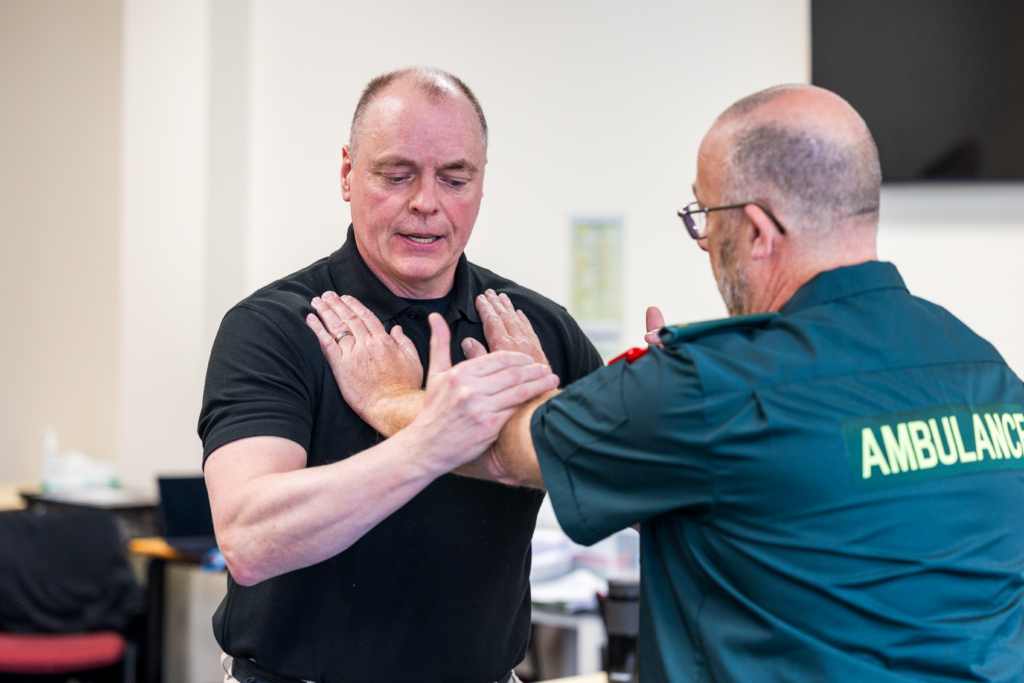
- Use force only as a last resort. If you’re trained and authorised to intervene physically, any force must be reasonable, necessary and proportionate to the threat.
After the incident
Once the person is back at baseline, the work isn’t finished. Check that everyone is safe and look for injuries. Record what happened while it’s fresh: what you saw at each stage, what you did and why. Report it through your employer’s incident system. Physical violence that causes certain injuries, such as one that keeps a worker off normal duties for more than seven days, must also be reported to the HSE under RIDDOR.
A team debrief should look at what triggered the incident, which warning signs appeared and what could change next time, without blame. Over time, a log of incidents shows patterns in triggers that you can design out.
When the assault cycle doesn’t apply
The assault cycle describes emotional, angry aggression: violence that builds as a person loses control. It doesn’t describe planned violence. Someone committing a robbery, or who has decided in advance to hurt someone, may show no trigger or escalation phase at all, or may hide the warning signs until they strike.
The stages can also be squashed together. Alcohol, drugs, pain, fear and some medical conditions, such as dementia or a head injury, can take a person from trigger to crisis in seconds, with little warning in between.
So treat the assault cycle as a guide, not a guarantee. It works best alongside a constant dynamic risk assessment: watching the person, the place and your own position, and being ready to leave if the risk rises.
Your own assault cycle
Staff go through the assault cycle too. When someone shouts at or threatens you, your own adrenaline rises: your heart races, your vision narrows, your fine motor skills get worse and clear thinking gets harder. That’s normal, but it affects how you respond.
Your behaviour also feeds the other person’s. Betari’s Box shows how attitude and behaviour bounce between two people: if you meet aggression with aggression, you both escalate. A calm voice, open posture and steady pace help bring the other person down, and you with them.
After a serious incident, staff go through their own recovery and post-crisis dip. Shaking, feeling sick, replaying the event or feeling flat later on are all common. Don’t send someone straight back to the front line without checking on them, and make support available in the days afterwards.
For Higher-Risk Roles
Physical Intervention Training
Teaches staff to prevent harm safely, using physical skills only as a last resort and within the law. See what’s covered and how to book.
- Level 3
- Up to 12 per trainer
- Delivered at your site
- Refresh every year
Assault cycle: frequently asked questions
What are the 5 stages of the assault cycle?
The five stages are trigger, escalation, crisis, recovery and post-crisis depression. Arousal rises from the person’s baseline through the first three stages, peaks at crisis, then falls and dips below baseline before returning to normal.
What is the first stage of the assault cycle?
The first stage is the trigger phase, when an event or stressor moves the person away from their calm baseline. Some diagrams show baseline as a starting point before the trigger, but it isn’t counted as one of the five stages.
Who created the assault cycle?
The assault cycle was published by S. G. Kaplan and E. G. Wheeler in 1983, in a paper for social and mental health workers called “Survival Skills for Working with Potentially Violent Clients”.
What is the assault cycle used for in the NHS?
In NHS and ambulance settings, the assault cycle is used in conflict resolution and violence reduction training to help staff spot warning signs, choose a response that fits the stage and debrief after incidents. It also helps staff explain their decisions when they record an incident.
What are the stages of a rage cycle?
The rage cycle is a different, three-stage model: rumbling, rage and recovery. It was developed by Brenda Smith Myles and Jack Southwick and is mainly used with autistic children. The assault cycle has five stages and was written for adults working with potentially violent people.
How long does the assault cycle last?
There’s no fixed length. The trigger and escalation phases can take hours or a few seconds. The crisis is usually short, but recovery can take much longer, so the risk of a second outburst lasts well after the peak.
Is the assault cycle the same as the cycle of abuse?
No. The cycle of abuse is a separate model that describes repeated patterns in abusive relationships, such as domestic abuse. The assault cycle describes a single episode of aggression, from trigger to recovery.




 01952 928134
