

News & Resources
12 De-Escalation Techniques From Former Police Trainers
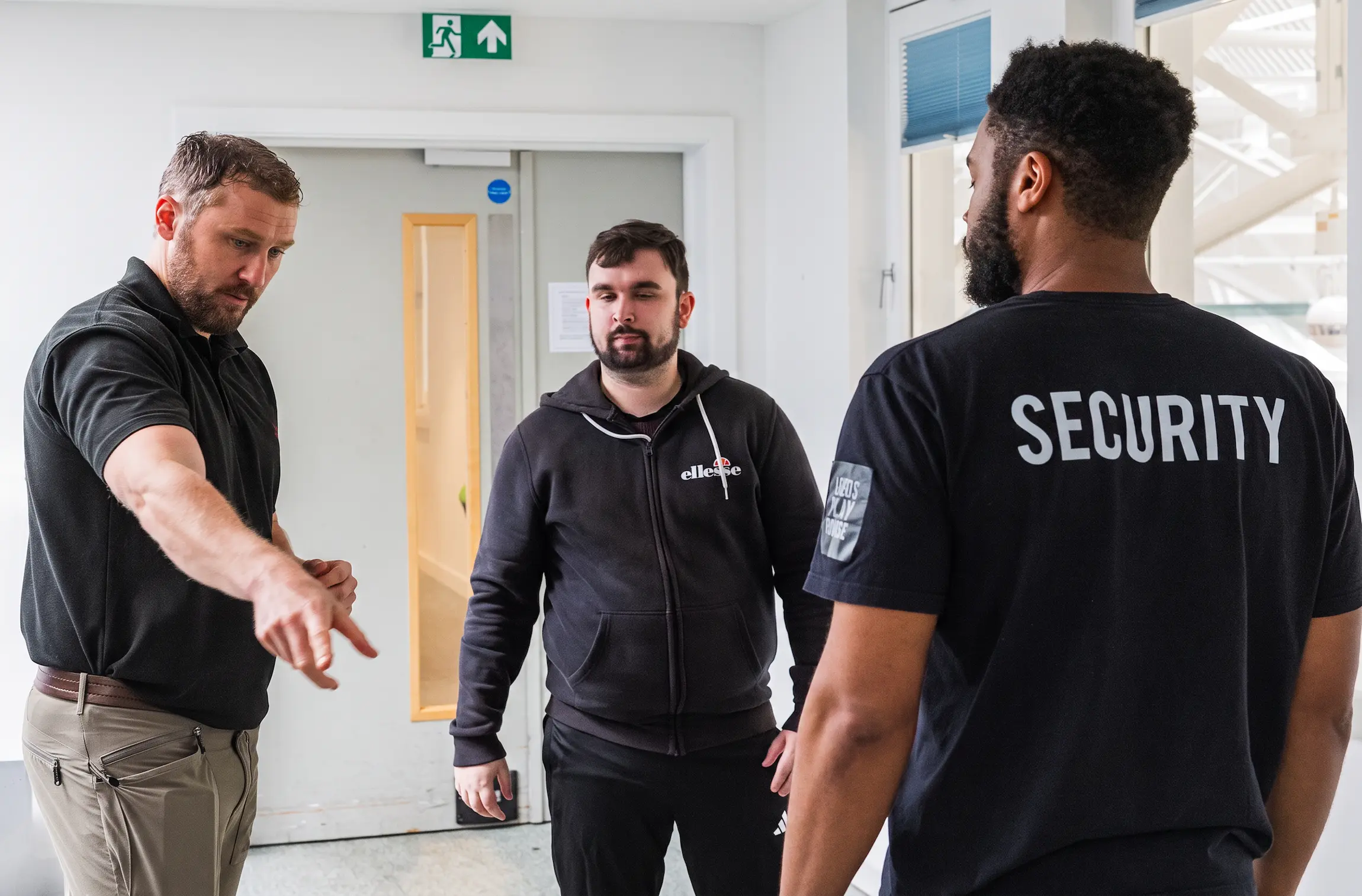
De-escalation techniques are the verbal and non-verbal skills used to bring a tense situation back down before it turns physical. Police officers use them. So do A&E staff, housing officers, bus drivers, security teams and anyone whose job puts them in front of people on the worst day of their week.
The scale of it is easy to underestimate. The Crime Survey for England and Wales recorded an estimated 689,000 incidents of violence at work in 2024/25, roughly 370,000 assaults and 319,000 threats. The 2025 NHS Staff Survey, published in March 2026 and answered by more than 760,000 people, found that around one in seven NHS staff had been physically assaulted by a patient or a member of the public in the previous year, the highest figure in three years. Among emergency department staff the picture is worse again: a Royal College of Emergency Medicine survey of over 2,000 staff in September 2026 found 96% had faced violence or aggression at work, about three quarters of them weekly or daily.
Stand2 was founded in 1999 by a former West Mercia Police officer safety trainer and public order tactical advisor, and our team includes a number of former police trainers. The techniques below are the ones we teach to ambulance crews, probation staff, universities and frontline teams across the UK. They are ordered roughly the way an incident unfolds, from what you do before you open your mouth through to what happens after everyone has calmed down, rather than grouped for neatness.
What are de-escalation techniques?
De-escalation techniques are the things you do and say to lower someone's level of agitation and stop a situation becoming physical: how you stand, how close you get, what you say, what you deliberately leave unsaid, and when you stop talking altogether. They apply across every kind of challenging behaviour, from a frustrated customer at a counter to a distressed patient on a ward.
The important thing to understand is that none of it is a script. Nobody works through a numbered list while somebody is shouting in their face. What follows is a set of habits to build, and the reason we train them through scenarios rather than slides is that pressure strips out anything you have only ever read about.
The 12 de-escalation techniques
1. Start with yourself
Agitation is contagious, and so is calm. Arrive tense, clipped or already irritated and you have joined the problem before saying anything useful. Three slow breaths and a deliberate drop of the shoulders is not a relaxation exercise, it is what stops you mirroring their state back at them. This is the loop Betari's Box describes: your attitude shapes your behaviour, which shapes theirs.
2. Respect the space they need
Agitation inflates personal space. The distance that felt perfectly normal five minutes ago can feel like a threat now. Move slowly, stay outside arm's reach and approach at an angle rather than square on. If you need to come closer, say so first. Standing slightly off to one side happens to be the safer position for you as well.
3. Watch what your body is saying
Open posture, hands visible, weight evenly balanced. Folded arms, pointing, hands on hips and squaring up all read as confrontational whatever you intended by them. People under stress read posture far faster than they process sentences, which is why a reasonable request delivered from a rigid stance still lands as a challenge.
4. Drop your voice and slow down
The instinct is to raise your voice to be heard over someone shouting, which simply raises the ceiling for both of you. Speaking quietly and slowly gives them something to match and buys you a few seconds to think. If you notice your own pace quickening, treat that as the cue to slow down rather than press on.
5. Listen for the feeling, not the story
What someone is angry about is often not what they are telling you about. The complaint about the waiting time may really be fear about the results. Listen underneath the words for fear, humiliation or loss of control, and answer that. Getting the emotion right matters more than getting the facts straight.
6. Acknowledge the feeling without conceding the argument
"I can see why that's wound you up" commits you to no position on who is right. It just tells them you have registered how they feel, which is usually all they are demanding. Telling someone to calm down does the opposite, because it says their reaction is unreasonable, and that is precisely the argument you are trying to avoid having.
7. Use fewer words, and use the same ones
Under stress the brain processes language slowly and unreliably, so explanations, reasons and caveats mostly go to waste. Pick one short instruction and repeat it in the same words: "I need you to put that down." Rewording it each time sounds like negotiation and invites a counter-offer. Repetition sounds settled.
8. Name the behaviour that has to stop
Be specific and unemotional. "I need you to stop shouting so I can sort this out" works where "calm down" or "behave yourself" does not, because it identifies the behaviour and gives a reason for changing it. Say it once, leave a gap for it to land, then say it again if you have to.
9. Offer a real choice, not an ultimatum
People escalate when they feel cornered, so leave them somewhere to go. "Would you rather wait here or step outside for a minute?" is a decision they can make. "Sit down or I'm calling security" is a threat they can call. Both may end in the same place, but only one lets them keep their dignity, and dignity is usually what the fight was about.
10. Let silence do some work
Silence is uncomfortable, so most of us fill it, generally by repeating ourselves or adding something unhelpful. Resist that. Once you have asked a question or set a limit, stop talking and let it sit. The pause gives the other person room to climb down without being seen to be pushed, and a surprising number of people will take it.
11. Know when to stop trying
Not everything can be talked down, and the skill is recognising that early rather than late. A weapon, a fixed stare, someone closing the distance while you speak, or a flat refusal to engage at all are all signals to change approach: bring in a colleague, move location, or withdraw. Disengaging safely is a trained physical skill in its own right, and withdrawing is a legitimate outcome rather than a failure of the first ten techniques.
12. Debrief while it is still fresh
The incident is not finished when the shouting stops. Record what triggered it, what worked, what made it worse and anything the person told you they needed. It protects the next colleague who deals with them, it supports whatever your organisation has to report, and it gives you somewhere to put the adrenaline other than the drive home.

What to avoid when de-escalating
Several things come naturally under pressure and work against you every time:
- Raising your voice to be heard over theirs
- Arguing the facts, or trying to win the point
- Folded arms, pointing, or standing square on
- Crowding their personal space, or touching them to reassure them
- Standing between them and the only way out, or turning your back
- Letting colleagues gather round, which turns a conversation into an audience
- Calling for help within earshot in a way that sounds like a threat
- Promising something you cannot deliver just to end the conversation
Verbal vs. non-verbal de-escalation techniques
Verbal de-escalation techniques cover what you say and how you say it: tone, pace, word choice, the limits you set and the questions you ask. Non-verbal techniques cover everything else, including distance, posture, hands, facial expression and how quickly you move.
Separating them is mostly an academic exercise. The most common failure we see on courses is somebody delivering the right words from the wrong body, and the body wins every time.
What UK guidance says about de-escalation
De-escalation is not just good practice, it is the expected first response in several settings. NICE guideline NG10, Violence and aggression: short-term management in mental health, health and community settings, is explicit that restrictive interventions should only be used once de-escalation and other preventive strategies have been tried and have failed. NICE consulted on a draft update to that guidance in August 2026.
Employers also have a duty under health and safety law to assess the risk of violence to their staff and put reasonable controls in place. Where the risk is foreseeable, and in most public-facing roles it plainly is, training staff to recognise and defuse escalating behaviour is one of the controls an inspector or a tribunal will expect to see evidence of.
Does de-escalation training actually work?
Honestly, the research is more mixed than most training providers admit. Studies of de-escalation training in healthcare settings have found improvements in staff confidence and knowledge more consistently than they have found reductions in actual incidents, and reviews tend to conclude that how an organisation implements and reinforces training matters at least as much as what is taught in the room.
That is not an argument against training. It is an argument against treating a one-off half day as a solution and moving on. Skills that are practised once and never revisited decay, and staff who are told to de-escalate without the staffing, the layout or the management backing to do it safely will quite reasonably ignore the advice.
Why de-escalation training matters
Reading a list is not the same as being able to use one while somebody squares up to you at a reception desk. That is why this is trained through realistic scenario practice rather than handed over as a checklist, and why the eleventh and twelfth techniques on this list matter as much as the first ten.
Our De-Escalation Training programme builds these techniques into role-specific scenarios for teams who deal with challenging behaviour as part of the job, across healthcare, housing, education, transport and security.




 01952 928134