

News & Resources
Positive Handling Techniques: A Guide for School Staff
TL;DR
- Positive handling starts long before anyone touches a pupil, with planning where you stand and what you say. Holds sit at the far end and should be rare.
- Under the April 2026 DfE guidance, force has to be necessary and proportionate, with the pupil's welfare in mind. It can never be used as a punishment, and nothing should affect a pupil's airway, breathing or circulation.
- Anything beyond ordinary physical contact counts as a significant incident. Write it up and tell parents in writing, ideally the same day.
Mention positive handling techniques in a staffroom and most people will think of holds. That's the part that worries staff, and it's the part that ends up in an incident log and a phone call home. But holds are only a small part of it. Positive handling covers everything you do to keep a pupil, and the people around them, safe when things start to escalate, from how the room is set up and where you stand to what you say, a guiding hand away from a crowded corridor and, only when nothing safer will work, a restrictive hold.
Most of the real skill is at the quiet end, and that's where most incidents are either calmed down or allowed to build.
Below we go through each level in turn, what the April 2026 DfE guidance says about it, and where the legal lines now sit.
The positive handling techniques continuum
It helps to think of it as a ladder. You start at the bottom and only go as high as the situation forces you to. Each step up carries more risk for the pupil and for you, and more to justify afterwards.
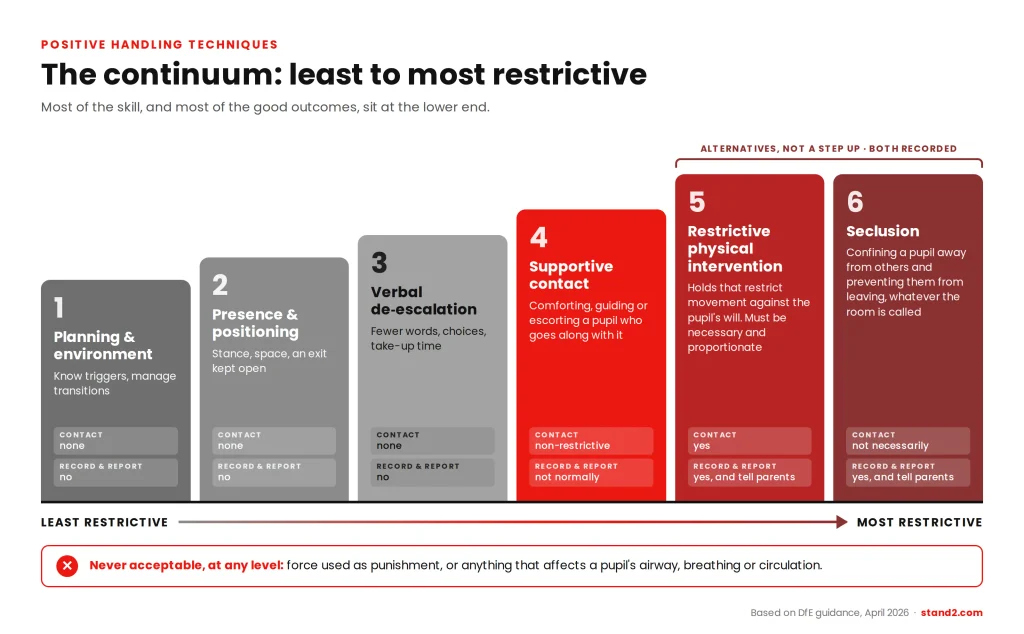
| Level | What it involves | Physical contact? | Recorded and reported? |
|---|---|---|---|
| 1. Planning and environment | Knowing triggers, adjusting demands, managing transitions and busy spaces | No | No |
| 2. Presence and positioning | Where you stand, stance, space, facial expression | No | No |
| 3. Verbal de-escalation | Tone, fewer words, choices, take-up time, redirection | No | No |
| 4. Supportive contact | Comforting, guiding or escorting a pupil who goes along with it | Yes, non-restrictive | Not normally |
| 5. Restrictive physical intervention | Holds that restrict movement against the pupil's will | Yes | Yes - a significant incident |
| 6. Seclusion | Confining a pupil away from others and preventing them from leaving, whatever the room is called | Not necessarily | Yes |
Levels 5 and 6 sit side by side at the top rather than one above the other. Both have to be recorded and reported to parents.
Two things are off limits at every level. Force can never be used as a punishment, which is illegal, and nothing you do should affect a pupil's airway, breathing or circulation.
Techniques that come before any contact
Planning and environment
Very few incidents come out of the blue. Ask the teaching assistant who has worked with a pupil since September and they'll usually be able to tell you when it tends to go wrong: coming in from lunch, a supply teacher last thing on a Friday, the dining hall on a wet day, being asked to read out loud. That knowledge is worth more than any technique. The DfE guidance expects schools to use it too, by looking at the environment, thinking about corridors and playgrounds, and writing strategies for individual pupils into their behaviour support plans.
Letting a pupil leave two minutes before the bell so they miss the crush on the stairs probably won't feel like positive handling to you. It is, though, and it'll head off more incidents than any hold.
Presence and positioning
A pupil who's wound up will have read your face, your stance and how close you are long before you open your mouth. Stand side-on rather than square to them, which looks less like a challenge and keeps you steadier on your feet. Keep out of arm's reach while things are heated, and with younger children, crouch down rather than stand over them.
Always leave a way out, for them and for you. Pupils who feel cornered are the ones most likely to lash out. Keep your hands where they can see them, open and low. And let one adult lead. Three members of staff gathered round might feel like backup from where you're standing, but to the pupil it looks a lot like being surrounded.
Verbal de-escalation
Once a pupil is properly dysregulated, they can't take in a lecture, however fair it is. Slow down, drop your voice and say less than feels natural. Most of us talk too much when we're anxious, and children pick up on it straight away.
A few things that tend to help:
- Acknowledge how they feel before anything else. "I can see you're really angry about that" will get you further than any instruction.
- Offer a small choice that really is a choice, such as "Do you want to sit here, or over by the window?"
- Give take-up time. Make the request, then step back or busy yourself with something else. Standing over a pupil while you wait for them to comply makes it much harder for them to do it without losing face.
- Get rid of the audience, either by moving the class or by moving the conversation. Very few teenagers will back down in front of thirty classmates.
- Bring someone else in if it isn't working. A colleague the pupil trusts can often get somewhere you can't, and there's no shame in handing over.
For pupils with SEND, the guidance also suggests removing whatever might be causing the distress and redirecting their attention towards something they're interested in or a familiar object.
Supportive contact: guiding, escorting and comforting
Plenty of staff have been told, or have decided for themselves, that the safest thing is never to touch a pupil at all. The DfE doesn't agree. Schools shouldn't have a "no contact" policy, and they shouldn't agree to requests from parents or staff that reasonable force is never used. The guidance gives its own examples of normal, appropriate contact, including first aid, comforting a pupil who's upset, holding a child's hand at the front of the line, and helping a pupil to a space they've chosen to calm down in.
Guiding a pupil well takes practice. Walk beside them rather than in front, use an open hand on the upper arm or shoulder blade, go at their pace instead of pulling, and keep talking so they know where you're heading and why.
What you need to keep an eye on is whether the pupil is going along with you. As long as they are, it's supportive contact. Once you're moving or holding them against their will, it has become a restrictive intervention and the higher legal test applies. If the force goes beyond ordinary contact, the guidance treats it as a significant incident that must be recorded and reported.
Restrictive physical intervention: when a hold is justified
Section 93 of the Education and Inspections Act 2006 gives all school staff, not only teachers, the power to use reasonable force to prevent or stop a pupil from:
- causing injury to themselves or others
- committing a criminal offence
- damaging property
- causing disorder among pupils
Reasonable, in this context, means no more force than you need, for no longer than you need it.
The three questions before any hold
The guidance frames the decision around three questions. In a real incident you'll have seconds to think, so they need to be second nature well before that point.
- Is it necessary? Could you manage this in a less restrictive way? Will holding the pupil actually reduce the risk, or will it make things worse?
- Is it proportionate? Are you using the least force for the shortest time? Have you taken into account the pupil's age, size, any medical conditions and any SEND?
- Have you thought about the pupil's welfare? A pupil who has experienced trauma, or who has sensory or communication needs, may find being held far more frightening than you'd expect. Protect their dignity where you can, for example by getting them out of sight of their friends.
Principles of a safer hold
We don't publish step-by-step holds, and we'd be cautious about anyone who does. A hold learned from a diagram or a video, and never practised in front of a trainer, is exactly the sort that gets improvised badly at the end of a long Thursday. What everyone should know are the principles behind any hold.
- Nothing should affect airway, breathing or circulation. The guidance specifically rules out covering the mouth or nose and putting pressure on the neck or abdomen, and we'd add the chest to that.
- Keep off the floor. The guidance warns that force is particularly dangerous on the ground, so if a pupil ends up there, release them or get back to sitting or standing as soon as it's safe.
- Ease off as soon as the risk allows, moving to something less restrictive, then to guiding, then to letting go altogether.
- One adult should lead and do the talking, telling the pupil what's happening, why, and what they need to do for you to let go.
- Another adult should be watching the pupil's face, colour and breathing throughout.
- Think about size. With a small child, lower yourself rather than lifting them. With a pupil bigger than you, a coordinated team is much safer than one adult on their own.
If a pupil is struggling to breathe, changes colour, is sick, goes floppy or tells you they can't breathe or have chest pain, let go and get medical help immediately. Take it seriously even if they've been shouting at you the whole time.
We don't teach pain-based techniques at Stand2, and we'd question any approach that relies on them.
Responding to biting, hair pulling, spitting and grabs
Staff tell us these are the situations they dread most, usually because nobody has ever shown them what to do.
- Biting: your instinct will be to pull away, but that usually makes the injury worse. Keep as still as you can, calmly tell the pupil to let go, and use the release you were trained in.
- Hair pulling: press their hand firmly against your head so the strain comes off your hair, then work on loosening their grip.
- Spitting: turn your face away and move back. Never cover a pupil's mouth or face to stop them.
- Grabs to wrists or clothing: pull against the weakest part of the grip, which is usually where the thumb and fingers meet, and create space rather than getting into a wrestle.
If you're hurt, make sure it goes into the school's accident records. Some injuries also have to be reported to the HSE. Being bitten or kicked shouldn't be shrugged off as part of the job.
Pupils with SEND and younger children
Pupils with SEND are more likely to be restrained or secluded than their classmates, and the guidance recognises this. Often it's because behaviour is the only way they can let you know they're in pain, overwhelmed, frightened or confused.
The adults who know a pupil best are the ones who can tell you what sets them off, so start there. The behaviour support plan should be written with the pupil and their parents rather than for them, and if there are circumstances where staff might need more physical contact than usual, the plan should say so clearly. For pupils with speech, language and communication needs, or who are still learning English, use pictures, gestures and fewer words, and then give them time to respond.
Look at the plan again after every significant incident. If it keeps ending in a hold, it isn't working.
With nursery and Reception children the principles are the same, but the scale changes. Get down to their level, keep any contact brief, and remember how easily a small child can be hurt by an adult's weight or grip.
A good plan helps, but staff still have to use their judgement on the day, and having a plan never removes the duty to record and report.
Seclusion and withdrawal spaces
Since April 2026, seclusion has had a formal definition. It means keeping a pupil somewhere away from others and stopping them from leaving, whether by standing in the way, blocking the exit or making them think they'll be punished if they come out. It should only be used to keep people safe when a pupil is very dysregulated, and never as a punishment. The space must be safe and not frightening, someone must supervise the pupil the whole time, and they have to be allowed to leave as soon as the immediate risk has passed.
Where schools most often go wrong is the name on the door. It might be called the calm room, the quiet room or the reflection space, but if a pupil can't leave it, it counts as seclusion and has to be recorded and reported in the same way as force. In April 2025, BBC News broadcast CCTV of an autistic boy being restrained face down in what his school called a calming room.
Why positive handling is under national scrutiny
Until this year, nobody could say with any confidence how often pupils were restrained in English schools, because schools weren't required to write it down.
In 2019 the Challenging Behaviour Foundation published a survey of 204 families of children with learning disabilities. Of those families, 88% said their child had been physically restrained, and more than a third said it happened regularly. Just over half said their child had been injured by it, and most of the restraint they described had happened at school. The families chose to take part, so the figures can't tell us how common restraint is across all pupils, but they give a clear picture of how badly it can go for the children it happens to.
In 2021 the Equality and Human Rights Commission looked at how 641 schools in England and Wales were monitoring restraint, and found that a significant proportion didn't have basic safeguards in place, including a policy on recording it. BBC investigations in 2024 and 2025 then showed pupils in special schools shut in bare seclusion rooms and being held face down by staff.
All of this led to the April 2026 rules: a legal duty to record and report, a formal definition of seclusion, and a clear line on anything that affects a pupil's breathing. For the teaching assistant who steers a Year 3 away from a fight on the playground, very little changes. The rules are there because, for too long, the worst practice went unrecorded, often behind doors with reassuring names.
What to do after an incident of positive handling
What happens in the hour after an incident matters nearly as much as the incident itself. We'd work through it in this order.
- Check everyone is all right. The pupil and any staff involved should be checked over, and treated if they need it, as soon as possible.
- Write it up the same day. The staff involved should record it as soon as they reasonably can. As a minimum, the guidance expects the record to include:
- who was involved, including any SEND and the pupil's SEN status code
- the time, date and location, and roughly how long it lasted
- what led up to it, and what was tried to calm things down
- the type and degree of force used, and why it was necessary
- any injuries, and the support given afterwards
- Let parents know in writing, ideally the same day. Tell them why force was needed, what kind and how much, and about any injuries. There are a couple of narrow exceptions, which we explain in our guide to the use of reasonable force in schools.
- Talk it through afterwards. Ideally someone who wasn't involved should lead the conversation, hearing from the pupil and the staff separately. The point is to learn from it and repair the relationship, and nobody should come out of it feeling blamed.
- Look after the people involved. Pupils who saw what happened may need support, and so may the member of staff who did the holding, who is easily forgotten.
- Update the behaviour support plan with what worked and what didn't.
Mistakes we see most often
In the schools we work with, the same handful of problems keep coming up.
- Only practising holds. If a hold is the one thing staff have rehearsed, it's what they'll reach for when they're under pressure.
- Improvising. The hold nobody has practised is the one most likely to hurt someone.
- Holding on too long. A lot of incidents drag on after the danger has passed, often because nobody's quite sure how to end them.
- Thin write-ups. "Pupil became aggressive and was restrained" tells a parent or governor nothing about why force was needed, or why that much of it.
- No-touch rules. They leave staff standing by when a child is in danger.
- Doing it once and never again. Physical skills fade quickly, and a course you did three years ago won't come back to you in the moment.
Records matter to families as well. In a 2025 study of parents whose children had been through restrictive practices, one mother described receiving "reams and reams and reams of logs, but it's all quite… victim blaming". A good record explains the decisions the adults made, rather than just describing what the child did.
Why techniques have to be practised, not just read
The DfE guidance doesn't set up an accreditation scheme or an approved list of providers. It leaves the decision with school leaders, provided the training they choose reflects its principles. Lots of schools know their techniques by the name of whoever trained them, and there's nothing wrong with that. What matters is whether staff can actually use them safely, under pressure, in the corridors, classrooms and playgrounds where incidents happen.
Our positive handling training for schools is delivered in your school and built around your behaviour policy, your withdrawal spaces and your pupils. The physical skills have been medically reviewed, and we assess staff by watching them carry out each one rather than with a quiz at the end.
Sources: Department for Education, Restrictive interventions, including use of reasonable force, in schools (April 2026); Education and Inspections Act 2006, section 93; Challenging Behaviour Foundation, Reducing Restrictive Intervention of Children and Young People (2019); Christie and Harding, Restrictive practices in English schools, Frontiers in Education (2025).
This article reflects our understanding of the DfE guidance and legislation at the time of writing. It is practical guidance for school staff, not legal advice.




 01952 928134