

























































LEVELS 02 – 03 · EDUCATION

Positive Handling Training for Schools

Our positive handling training is suitable for any member of school staff who may need to use reasonable force with a pupil – from teachers and teaching assistants to behaviour, pastoral, PRU and SEND teams.

Built around the April 2026 DfE guidance on restrictive interventions, and around your school’s own behaviour and safeguarding policies.

Available as a one-day course, or a two-day programme covering the full physical intervention syllabus.

 
Duration 1 or 2 Days
Delivery Methods
  • In person
  • Standpoint
  • Affiliate Trainer Programme
Assessments
  • OBSERVATION
  • PARTICIPATION
  • DISCUSSION
  • COACHING
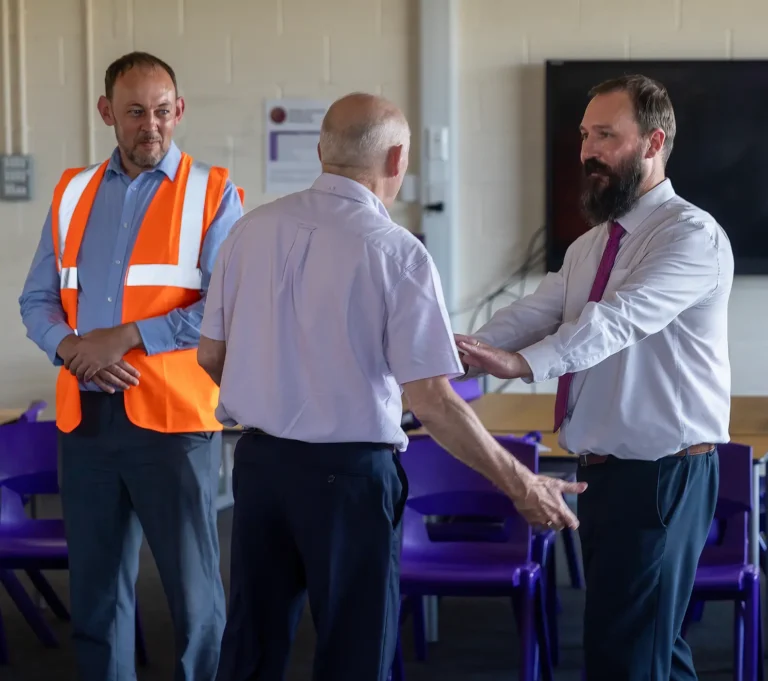
Grabbing a man's wrists during training

•01COURSE OVERVIEW

Positive handling training built around what schools now have to do

Our positive handling training is for staff who may need to use reasonable force with a pupil – and who need to get everything before that point right first.

Staff will learn to read the early signs of escalation, defuse situations before they harden, and make proportionate decisions they can defend afterwards. Where physical intervention genuinely cannot be avoided, they learn to do it safely, record it properly, and handle what follows.

What separates this from training your staff may already have had is the April 2026 DfE guidance, which replaced the 2013 rules and changed three things most positive handling courses haven’t yet caught up with. Seclusion is now formally defined, so a withdrawal or time-out space may carry duties your school doesn’t realise it has. Recording and reporting significant incidents is a legal duty, not good practice. And SEND pupils need behaviour support plans co-produced with them and their families.

Most of our course is spent on everything that happens before anyone touches anyone.

• 02 HOW THIS TRAINING HELPS

How our positive handling training helps your school

  • Staff who recognise escalation early and defuse it, so physical intervention is needed less often
  • Confident, consistent responses when reasonable force genuinely is the safest option – for pupils and staff alike
  • Incident records that stand up to scrutiny from governors, the local authority or Ofsted
  • Clear understanding of when a withdrawal space meets the definition of seclusion, and what that triggers
  • Staff who know what happens if an allegation follows an incident, and are not facing it unprepared
  • Stronger alignment between your behaviour policy, individual positive handling plans, and what staff actually do
  • Reduced injuries to pupils and staff during incidents
AdobeStock_183480539

•03.RISKS ADDRESSED

Since April 2026, the cost of out-of-date training has gone up. Without it, your staff may:

Checklist icon Miss the early signs and reach for a physical response that a conversation would have prevented
Checklist icon Use a withdrawal or time-out space without realising it now meets the regulatory definition of seclusion
Checklist icon Fail to record or report an incident the guidance requires to be recorded and reported
Checklist icon Improvise a hold they haven’t been trained in – particularly with a much smaller or younger pupil
Checklist icon Respond unsafely to biting, spitting or hair pulling because nobody has shown them how
Checklist icon Leave a colleague exposed when a parent makes an allegation, because the documentation isn’t there
Checklist icon Apply force inconsistently across a school, so no one can show a pattern or defend a decision

The good news is that this is entirely preventable. That’s what this course is for.

• 04 LEARNING OUTCOMES

What your staff will be able to do after positive handling training

Recognise and manage the three types of risk

• 04 LEARNING OUTCOMES

What your staff will be able to do after positive handling training

  1. 01 Recognise and manage the three types of risk
  2. 02 Recognise early behavioural and environmental indicators of escalating conflict
  3. 03 Use verbal and non-verbal communication strategies to defuse tension and reduce the need for physical intervention
  4. 04 Explain the legal, ethical and organisational principles governing reasonable force in schools
  5. 05 Describe the hierarchy of responses, emphasising prevention, de-escalation and last-resort physical contact
  6. 06 Recognise when separating a pupil meets the regulatory definition of seclusion, and risk-assess withdrawal spaces accordingly
  7. 07 Record and report incidents to the standard the April 2026 guidance requires, including parental notification and its exceptions
  8. 08 Contribute to individual positive handling plans, co-produced with pupils and families
  9. 09 Demonstrate self-control and professional judgement under pressure, and recognise personal limits
  10. 10 Perform low-level breakaway skills to release safely from grabs and holds, and withdraw
  11. 11 Identify the risks associated with physical intervention, including medical, positional and situational risks
  12. 12 Demonstrate safe, non-harmful physical skills that reduce risk for everyone involved
  13. 13 Apply safe positioning, movement and team coordination, including where there is a significant size difference between staff and pupil
  14. 14 Respond safely to biting, spitting and hair pulling
  15. 15 Manage bystanders – including other pupils – during a live incident, and transition away from physical contact as soon as it is safe
  16. 16 Contribute to post-incident debriefs, and support colleagues through the allegation process where one arises
05 CASE STUDY

FUEL Independent School – Alternative Provision, Nottingham

FUEL is an independent alternative provision school working with young people at risk of permanent exclusion, those who have already been excluded, and learners who have disengaged from education altogether. Across two Nottingham sites, staff support small groups through GCSEs, Functional Skills and vocational qualifications in construction, mechanics, health and social care and childcare – often with pupils who arrive having had mainstream school go badly wrong for them, and for whom the behaviour that contributed to an exclusion can resurface under pressure.

Stand2 delivers positive handling training to FUEL’s teaching and support staff on an ongoing basis, refreshed as teams change. Sessions are built around the spaces staff actually work in – small classrooms, one-to-one rooms, workshops and community sites – and around FUEL’s own behaviour and safeguarding procedures. The emphasis is on recognising escalation early and defusing it, so physical intervention stays a genuine last resort rather than a routine response, and on recording and reviewing incidents to a standard that holds up when a placement or referral is scrutinised.

Encroachment drill
• 06 Course Delivery & Assessment

Restraint training for schools, delivered in your school and around your policies

Delivery: Unlike open-enrolment restraint training for schools, this is delivered in your school – built around your behaviour policy, your withdrawal spaces, your safeguarding procedures, and the pupils your staff actually work with. One day or two, in person. StandPoint, our online learning platform, carries the supporting materials.

Assessment: No written exams. Staff are assessed continuously, on how they apply the communication and physical skills in supervised practical exercises.

Certification: Each delegate is entered onto the Stand2 Training Register, which we maintain on your behalf – giving your school or trust a clear, auditable record of who has been trained and when annual refresher training is due.

Training environment: Sessions follow trauma-informed practice with a clear opt-out at every stage – nobody is asked to take part in anything they’re uncomfortable with. The physical skills are low-risk by design and aligned with medical and organisational standards.

•07.Frequently asked questions

Positive handling training: frequently asked questions

What's the difference between the one-day and two-day course?
The one day covers prevention, de-escalation, the legal framework, the April 2026 recording and seclusion duties, and low-level breakaway. The two-day adds the full physical intervention syllabus – safe positioning, team coordination, responding to specific behaviours, and managing incidents where size difference is a factor.
Does a positive handling trainer need to be accredited?
No. The April 2026 guidance mandates no accreditation scheme and names no approved provider list. The test it sets is whether training is adequate, safe, lawful, preventative, and tailored to your setting.
How does this compare to Team Teach?
Team Teach is widely used and many schools are already trained in it. Ours is a different programme rather than a version of theirs: built around your school’s own policies rather than a fixed national syllabus, with techniques independently reviewed by a consultant in emergency medicine. If your staff are already Team Teach trained, tell us and we’ll be honest about whether retraining adds anything.
Is positive handling training available online?
The legal and de-escalation content can be. The physical skills can’t be taught or assessed safely that way, and we won’t certify anyone on techniques we haven’t watched them perform.
Does this cover seclusion and time-out rooms?
Yes. Since April 2026 seclusion is formally defined and carries the same recording and reporting duties as physical force. Many schools haven’t yet realised their withdrawal space meets the definition.
What is positive handling?
A graduated, least-intrusive approach to managing challenging behaviour – from presence and verbal redirection through supportive guidance, with restrictive physical intervention only at the far end. We’ve set out what positive handling means in schools in more detail.
Which staff should attend?
Teaching assistants, learning support staff, behaviour leads, pastoral teams, and PRU and SEND staff – anyone likely to need to use reasonable force.
How often should staff refresh this training?
Every two years for the 1-day course, annually for 2-day course with physical elements.
Is there a Positive Handling course specifically for schools?
Yes – Stand2 runs a Positive Handling course built specifically for schools, for teachers, teaching assistants, behaviour, pastoral, PRU and SEND staff. It’s built around the April 2026 DfE guidance and delivered in your school around your own policies, as a one-day or two-day programme.
•08.Start the conversation

This course is ideal for schools, colleges and PRUs where staff manage challenging behaviour and need a defensible, proportionate approach – particularly if your current training predates the April 2026 guidance.

"*" indicates required fields

It helps to know your sector, roughly how many staff, and the kinds of situations they face – but as much or as little as you like.
We do not use your personal information for any reason other than to contact you back. You can find our privacy policy by clicking here.

Google Reviews

At Stand2 we go above and beyond to understand and meet your expectations. Here are some of our recent reviews.

As the trusted leader in conflict management, personal safety, and physical intervention training, we aim to elevate standards across the UK and beyond by bringing evidence-based practice, operational credibility, and expert instruction to every sector we serve.
View All Reviews
Great session on conflict resolution. Session was informative and helpful for managing situations of conflict. Would highly recommend.

Brilliant course! Instructors (Steve and Dave) friendly and knowledgeable, made everyone feel really comfortable. Wonderful overall experience and know have a better knowledge of conflict resolution techniques.

Good training, helpful for increasing awareness of threats and process for justifying and processing conflict resolution.

Great experience practical elements really helped consolidate my knowledge.

The instructors were very knowledgeable, approachable and supportive. Great and informative session, thank you!


Excellent delivery, really informative & engaging, cannot fault the whole package. Thank you

Great training and was delivered to a high standard. Paul was very friendly and made me feel at ease

Very useful in practical life, specifically in my workplace.