

News & Resources
Three Ambulance Trusts, One Training Partner: Why LAS, WMAS and SECAmb Choose Stand2
TL;DR
Violence against UK ambulance crews is up 46% since 2021/22 and three NHS trusts (WMAS since 2003, LAS since 2010, SECAmb since 2024) have remained with Stand2's conflict management training because it's built on principles that work in any environment, not techniques mapped to a rigid list of scenarios.
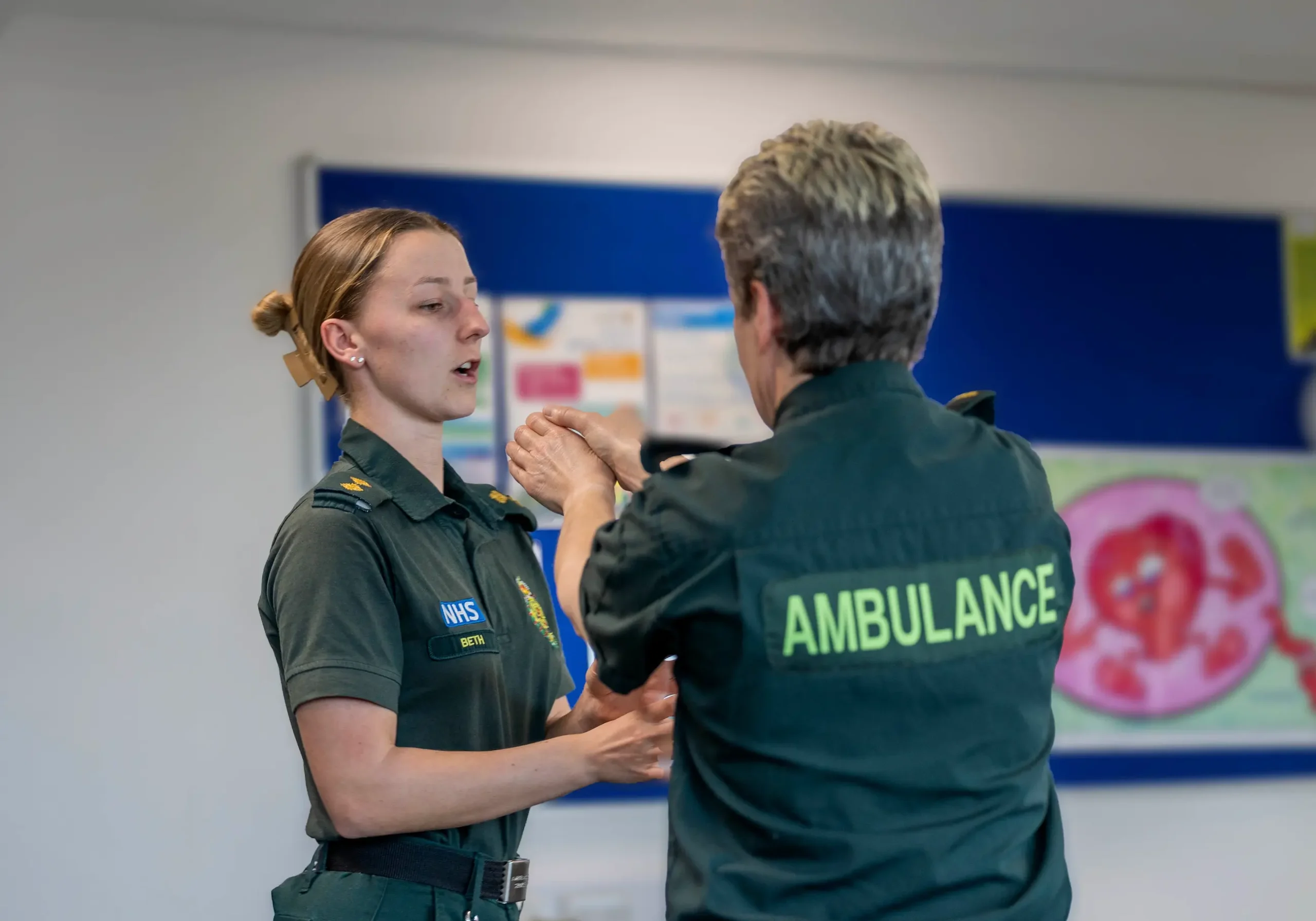
Stand2 has been training ambulance crews since 2003. Fast forward to today, and that means active, long-term relationships with London Ambulance Service, West Midlands Ambulance Service, and South East Coast Ambulance Service - three trusts, three different starting points, some already familiar with what else was on the market before choosing Stand2.
What connects all three is simple: they've each experienced, first-hand, the quality and impact of Stand2's training. That's not an accident, and it starts with who's actually standing in the room teaching it.
I've been teaching emergency services personnel since the 1990s - more than thirty years now, starting with operational police officers, training them to stay safe in genuinely difficult situations. Training paramedics has become a natural extension of that same passion. Every instructor on the Stand2 team is held to the same standard I hold myself to: real, lived operational experience - actual years spent policing or in comparable high-risk roles, not a few days on an instructor course and a certificate to show for it. That matters more in our sector than almost any other, because when you're teaching someone how to stay safe in a highly stressful situation, it makes a genuine difference if you've been there yourself and can relate to what your students will actually face, rather than having just learned how to talk about it.
That's honestly what drives me. It's the standard I hold my team to, and it's why WMAS has stayed with us for 22 years, why London Ambulance Service hasn't looked elsewhere since 2010, and why South East Coast Ambulance Service has renewed since 2024.
The Reality Facing Ambulance Crews Today
That kind of trust isn't handed out lightly. Ambulance trusts don't renew a training relationship for two decades because it's convenient - they do it because what their crews are actually facing is serious, and getting the training wrong has real consequences.
Key Takeaways
The risk facing ambulance crews is real, rising, and not unique to the UK
-
Recorded violence against UK ambulance staff is up 46% since 2021/22. That's AACE's own national incident data, not an estimate - and it's part of a multi-year climb, not a single bad year.
-
The picture worsened sharply in just the last twelve months of data. NHS Staff Survey figures show ambulance staff reporting at least one violent incident jumped from 31% to 52% year-on-year - the steepest rise of any NHS staff group.
-
This is no longer a workforce issue trusts can manage quietly. From July 2026, new NHS Workforce Standards require every ambulance trust to report on violence prevention and staff wellbeing, tracked through the NHS Oversight Framework.
-
It isn't a uniquely British problem. Comparable research from Sweden, Norway and Canada shows the same pattern across ambulance services internationally, with career violence exposure among paramedics as high as 57–93%.
This page draws on AACE's national incident data and the NHS Staff Survey - the full breakdown of both is in Ambulance Assaults: 62 Staff Attacked Every Day and the SECAmb training renewal post. These pressures now carry real regulatory weight too, following the new NHS Workforce Standards introduced in July 2026.
Understanding Why It Happens
The simple numbers tell you violence is common and getting worse. But they don't explain why it happens, or what actually reduces it, and that's where the Canadian, Swedish and Norwegian research goes further.
A 2025 Canadian study of 974 violence reports filed by Ontario paramedics found the risk wasn't spread evenly, it clustered hard around specific conditions. Calls from non-residential locations (streets, hotels, bars), afternoon and overnight shifts, and callers who were intoxicated or in a mental health crisis carried by far the highest odds of an assault. That's a pattern, not a random hazard, which means it's trainable.
Here's the counter-intuitive part. A 2025 Swedish study took the rather unusual step of analysing court trial transcripts - 23 cases where someone had actually been convicted of assaulting ambulance staff - to understand the incident from the offender's side. Four consistent patterns emerged. The offender felt misunderstood, felt disrespected, was in some kind of vulnerable state (usually intoxication or crisis), or had an expectation that hadn't been met, usually about how long they'd been waiting. None of that excuses what happened next. But it does mean that a meaningful share of these incidents aren't random aggression, they're the tail end of a communication breakdown that, in principle, had a point where it could have gone differently.
That's backed by a 2025 Norwegian study that went straight to paramedics themselves, asking how they read and manage this risk in real time. It found that experienced clinicians don't work from a fixed checklist - they build a continuous, shifting judgement, shaped by situational awareness, professional duty, and intuition, that sharpens across a career. The same study flagged something less discussed: paramedics often struggle to convey or document that judgement afterwards, and can feel unsupported or misunderstood by managers and other services when they do.
Put those three findings together and you get a genuinely useful picture: violence against ambulance crews clusters around identifiable conditions, a real share of it stems from a breakdown that had an earlier off-ramp, and the skill that prevents it - reading a situation and acting on it - is learned, not innate, and takes years to mature without deliberate training. That's a research-backed argument for exactly the kind of scenario-based, principles-led training this page exists to make the case for.
How the Job Has Evolved Since 2003
Understanding what triggers a violent incident today is only half the picture. The job producing those incidents has changed shape dramatically since Stand2 started training ambulance crews in 2003, and treating it as if it hasn't is one of the fastest ways for training to fall behind reality.
Mental health presentations are a far bigger share of the workload than they used to be - English ambulance crews now spend around 1.8 million hours a year on mental health call-outs alone, and recent research confirms paramedics still often feel under-prepared for it, not because they lack compassion but because it's a fundamentally different skill from trauma or cardiac response. At the same time, the "Right Care, Right Person" policy has shifted how much police support turns up alongside ambulance crews on mental health calls - in practice, often less than before, not more, which can leave a crew more exposed on exactly the calls where things are least predictable.
The law has caught up with some of this. The Assaults on Emergency Workers (Offences) Act 2018 created a specific criminal offence for assaulting an emergency worker, with sentencing since doubled to two years - a clear signal that this is now recognised as a distinct problem, not an accepted cost of the job. The job is also done under far more scrutiny than it used to be - cameras on the crew, cameras on the street, and a real chance any incident ends up filmed on a bystander's phone before the crew has even left the scene. None of that is a bad thing, but it does mean paramedics need genuine confidence in how they de-escalate and physically manage a situation, not just the ability to do it, because how it looks now matters almost as much as what actually happens.
Training that hasn't moved with any of this - still built around the assumptions of even ten years ago - is training that's already out of date.
Why We Teach Principles, Not Techniques
A job that keeps changing shape is exactly why technique-matching training keeps falling behind. If you train someone to handle a fixed list of scenarios, every shift in the job - a new drug on the street, a change in how mental health calls are handled, a form of scrutiny that didn't exist five years ago - makes part of that list obsolete. Principles don't expire the same way.
Most conflict management training teaches techniques mapped to scenarios: how to handle an intoxicated patient, how to handle someone in psychosis, how to handle a hostile bystander. The problem is that a paramedic under real pressure doesn't get a labelled scenario. They get a person, in a state they don't have time to fully diagnose, in an environment they don't control - and they have to act before they've worked out exactly what's happening.
So Stand2 teaches principles instead of techniques: how to recognise and respond to a behaviour - rising agitation, closing distance, a change in tone - regardless of what's causing it. Understanding the likely cause still matters, and it's still part of the training, but it comes after the immediate priority, not before it. Get the paramedic, the patient, and anyone else nearby safe first; work out whether it was a diabetic episode, a mental health crisis, or simple fear afterwards. A principle like that is something a paramedic can actually recall and apply under real pressure - a twelve-point checklist for diagnosing the specific situation in front of them usually isn't.
It's also, as it happens, exactly what the Swedish offender research above would predict works: if a real share of these incidents trace back to a person feeling misunderstood or disrespected before anything physical happened, then training built around reading and responding to behaviour early - not waiting to first identify the medical or psychiatric cause - is addressing the problem earlier in its timeline, not just managing the aftermath.
That's the theory. What actually shows whether it holds up is whether it works across genuinely different environments, for years at a time, without a trust deciding to look elsewhere.
Three Trusts, Three Relationships
West Midlands Ambulance Service - since 2003
This is where Stand2's ambulance work started, training what was then Hereford & Worcester Ambulance Service - one of four county trusts that merged in 2006 to form the modern West Midlands Ambulance Service University NHS Foundation Trust. The training relationship carried on through that merger and has continued for 22 years since - the longest-standing of Stand2's three ambulance partnerships, spanning the trust's entire life as a merged, university-status foundation trust.
WMAS today covers one of the largest geographic areas of any ambulance trust in the country - a mix of dense urban conurbation around Birmingham and wide rural stretches across Shropshire, Herefordshire and Worcestershire. That geographic spread creates its own risk profile: crews can be a genuinely long way from backup, in areas where the nearest colleague might be twenty minutes out rather than two streets away.
London Ambulance Service - since 2010
LAS is the busiest ambulance service in the UK - the only London-wide NHS trust, responding to millions of 999 calls a year across one of the most densely populated and diverse cities in the world. The risk environment here isn't isolation, it's volume and density: high call rates, tight urban access, and a role at the centre of major-incident response for the capital. Training built for a WMAS-style rural callout doesn't automatically transfer to a central London tower block or a packed public event - the environment demands its own read.
South East Coast Ambulance Service - since 2024
The newest of the three, covering Kent, Surrey, Sussex and North East Hampshire - around 3,600 square miles and a population of roughly 4.5–5 million, spanning everything from dense coastal towns to some of the busiest motorway stretches in the country. It's a genuinely different relationship in age from the other two - not two decades of history, but already renewed inside its first few years. As Sean Singleton from SECAmb put it: "It's been a pleasure collaborating and working together over the last three years to embed this programme in our ambulance service!"
Why Stand2?
It did. Three genuinely different operating environments, the same training partner across all of them - and what's kept it that way isn't being the biggest name in the market, since Stand2 has never positioned itself that way. It's that every programme is independently medically reviewed and risk assessed, and built around five core principles that hold constant across every trust and every environment: Safety First, Prevention Before Intervention, Ethical Decision-Making, Least Restrictive Practice, and Trauma-Informed, Context-Led practice. What changes from trust to trust isn't the principles - it's how they're applied: a WMAS crew twenty minutes from backup in rural Herefordshire needs something different from a LAS crew navigating a packed central London event, which is different again from a SECAmb crew working a motorway incident on the M25.
The feedback that matters most doesn't come from a marketing line - it comes directly from the paramedics who've sat through the training. Consistently, what they tell us afterwards isn't just that the session was useful, but that it left them feeling genuinely more confident and prepared to do the job - which, for a role where the environment is unpredictable by definition, is the outcome that actually counts.
Frequently Asked Questions
Why does ambulance training need to be different from generic conflict management courses?
Because "ambulance work" isn't one environment - a rural WMAS callout, a dense central-London LAS response, and a SECAmb motorway incident all carry different risks. Generic conflict management content is built for a single, predictable setting like a reception desk; ambulance training has to hold up across environments crews don't get to choose.
Which ambulance services does Stand2 currently work with?
Stand2 holds active training relationships with West Midlands Ambulance Service (since 2003), London Ambulance Service (since 2010), and South East Coast Ambulance Service (since 2024).
Why does Stand2 teach principles rather than scenario-specific techniques?
Under real pressure, a paramedic doesn't get a labelled scenario - they get a person in a state they don't have time to fully diagnose. Teaching behaviour-based principles that apply regardless of the underlying cause is something a paramedic can recall and use in the moment; a checklist for diagnosing the exact situation first usually isn't.
Is this training based on UK-specific evidence?
The scale data (AACE incident figures, the NHS Staff Survey) is UK-specific. Some of the supporting academic research on paramedic risk and behaviour is international - Norwegian, Swedish and Canadian studies - reflecting where the most recent peer-reviewed work has been published. The underlying patterns are consistent with what Stand2 sees delivering training across LAS, WMAS and SECAmb.
About the Author
Paul is the founder and Managing Director of Stand2, bringing over 30 years of operational and instructional experience from both policing and military service. He has designed and delivered conflict management, de-escalation, personal safety, and physical intervention training across the NHS and ambulance services - including London Ambulance Service, a partnership running since 2010, and West Midlands Ambulance Service - alongside probation services, schools, universities, and security teams.
Explore Further




 01952 928134