

News & Resources
The LEAPS Model of Communication: What It Is and How to Use It
The LEAPS model of communication is a five-step way of talking to someone who is angry or upset: Listen, Empathise, Ask, Paraphrase, Summarise. It was written into the NHS national conflict resolution syllabus in 2004, it is taught to police officers, and it works just as well at a reception desk, on a shop floor or on the phone. This guide explains what each step means, gives you something to say at each one, and tells you when to stop using it and get help.
TL;DR
- LEAPS stands for Listen, Empathise, Ask, Paraphrase, Summarise. Do the steps in that order.
- The order matters because an angry person cannot problem-solve until they feel heard. The first two steps deal with the feeling; the last three deal with the problem.
- It is not a script. One sentence per step, in your own words, is enough. Examples for customers, patients and callers are below.
- It has a limit. LEAPS is for someone who is upset but can still listen. If they threaten you or keep escalating, stop, create distance and get help.
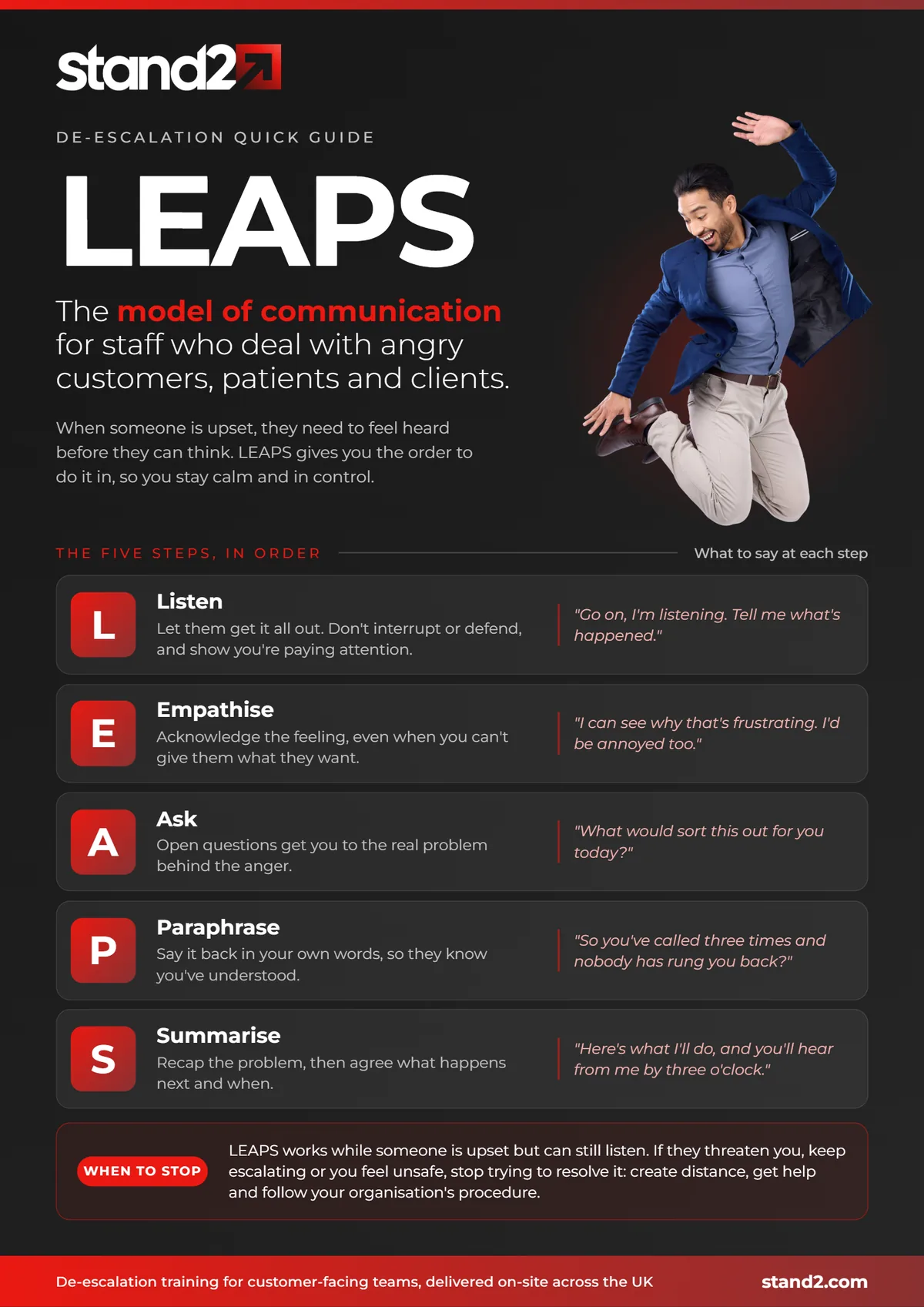
- Free poster. Download the A4 LEAPS poster below for staff rooms and phone desks.
What does LEAPS stand for?
LEAPS stands for Listen, Empathise, Ask, Paraphrase and Summarise. Each letter is one step, and each step has one job. The table gives you the step, what it does, and an example of what you might say.
| Step | What it does | What you might say |
|---|---|---|
| Listen | Lets the person say everything they need to say, without interruption, while you show you are paying attention | "Go on, I'm listening. Tell me what's happened." |
| Empathise | Acknowledges how they feel, even when you cannot give them what they want | "I can see why that's frustrating. I'd be annoyed too." |
| Ask | Uses open questions to find the real problem behind the anger | "What would sort this out for you today?" |
| Paraphrase | Repeats what you have heard in your own words, so they know you have understood | "So you've called three times and nobody has rung you back?" |
| Summarise | Recaps the problem and agrees what happens next, and when | "Here's what I'll do, and you'll hear from me by three o'clock." |
Free A4 PDF. Opens in a new tab.
Where the LEAPS model came from
LEAPS was part of the national syllabus for Conflict Resolution Training that the NHS Security Management Service introduced in 2004 for frontline health staff. If you have worked in a hospital, a GP practice or an ambulance service, you have probably been taught it on a mandatory course, whether or not you remember the acronym. The same model is used in police communication training, including for handling calls, which is where many of our trainers first learned it.
It has lasted because it is short, it is in the right order, and it does not depend on the other person being reasonable. You can run every step of LEAPS with someone who is shouting at you.
How to use the LEAPS model with an angry customer
Here is the LEAPS communication model used in full. A customer has come into a council housing office. Their boiler has been broken for nine days, two engineers have failed to turn up, and they are now shouting at the person on the front desk, who had nothing to do with any of it.
Listen
The hardest step, because every instinct says defend yourself or explain. Don't. Let them finish, keep your hands visible and still, nod, and use small sounds ("right", "okay") so they know you are following. Most people run out of steam in under a minute if nobody interrupts them. If you cut in at twenty seconds, they start again from the top, louder.
Empathise
Empathy is not agreement and it is not an apology for something you did not do. It is naming the feeling: "Nine days without heating, with two missed appointments. I'd be furious." You have given nothing away and promised nothing, but the customer has just heard, for the first time in nine days, that someone thinks their anger is reasonable. That is usually the moment the volume drops.
Ask
Now you can find out what they actually need, which is often not what they walked in shouting about. "What's the most important thing I can do for you today?" might get "I just need someone to tell me when they're coming." That is a smaller problem than "fix my boiler", and it is one the person on the desk can solve. Keep questions open (what, how, when) and ask one at a time.
Paraphrase
Say it back in your own words: "So two engineers have been booked and neither has turned up, and what you need is a date you can rely on." Paraphrasing does two things. It proves you were listening, and it lets the customer correct you before you go off and solve the wrong problem.
Summarise
Close with what happens next, who is doing it, and by when: "I'm going to ring the repairs team now while you're here. If I can't get a confirmed slot, I'll call you back on this number before I finish at five." A summary with a time attached is what stops the customer coming back tomorrow, angrier.
Using the LEAPS model with patients and relatives

In healthcare the model is the same, but the fuel behind the anger is different. A relative shouting at a ward clerk is usually frightened, not entitled, and a patient who has waited four hours in A&E is often in pain as well as angry. That changes how you run two of the steps.
- Empathise with the fear, not just the wait. "You've been sitting here for hours not knowing what's happening to your mum. That's a horrible position to be in." Naming the fear works better than apologising for the wait, which you cannot fix.
- Ask what they already know. "What have you been told so far?" often reveals that the real problem is that nobody has spoken to them, which you can put right in two minutes.
- Summarise only what you can deliver. Never promise a doctor will come "soon". Promise what you control: "I'll let the nurse in charge know you're waiting for an update, and I'll come back and tell you what she said."
If you work in the NHS and learned LEAPS on your mandatory conflict resolution training, the thing most people forget afterwards is the order. Staff tend to jump straight to Summarise ("The doctor will be with you as soon as possible") because it feels efficient. To an angry relative it sounds like a brush-off, because the first two steps were skipped.
LEAPS and conflict resolution: why the order matters
An angry person is not ready to problem-solve. The anger has to come down first, and it comes down when they feel heard. That is why the first two steps of LEAPS are about the person and the last three are about the problem. Run them backwards and you are trying to negotiate with someone who is still deciding whether you are on their side.
There is a second reason. Behaviour breeds behaviour, which is the idea behind Betari's box: if you meet anger with defensiveness, you get more anger, and the cycle feeds itself. Listening and empathising are the two steps that break the cycle, because they are not what the angry person expects. Once the loop is broken, the rest of the de-escalation techniques you have been taught start to work.
Does LEAPS work on the phone?
Yes, and in some ways it works better, because the caller cannot see you and you have to put everything into words. Three adjustments:
- Listening has to be audible. Silence on a phone sounds like you have gone. Use "mm-hm", "right", "I see" every few seconds so the caller knows you are still there.
- Paraphrase more often. Without body language, paraphrasing is the only proof the caller has that you understood. Do it after each point, not just at the end.
- Summarise with a reference. "You'll get a call back by four, and your reference is 2291" gives the caller something to hold, which makes them far less likely to ring back in an hour to check.
When the LEAPS model is not enough
LEAPS is a model for someone who is upset but can still hear you. It is not appropriate for all types of conflict, and knowing where it stops is part of using it well. Stop trying to resolve the situation and move to keeping yourself safe if:
- the person makes a threat, or shows or reaches for a weapon
- they keep escalating despite you running Listen and Empathise properly
- they are too intoxicated, or too unwell, to take anything in
- you feel unsafe, whatever the reason
At that point the job changes: create distance, get a colleague or security, and follow your organisation's procedure. Nobody has ever been criticised for stepping back from someone who was threatening them. The model is there to resolve conflict where it can be resolved, and good de-escalation training for customer-facing staff spends as much time on recognising the limit as on the five steps.
Free Three-Minute Check
Are your staff protected? Check your duty of care.
Fourteen questions, scored against HSE guidance. You get a red, amber or green rating for each area and the three things to fix first. No sign-up.
LEAPS or PALMS?
The two are often taught together and they do different jobs. LEAPS is what you say. PALMS (Position, Attitude, Look and listen, Make space, Stance) is how you hold yourself while you say it. Staff who learn both tend to run PALMS in the background and LEAPS out loud. If you are new to PALMS, our guide to the PALMS model of communication covers it step by step.
Three mistakes that stop LEAPS working
- Listening while planning your reply. People can tell. If you are composing your answer, you are not listening, and the person will keep going until they believe you are.
- Saying "I understand". It is the most common empathy phrase and the least effective, because the angry person's immediate thought is "no you don't". Name the specific feeling or the specific situation instead.
- Summarising something you cannot deliver. One broken promise at the Summarise step and the next conversation starts further back than the first one did.
Test yourself: which LEAPS step comes next?
Test yourself
Which LEAPS step comes next?
Five short situations from customer-facing work. For each one, pick the response that follows the LEAPS model. No answers are stored.
For practice only. Real situations depend on the person, the setting and your organisation's procedures, and nothing here replaces in-person training.
Print the free LEAPS poster (PDF) for the staff room or the phone desks, and practise the five steps on the small irritations before you need them for the big ones.
LEAPS model of communication: frequently asked questions
What does the LEAPS model of communication stand for?
LEAPS stands for Listen, Empathise, Ask, Paraphrase and Summarise. It is a five-step model for calming someone who is angry or upset, used in order: the first two steps deal with the feeling, the last three deal with the problem.
Is the LEAPS communication model appropriate for all types of conflict?
No. LEAPS is for someone who is upset but can still listen and respond. If a person makes threats, keeps escalating, or is too intoxicated or unwell to take anything in, stop trying to resolve the situation, create distance and get help.
What is LEAPS in the NHS?
LEAPS was included in the NHS national syllabus for Conflict Resolution Training introduced by the NHS Security Management Service in 2004, so most frontline NHS staff learn it on their mandatory conflict resolution course. It is used with patients, relatives and visitors who are angry or distressed.
Is LEAPS a police model?
LEAPS is widely used in police communication training, including for handling calls from the public, as well as in the NHS, security and customer service. It is not owned by any one organisation and can be used in any customer-facing role.
What is the difference between paraphrase and summarise in LEAPS?
Paraphrasing repeats what the person has told you, in your own words, to check you have understood. Summarising comes at the end and states what has been agreed and what happens next. Paraphrase is about their problem; summarise is about the plan.
Is LEAPS the same as PALMS?
No. LEAPS is a verbal model for what you say to an angry person. PALMS is a non-verbal model for how you position yourself and hold your body during the conversation. They are often taught together on de-escalation training.
LEAPS is the verbal half of de-escalation. The rest of it, reading the warning signs, where to stand, and knowing when to step back, is what we cover on site with customer-facing teams across the UK.
For Customer-Facing Staff
De-escalation Training
Teaches staff what to say to an angry customer, patient or caller, what to avoid, and when to step back and get help. See what’s covered and how to book.
- 4 hours
- Up to 16 per trainer
- Delivered at your site
- Refresh every 3 years




 01952 928134
