

News & Resources
What Is PMVA Training, and Who Actually Needs It?

PMVA training is training in the prevention and management of violence and aggression. It teaches staff to recognise a situation building before it turns violent, to bring it back down wherever possible, and to use safe and lawful physical intervention only where there is no safer alternative. The term is used mainly within the NHS, and most often in mental health and acute trusts.
If someone has told you your team needs PMVA, they are describing a set of skills rather than a single named qualification. That distinction matters when you come to compare providers, because the label on a course tells you far less than most people assume.
What does PMVA stand for?
PMVA stands for Prevention and Management of Violence and Aggression. The same training is occasionally written as PAMOVA, which means the same thing.
The order of the words carries the PMVA meaning. Prevention comes first because most incidents give some warning before they happen, and the bulk of a well-built course goes on the part that stops a situation ever reaching the point where anyone puts hands on anyone. Management covers what happens when prevention has not worked.
Which sectors use the term PMVA?
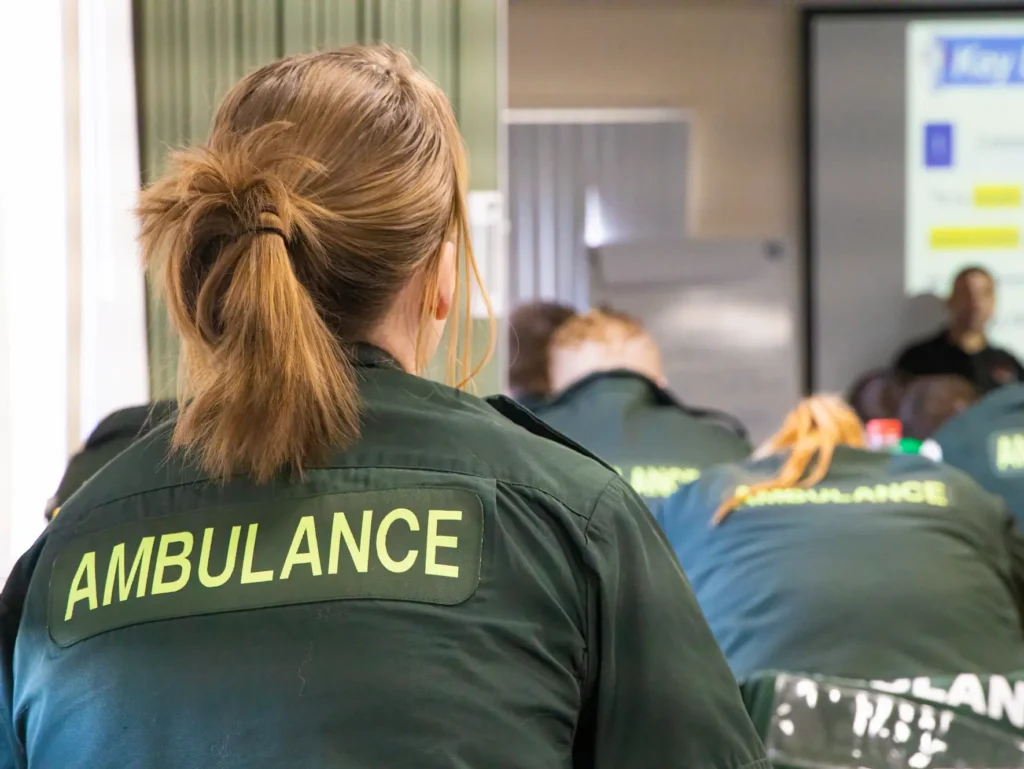
PMVA is predominantly an NHS term. It is most established in inpatient mental health services, and it is used across acute trusts, ambulance services, social care and secure or forensic settings.
It is worth being clear about what the term does and does not tell you. PMVA describes what training is for. There is no national syllabus behind it, no level or framework attached to it, and it is not a regulated qualification. Two courses both described as PMVA can differ considerably in length, in content and in how much physical skills work they contain. One trust may commission three days of it. Another may commission one.
What does PMVA training include?
Most programmes work through broadly the same sequence:
- Why violence and aggression happen, including the effects of pain, distress, confusion, intoxication and mental ill health
- Trauma-informed practice, meaning how someone's history shapes the way they react and how to avoid compounding it
- Recognising escalation early, both in behaviour and in the environment
- Communication and de-escalation skills to bring a situation back down
- Breakaway or disengagement skills, to release from a grab or hold and withdraw safely
- Restrictive physical intervention, usually shortened to RPI, used only as a last resort and only where the risk justifies it
- The legal and ethical boundaries around all of it
- Reporting, post-incident support and organisational learning
Two principles run through the whole of it. The first is the least restrictive option: if something less intrusive will work, that is what you use. The second is proportionality, meaning the response has to match the risk actually in front of you rather than the worst case you can picture. Both are what a coroner, a safeguarding panel or a regulator will look at afterwards.
Duration follows content. A course built around prevention, de-escalation and breakaway can run in a day. One that includes team-based restraint usually runs to two or three.
Who needs PMVA training?
Job title matters less here than risk assessment. Staff working where violence is a foreseeable part of the environment need training proportionate to that risk, and an acute mental health ward with a history of restraint needs something quite different from a community clinic.
The scale is not marginal. Around one in seven NHS staff reported experiencing physical violence from a patient, relative or member of the public in the 2025 NHS Staff Survey, published in March 2026, the highest figure in three years.
In practice, the groups most often trained are inpatient mental health staff, emergency department teams, ambulance crews, learning disability and social care services, and staff in secure settings. Reception and administrative staff in those same buildings are frequently left out, despite often being the first person an agitated visitor speaks to.
Where PMVA training is a legal requirement
For most employers, training in violence and aggression falls under general health and safety duties: assess the risk, then control it proportionately. In mental health units it is considerably more specific.
The Mental Health Units (Use of Force) Act 2018, known as Seni's Law after Olaseni Lewis, placed a statutory training duty on mental health units from 31 March 2022. The Act sets out what that training must cover, and the list reads very much like a PMVA syllabus: techniques for avoiding or reducing the use of force, the risks and impact of force on a patient's health, the effects of trauma, involving patients in their own care, respecting their wishes and their diversity, avoiding discrimination and harassment, safety, and the relevant legal and ethical issues. It also requires refresher training at regular intervals rather than a single session at induction.
If you run a mental health unit, that is the clearest answer available to whether this training is optional. Elsewhere the duty is real but less prescriptive.
Other sectors, different names
The NHS calls it PMVA. Other sectors call much the same training something else, and the content underneath is frequently near identical.
| Descriptive term | Where you'll hear it |
|---|---|
| PMVA | NHS mental health and acute trusts |
| MVA | Healthcare, as a shorter variant |
| MAPA (Management of Actual or Potential Aggression) | Health, social care and education |
| PROACT-SCIPr-UK | Learning disability and special education settings |
| Conflict Resolution Training | NHS statutory and mandatory training |
| Positive Handling | Schools and education |
| Positive Behaviour Management or Support | Social care and learning disability services |
| Control and Restraint | Prison and secure settings |
| Physical Intervention | Security and SIA-regulated roles |
| Breakaway | The disengagement element, used across all of them |
People often search for PMVA and MAPA as though they were one thing. They are not. MAPA is a specific named programme, whereas PMVA is a generic description, so a MAPA course may well be exactly what a trust means when it asks for PMVA.
The practical consequence is that two courses sharing a name can contain quite different material, and two courses with different names can cover the same ground to the same standard. When comparing providers, ask what the course actually contains, how long it runs and how the physical skills are assessed. Matching the acronym tells you very little.
Can PMVA training be done online?
Partly, and only the theory. Prevention, legal content and de-escalation transfer reasonably well to e-learning. Breakaway and physical intervention do not, because they are physical skills assessed by observation, and a certificate issued without anyone watching you perform them is unlikely to satisfy your own policy, let alone anyone reviewing an incident afterwards. Free online PMVA courses exist and have their uses as background or refresher reading, but they are not a substitute for the practical element.
How Stand2's training covers the same ground
Stand2 has delivered conflict management and physical intervention training to NHS trusts and ambulance services for over 25 years. We do not badge our programmes as PMVA, because we work across healthcare, education, housing, transport, security and local government, and each of those sectors uses its own name for it.
Conflict Management & Personal Safety for Healthcare covers the prevention end: recognising escalation in a clinical environment, structured de-escalation, low-level breakaway and safe withdrawal. Physical Intervention Training covers the restrictive end, for environments where there is a foreseeable risk of physical harm and staff may need to intervene as a last resort.
If a trust has asked your team for PMVA, that combination covers the same ground. We can map it against your own risk assessment and policy so the training fits the risks your staff actually face.




 01952 928134