

News & Resources
What Are the 4 Levels of Disruptive Passenger Behaviour?
The ICAO four levels of disruptive passenger behaviour, what Level 2 and Level 4 threats look like on board, and where crews should focus training.
TL;DR
The four levels of disruptive passenger behaviour run from verbal disruption to a breach of the flight deck.
01
Most is Level 1
Verbal, not physical, and easiest to calm.
02
Level 2 is physical
Pushing, hitting or damaging property.
03
Level 4 is rare
An attempt to breach the flight deck.
Need this training? Get a price for your team.
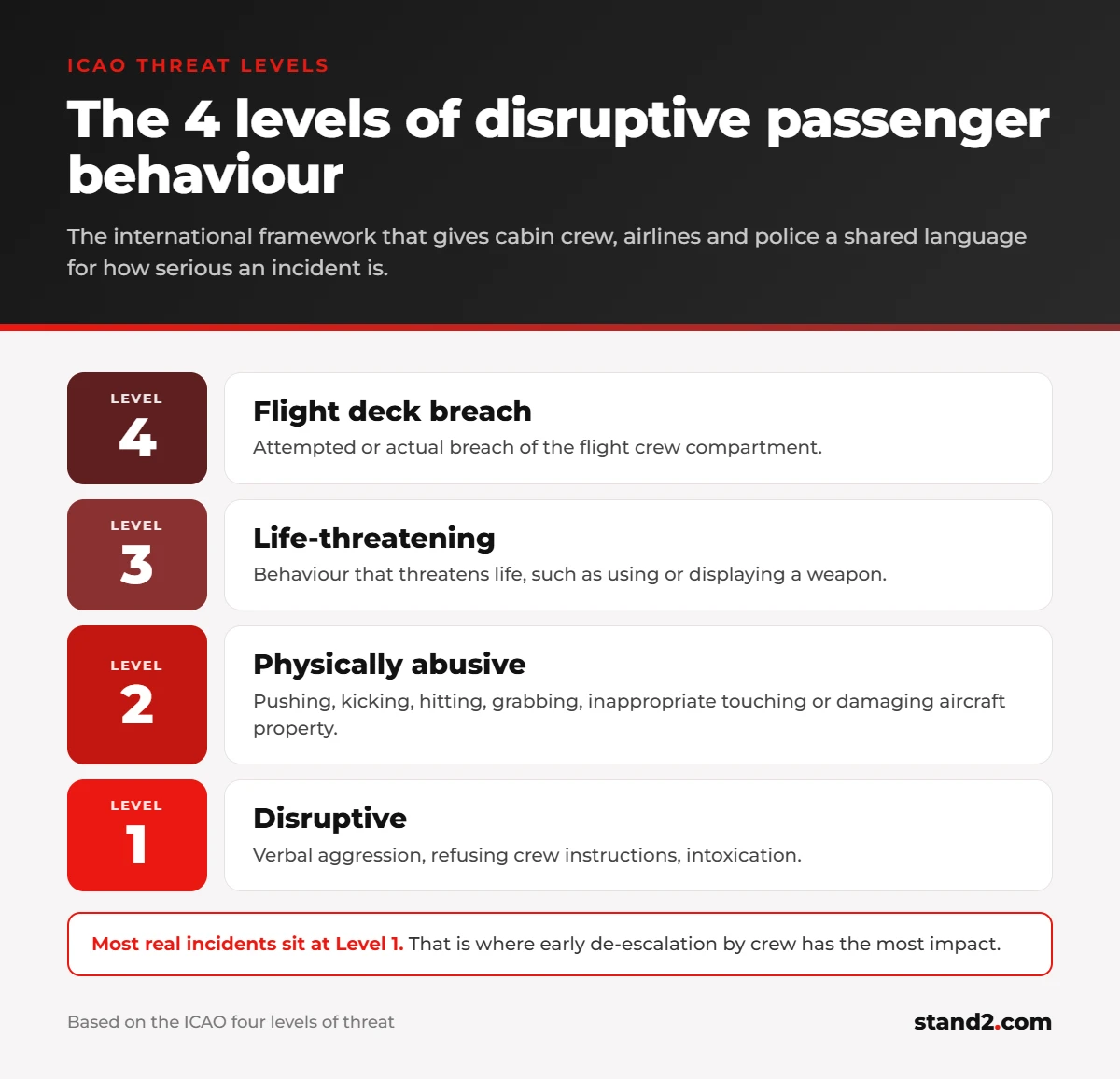
Get a quoteLevel 1 is disruptive behaviour - verbal aggression, refusing crew instructions, intoxication.
Level 2 is physically abusive behaviour.
Level 3 is life-threatening.
Level 4 is an attempted or actual breach of the flight crew compartment.
Where the 4 Levels Come From
This is the ICAO "4 Levels of Threat" framework, often referred to as the ICAO threat levels or airline threat levels, adopted internationally to give flight crews, airlines and police a shared language for how serious an incident actually is.
What Is a Level 2 Threat on a Plane?
A Level 2 threat is physically abusive behaviour.
It's the point where an incident stops being verbal and becomes physical: pushing, kicking, hitting, grabbing, inappropriate touching, or deliberately damaging aircraft property. Under the ICAO framework it sits above Level 1 (verbal disruption) and below Level 3 (life-threatening behaviour, such as the use or display of a weapon).
The overwhelming majority of real incidents sit at Level 1 - verbal, not physical - which is exactly where early, confident de-escalation makes the biggest difference. That's the focus of our Conflict Management & Personal Safety course for transport staff: recognising a Level 1 situation and responding at the earliest stage, rather than waiting to see where it goes.
The jump from Level 1 to Level 2 matters because it changes what crew are dealing with. Once someone has used force, the priority is no longer just calming them down but protecting everyone around them.
What Is a Level 4 Threat on an Airline?
A Level 4 threat is an attempted or actual breach of the flight deck.
It's the most serious of the four levels: someone trying to get into the cockpit, or succeeding, for example by forcing the flight deck door. Crews treat it as a potential hijacking. The priority becomes keeping the flight deck secure, the aircraft will typically divert to the nearest suitable airport, and police meet it on landing.
Level 4 incidents are very rare. Most crews will never face one, which is why training time is better spent on spotting and calming Level 1 behaviour before it has a chance to build.
Knowing the framework is one thing; knowing what to actually do in the moment is the harder skill.
For Transport Staff
Conflict Management and Personal Safety Training for Transport Staff
Teaches staff to deal with disruptive passengers calmly and stop incidents escalating. See what’s covered and how to book.
- 6 hours
- Up to 12 per trainer
- Delivered at your site
- Refresh every 2 years




 01952 928134
