

News & Resources
Physical Intervention Training: Why Saying No Carries More Risk Than You Think
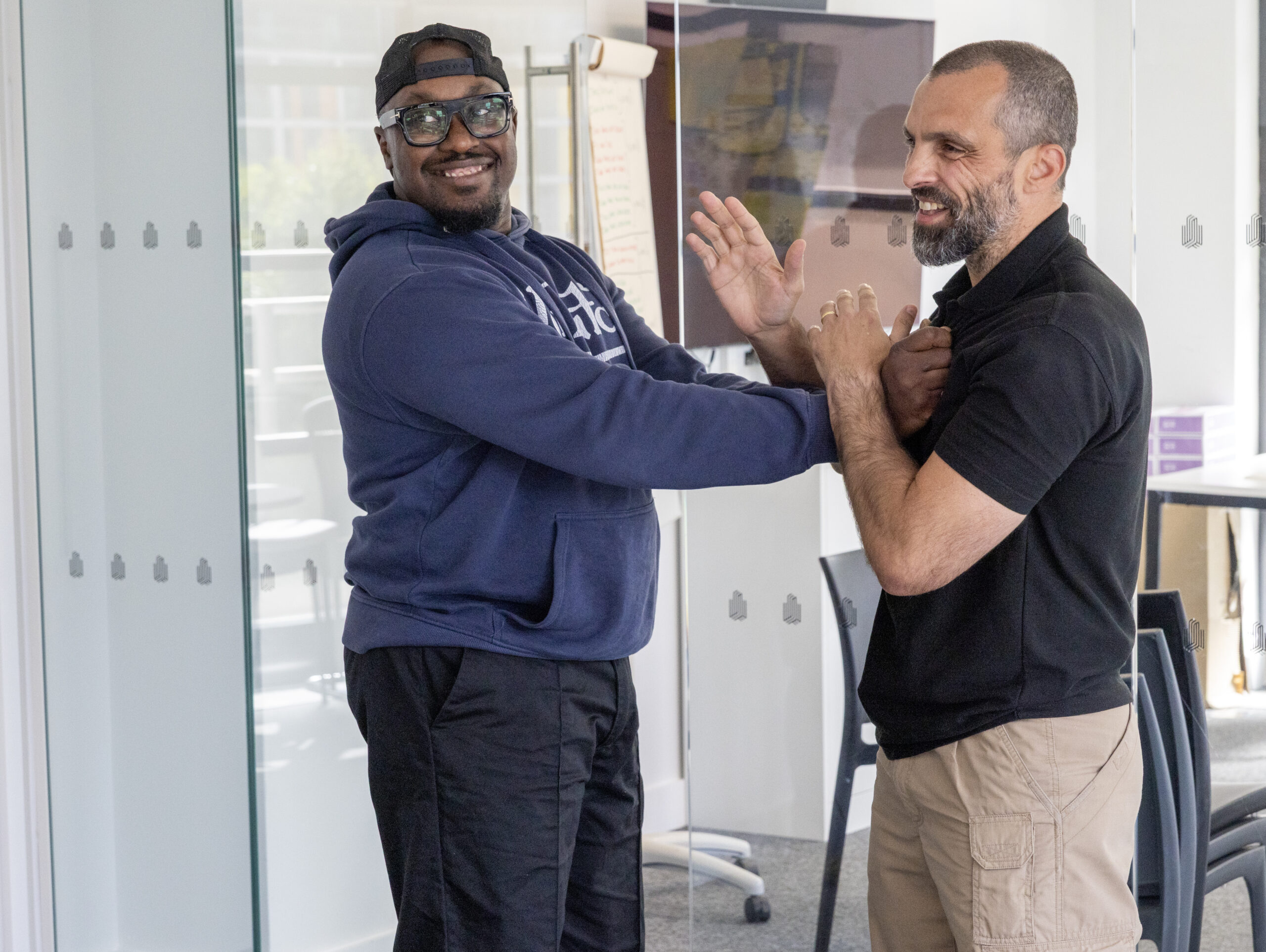
TL;DR
HSE guidance is clear: if staff face a foreseeable risk of physical aggression, avoiding physical intervention training doesn't remove your organisation's liability - it creates one.
Good training is principle-led, proportionate, medically reviewed, and refreshed regularly - not martial arts, and not a box-ticking exercise.
Physical intervention training is one of the most avoided subjects in workplace safety - and one of the most necessary.
The most common things we hear when discussing training with organisations for the first time are:
"We don't want our staff to think they can physically intervene."
"We're worried about injuries to staff and to the people they work with."
"If we train physical skills, won't that increase the likelihood of someone using them inappropriately?"
These are by no means unreasonable concerns. They come from people trying to do the right thing - HR leads, training managers, and senior officers who have seen what happens when physical intervention goes wrong and want to protect their organisations from that outcome.
But the instinct to avoid the subject entirely can create a different and equally serious problem. And understanding why matters, not just for staff safety, but for organisational liability.
What the law actually requires
The Health and Safety Executive is unambiguous on this point.
Staff caring for persons that present a serious risk of physical aggression may also need training in physical intervention techniques, as well as basic training. Confidence and capability are important when dealing with a potentially aggressive or violent incident. Staff will need refresher training from time to time to update their skills.
This is not a recommendation. It is part of the HSE's guidance on managing the risk of violence and aggression at work - guidance that sits alongside the legal duty on employers under the Health and Safety at Work Act 1974 to assess foreseeable risks and put appropriate controls in place.
The key phrase is foreseeable. If your risk assessment identifies that staff may face physical aggression - and in healthcare, social care, ambulance services, security, probation, and many other sectors, that risk is clearly foreseeable - then the control measures you put in place need to reflect that reality.
The HSE recorded an estimated 689,000 incidents of work-related violence in 2024/25, of which 370,000 were physical assaults. Those are not incidents that happened because organisations decided to teach physical skills. They are incidents that happened regardless of what organisations decided to teach.
The question is not whether your staff will encounter physical risk. For many roles, they will. The question is whether they will be prepared when they do.
What physical skills training is not
Much of the reluctance to include physical skills in conflict management training comes from a misunderstanding of what that training should look like.
It is not martial arts. It is not fighting techniques. It is not about turning staff into security operatives or giving people confidence they have not earned.
Done properly, physical skills training in a workplace context is about three things.
The first is protection. Staff need to know how to protect themselves - how to create space, maintain balance, avoid being grabbed or struck, and disengage from a situation that has become physical. These are not aggressive skills. They are survival skills.
The second is proportionality. Staff need to understand what reasonable force means in practice - not just as a legal concept, but as a lived decision that has to be made in seconds under pressure. Without training, that decision defaults to instinct. Instinct is unreliable.
The third is confidence. Staff who have practised what to do in a physical confrontation are less likely to panic, freeze, or overreact. Training does not make people more aggressive. It makes them calmer. That calmness reduces the likelihood of escalation, not the other way around.
The risk of doing nothing
Here is the argument that organisations rarely want to hear.
If your staff face a foreseeable risk of physical aggression and you have not provided appropriate training to manage that risk, you have not avoided a liability. You have created one.
The HSE's guidance on preventing workplace violence includes a case study that is worth quoting directly. A care worker visited a child's home to carry out a safety plan assessment when the parent struck them over the head with a metal object. The worker received serious head wounds and was later diagnosed with post-traumatic stress disorder. The parent was known to have a history of violence, but the care worker had not been informed prior to the visit.
That case illustrates two failures: a failure of information sharing and a failure of preparation. Both are organisational responsibilities. Both are foreseeable. And both, in an incident review or a tribunal, become the organisation's problem to explain.
Removing physical skills from training does not remove the risk of physical violence. It removes one layer of preparation that staff might have relied on.
The quality question
Accepting the case for physical skills training is only the beginning. The quality of that training matters as much as its presence.
Poor physical skills training can be worse than no training at all. If techniques are unrealistic, overly complex, legally unclear, or disconnected from the environments staff actually work in, the result is false confidence - staff who believe they are prepared but are not. That gap between perceived capability and actual capability is dangerous.
Good physical skills training shares a set of characteristics regardless of sector.
It is principle-led rather than technique-led. Staff learn what they are trying to achieve - create distance, protect themselves, reduce harm - not just a series of moves that may not fit the situation in front of them.
It is proportionate. Every technique is taught within a clear legal and ethical framework. Staff understand not just how to do something, but when it is appropriate to do it and when it is not.
It is medically reviewed. In any environment where physical intervention may be necessary, the techniques used carry a risk of harm. That risk should be assessed and minimised by people with the clinical expertise to do so. At Stand2, every physical programme is independently reviewed by a consultant in emergency medicine and fully risk assessed by a NEBOSH-qualified practitioner.
It is refreshed regularly. Physical skills fade without practice. A staff member trained eighteen months ago who has not rehearsed those skills since is not the same as a staff member who trained last month. The HSE is clear that refresher training is a requirement, not an option.
And it is delivered by people who have genuinely been in the environments they are training for. Stand2's training team includes former Royal Marine Commandos, specialist police firearms officers, prison service instructors with national incident response experience, and professionals from close protection, covert operations, and military EOD backgrounds. When they teach staff how to manage physical risk, it is from the position of people who have faced it themselves.
The right question to ask
The question organisations should be asking is not "do we want to teach physical skills?"
The right question is: do our staff face a foreseeable risk of physical aggression?
If the answer is yes - and for a significant proportion of roles across healthcare, ambulance services, social care, probation, housing, transport, and security it clearly is - then the follow-up question is: what level of preparation do they need to manage that risk safely, lawfully, and proportionately?
The answer to that question should be determined by an honest risk assessment, not by discomfort with a subject that feels difficult to address.
Avoidance is not protection. Preparation is.
Stand2's physical intervention programmes are independently medically reviewed, fully risk assessed, and built around the specific environments your staff work in. If you're ready to have an honest conversation about what your organisation actually needs, we'd welcome it.




 01952 928134