

News & Resources
The Drama Triangle: Why Your Job Has Already Cast You a Role

TL;DR
The drama triangle is a model of how conflict pulls people into three roles: Victim, Rescuer and Persecutor. On the frontline, your job title often assigns you one before you've said a word.
The most common trap is helping too much. When a rescue fails, the person you helped can turn on you. Stepping out means helping people act, setting boundaries without blame, and not taking the role you've been handed.
The drama triangle explains something most frontline staff have felt but never named: the people you try hardest to help are often the ones who end up complaining about you.
One GP writing about it put it simply: many doctors notice it's the patients they do the most for who complain (Lantum). Receptionists, housing officers, carers and call handlers see the same pattern every week.
It isn't bad luck, and it isn't always the other person. It's a predictable pattern, and once you can see it, you can step out of it.
What is the drama triangle?
The drama triangle is a model of the roles people fall into during conflict: Victim, Rescuer and Persecutor. It was created by psychiatrist Stephen Karpman in 1968 and comes from transactional analysis, the approach to communication developed by Eric Berne.
Karpman first described it in a short article on fairy tales (Karpman, 1968). His key idea was that drama comes from people switching roles, and the faster and more sharply they switch, the more intense it gets.
He chose the word "drama" deliberately. In the triangle, the Victim isn't someone who has genuinely been harmed. It's someone feeling or acting powerless. That distinction matters on the frontline, where staff can be real victims of abuse.
The three roles
Everyone moves between all three roles. Most people have one they slip into first.
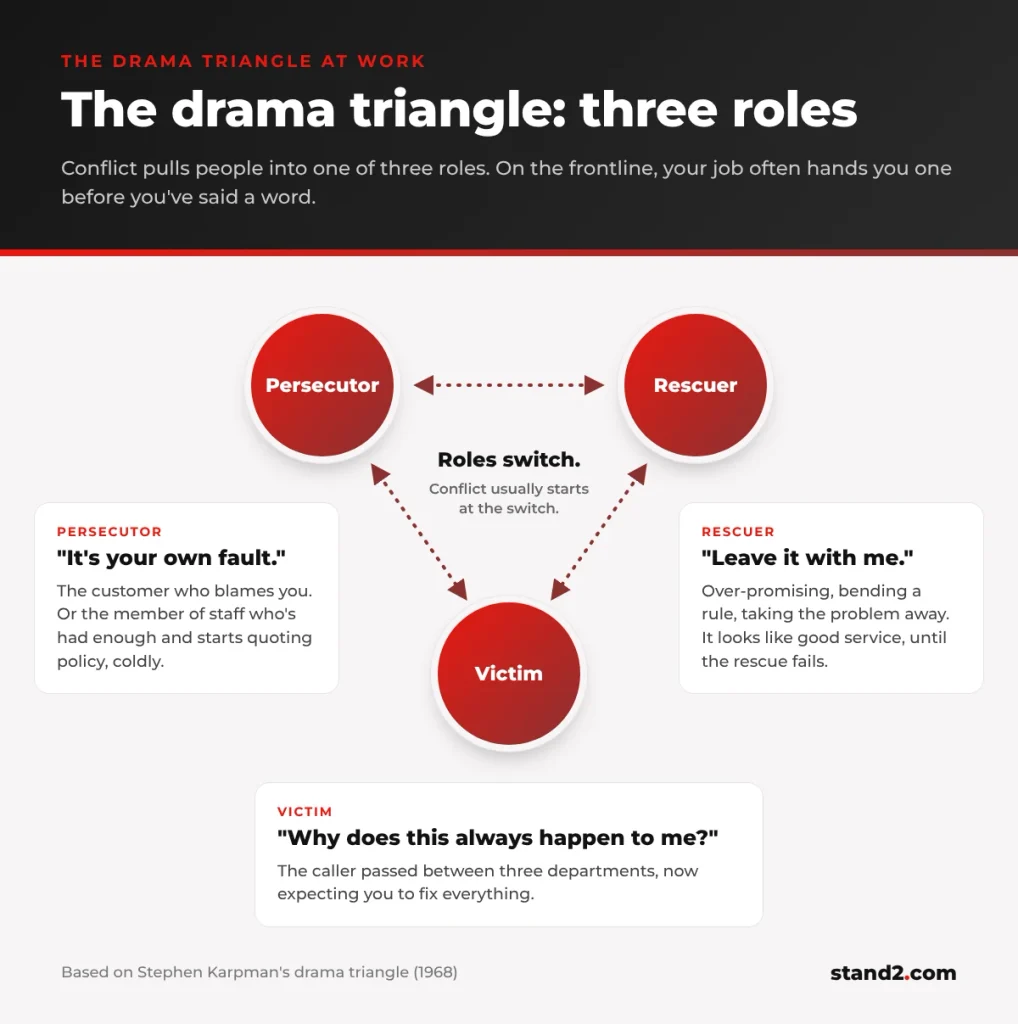
The Victim: "Why does this always happen to me?"
The Victim feels powerless and looks for someone to save them or someone to blame. On the frontline, this is the caller who has been passed between three departments and now expects you to fix everything, or the patient who feels nobody is listening.
The Rescuer: "Leave it with me."
The Rescuer jumps in to fix things, often without being asked. It looks like good service: over-promising, bending a rule, taking the problem away. But it keeps the other person dependent, and it puts all the responsibility on you.
The Persecutor: "It's your own fault."
The Persecutor blames, criticises or controls. Sometimes that's the angry customer. Sometimes it's the member of staff who has had enough and starts quoting policy in a cold, clipped voice.
How your job casts you in a role
Most writing on the drama triangle treats it as a personal habit. On the frontline, it's often built into the job.
- Helping roles start as Rescuers. Reception, healthcare, support work and customer service all exist to solve people's problems. The public expects you to save the day.
- Enforcement roles start as Persecutors. Parking, security, housing and benefits staff are often seen as the obstacle before they speak.
- The public often arrives as the Victim. Long waits, bad news and being passed around leave people feeling powerless before they reach you.
A social worker in a Social Care Wales training video makes the point well: calling yourself a "child protector" quietly casts the family as the Persecutor before you've walked through the door.
So the triangle is usually already set up when the conversation starts. The question is whether you play the part you've been given.
The switch: why helping turns into conflict
The drama triangle's most important idea is the switch. Roles don't stay fixed, and the switch is usually where conflict starts.
Karpman describes a common pattern: a helper gets drawn in, the help backfires, and the helper becomes the new Victim (Karpman, 2007). On the frontline it often goes like this:
- A customer arrives frustrated and powerless (Victim).
- You promise to sort it, or bend a rule to help (Rescuer).
- The promise can't be kept, or the next person won't bend the rule.
- The customer turns on you: "You said you'd sort this" (now the Persecutor).
- You feel attacked and unfairly blamed (now the Victim).
The same switch happens the moment a helper says no. In the other person's eyes, you've moved from Rescuer to Persecutor in one sentence.
This is why kindness alone doesn't always calm things down. Over-promising and over-helping create expectations, and broken expectations are one of the fastest routes to aggression.
Quick Check: Which Drama Triangle Role Do You Slip Into?
Quick check
Which drama triangle role do you slip into?
Five situations from working life. Pick what you'd most likely do or think when you're under pressure.
Your default under pressure
Why it backfires:
Remember: everyone slips into all three roles. The skill is noticing when someone invites you into one, and choosing not to accept.
A quick reflection based on Karpman's drama triangle and Emerald's Empowerment Dynamic. It isn't a psychological assessment.
How to step out of the drama triangle
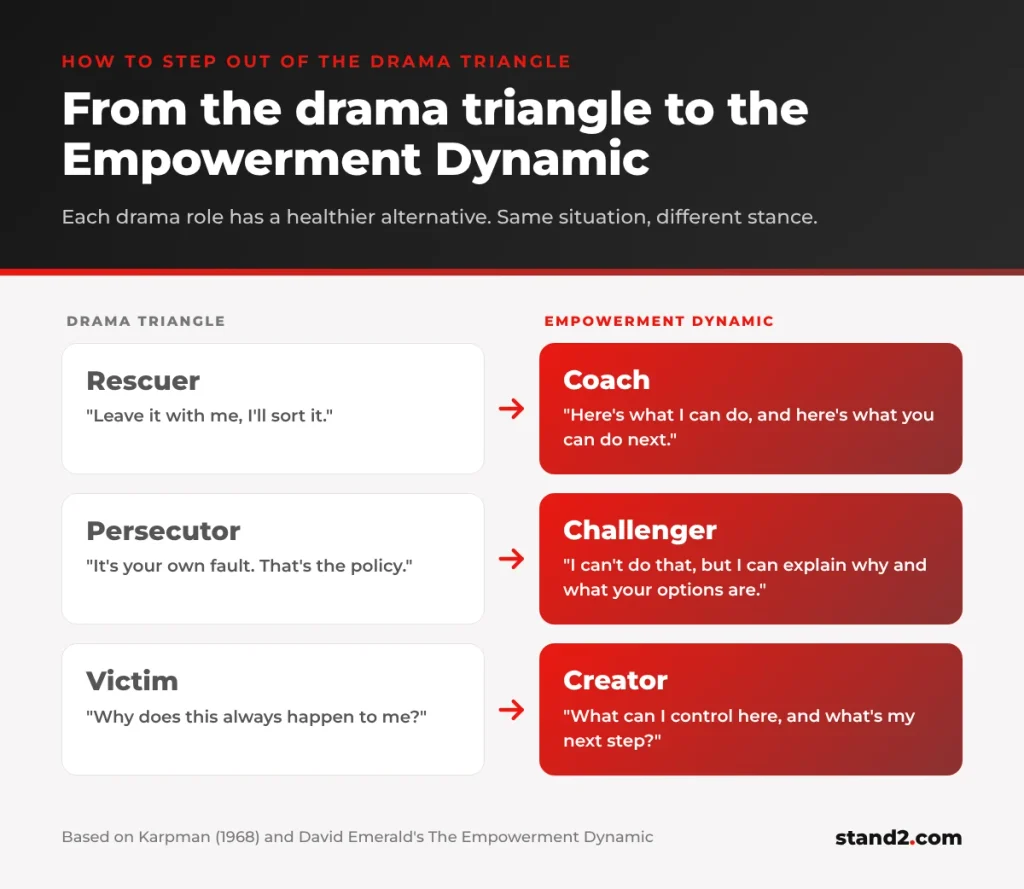
The best-known way out is David Emerald's Empowerment Dynamic, sometimes called the empowerment triangle. It swaps each drama role for a healthier one. An earlier version, Acey Choy's Winner's Triangle (1990), uses vulnerable, caring and assertive instead.
| Drama role | Healthier stance | On the frontline |
|---|---|---|
| Rescuer | Coach | "Here's what I can do, and here's what you can do next." |
| Persecutor | Challenger | "I can't do that, but I can explain why and what the options are." |
| Victim | Creator | Focus on what you can control, not on what's being done to you. |
Three practical habits help most:
- Don't promise what you can't control. Be clear about what you can and can't do from the start.
- Set boundaries without blame. A clear, calm "no" with a reason and an alternative stops you becoming the Persecutor.
- Notice the invitation. When someone casts you as their rescuer or their enemy, you don't have to accept the role.
This links closely to Betari's Box: your stance affects the other person's, and theirs affects yours. Change your stance and you change the conversation.
What the evidence says
The drama triangle is widely used, but it's worth being honest about how well tested it is.
- It wasn't built from research. Karpman developed it from fairy tales and, by his own account, from doodling basketball and football fakes (Karpman, 2007).
- The roles do seem real. A 2022 study built the first validated Drama Triangle Scale across three samples of adults. It confirmed the three roles and linked them to anxiety, stress and insecure attachment, with the Victim role most strongly linked to poor outcomes (Lac & Donaldson, 2022).
- It matters at work. A 2026 study of 388 employees found that more drama triangle behaviour went with lower well-being, and recommended training leaders to recognise it (Frolova, 2026).
What hasn't been proven yet is whether teaching people the model reduces conflict on its own. It's best used as a way of seeing what's happening, alongside practical de-escalation skills.
Bottom line
On the frontline, the drama triangle is usually set up before you say a word. Your job casts you as the Rescuer or the Persecutor, and the person in front of you often arrives as the Victim. Conflict starts at the switch, most often when a rescue fails or a helper says no.
The way out isn't to care less. It's to help without taking over, say no without blame, and decline the role you've been handed. Our De-Escalation Training builds exactly these skills, and our Managing Challenging Behaviour course covers the transactional analysis behind them.
For Frontline Staff
Managing Challenging Behaviour Training
Teaches frontline staff to spot rising tension, set clear boundaries and calm difficult conversations. See what's covered and how to book.
Drama triangle: frequently asked questions
What is the drama triangle theory?
The drama triangle is a model created by Stephen Karpman in 1968. It describes three roles people fall into during conflict (Victim, Rescuer and Persecutor) and shows how switching between them keeps conflict going.
What are the three roles in the drama triangle?
The Victim feels powerless, the Rescuer jumps in to fix things, and the Persecutor blames or controls. Most people move between all three.
How do you break the drama triangle?
Notice which role you're being invited into and don't take it. Help people act for themselves instead of rescuing, set boundaries without blame, and focus on what you can control.
What is the healthy version of the drama triangle?
The best known is David Emerald's Empowerment Dynamic, where Victim becomes Creator, Rescuer becomes Coach and Persecutor becomes Challenger. Acey Choy's earlier Winner's Triangle uses vulnerable, caring and assertive.




 01952 928134
