

News & Resources
Dynamic Risk Assessment: What It Is and How to Do One

What a dynamic risk assessment is, how it differs from your written risk assessment, and how to carry one out when the hazard is a person.

TL;DR
A dynamic risk assessment is the continuous, on-the-spot process of spotting hazards, judging the risk and acting to stay safe as a situation changes in real time.
01
It adds, never replaces
It works alongside your employer's written risk assessment.
02
Assess three things
The person, the place and your own position.
03
Then decide
Continue, adapt or withdraw.
Free template: a three-page checklist to print and use.
Get the free templateA written risk assessment is made at a desk, days or weeks before the work happens. The visit itself happens on a doorstep, at a reception desk or on a ward, where things change by the minute.
Dynamic risk assessment fills that gap. It's how a trained person keeps judging risk while the work is under way, and decides what to do when the situation stops matching the plan.
This guide explains what a dynamic risk assessment is, how it differs from a written one, what the law says, and how to carry one out step by step. It then looks closely at the hardest hazard to predict: other people. There's also a free printable template at the end of the steps.
What is a dynamic risk assessment?
A dynamic risk assessment is the continuous process of identifying hazards, assessing risk and taking action to remove or minimise it, in real time, as a situation develops. It happens on the spot, before and during a task, by the person doing the work. You may also hear it called a live risk assessment.
The term comes from the UK fire service. Home Office guidance published in 1998, Dynamic Management of Risk at Operational Incidents, described it as a continuous cycle of identifying hazards, assessing risk, acting, then monitoring and reviewing "in the rapidly changing circumstances of an operational incident". Firefighters can't risk assess a burning building in advance, so they assess it as they go.
The same idea now applies to the emergency services, construction, healthcare and any work where conditions can change without warning, from the weather turning to equipment failing. A delivery driver arriving at an unfamiliar site, a paramedic walking into a stranger's home, an engineer finding a hidden hazard: each has to judge the risk in front of them, not the risk someone predicted. This guide focuses on the version most of our clients need, where the hazard is a person.
Dynamic risk assessment vs written risk assessment
A written risk assessment, sometimes called a formal, standard or static risk assessment, is carried out before work begins. It covers the hazards you can foresee and the control measures for them. Unlike a written assessment, a dynamic risk assessment is carried out during the work and covers what the written one couldn't predict. You need both.
| Written (formal) risk assessment | Dynamic risk assessment | |
|---|---|---|
| When | Before the work starts, then reviewed | On arrival and throughout the task |
| Who | The employer, or a competent person they appoint | The person doing the work |
| Covers | Foreseeable, routine hazards | New, unknown or unpredictable hazards |
| Recorded | Yes: significant findings must be written down if you have five or more employees | No set form, but decisions and incidents should be recorded afterwards |
| Legal basis | Regulation 3, Management of Health and Safety at Work Regulations 1999 | Part of keeping that assessment valid as things change |
Is a dynamic risk assessment a legal requirement?
The law requires a suitable and sufficient risk assessment that is kept up to date as things change; a dynamic risk assessment is how that happens on the spot. The phrase "dynamic risk assessment" itself doesn't appear in the regulations.
Under regulation 3 of the Management of Health and Safety at Work Regulations 1999, every employer must assess the risks to employees and anyone else affected by their work. The assessment must be reviewed when there's reason to think it's no longer valid, or when something significant has changed. Employers with five or more employees must record the significant findings.
Employees have a duty too. Section 7 of the Health and Safety at Work etc. Act 1974 requires them to take reasonable care of themselves and of others affected by what they do. Pausing, adapting or leaving when a situation becomes unsafe is part of that.
So a dynamic risk assessment doesn't replace your written assessment, and it isn't a way of skipping one. If your written assessment relies on staff making dynamic decisions, they need the training to make them and the backing to act on them.
When should you carry out a dynamic risk assessment?
You should carry out a dynamic risk assessment whenever the situation in front of you differs from what was planned, and keep doing it until the task ends. Common triggers include:
- Arriving somewhere new: a home visit, an unfamiliar site or a room you haven't seen before.
- A change in someone's behaviour: raised voices, agitation, signs of alcohol or drugs, or a sudden silence.
- Someone else arriving: a new person in the room changes the risk.
- New information: a warning on file, something a neighbour says, or a detail that doesn't add up.
- The plan isn't working: the approach you agreed isn't calming things down.
- Working alone or in a high-risk role: when help isn't nearby, you're the only one who can spot the change.
How to carry out a dynamic risk assessment
There's no single official method, but most approaches follow the same five steps. In a fast-moving situation they happen in seconds, and they repeat for as long as the task lasts.
- Evaluate the situation. Pause, observing the person, the environment and the task before you commit. What has changed since you planned this? This is situational awareness put to work.
- Identify hazards. Name what could cause harm now, and who might be harmed and how: a person's behaviour, a blocked exit, an object within reach, a dog in the hallway.
- Decide and act. Weigh the likelihood and severity of harm, then choose to continue, adapt your safe system of work with extra controls, or withdraw.
- Monitor. Stay alert and keep watching to check your decision is working and nothing new has appeared. If it changes, go back to step one.
- Review and record. Afterwards, write down what changed and what you did, report any incident, and tell your manager so the written risk assessment can be reviewed.
Free download
Dynamic Risk Assessment Template
A three-page printable checklist for lone workers: before you go, on arrival, the continue, adapt or withdraw decision, and a record to fill in afterwards.
The 3 A's of dynamic risk assessment
The 3 A's are a common mnemonic for dynamic risk assessment in conflict management and lone working: Assess the person, Assess the surroundings, Act. It's a simple way to remember that the risk comes from both who you're with and where you are, and that assessing is pointless unless it leads to a decision.
You'll hear other models too. Police officers, for example, structure their decisions using the College of Policing's National Decision Model. Our own courses teach a structured decision model built for the situations our clients face. Whichever model you use, it should make you stop, look, decide and keep checking.
Dynamic risk assessment when the risk is a person
A slippery floor stays a slippery floor. A person can go from calm to angry in seconds, which makes people the hardest hazard to assess and the one most generic guidance skips. For lone workers, frontline staff and anyone who meets the public, this is where dynamic risk assessment matters most.

Assess the person
Start at the door, before you go in. Is the person calm, or showing signs of distress, frustration or anger? Are there signs of alcohol or drug use? Watch for any shift in body language: clenched fists, pacing, squaring up, a fixed stare or a sudden quiet. Think about what's driving the behaviour, because fear, pain and bad news can all push someone towards aggression.
Assess the place
Look at the environment as carefully as the person. Know where the exits are and whether you can reach them. Check for anything that could block your way out, and for items that could be picked up and used as a potential weapon, including your own equipment. Notice who else is there, any dogs, and whether anyone else could see or hear you if you needed help.
Assess your own position
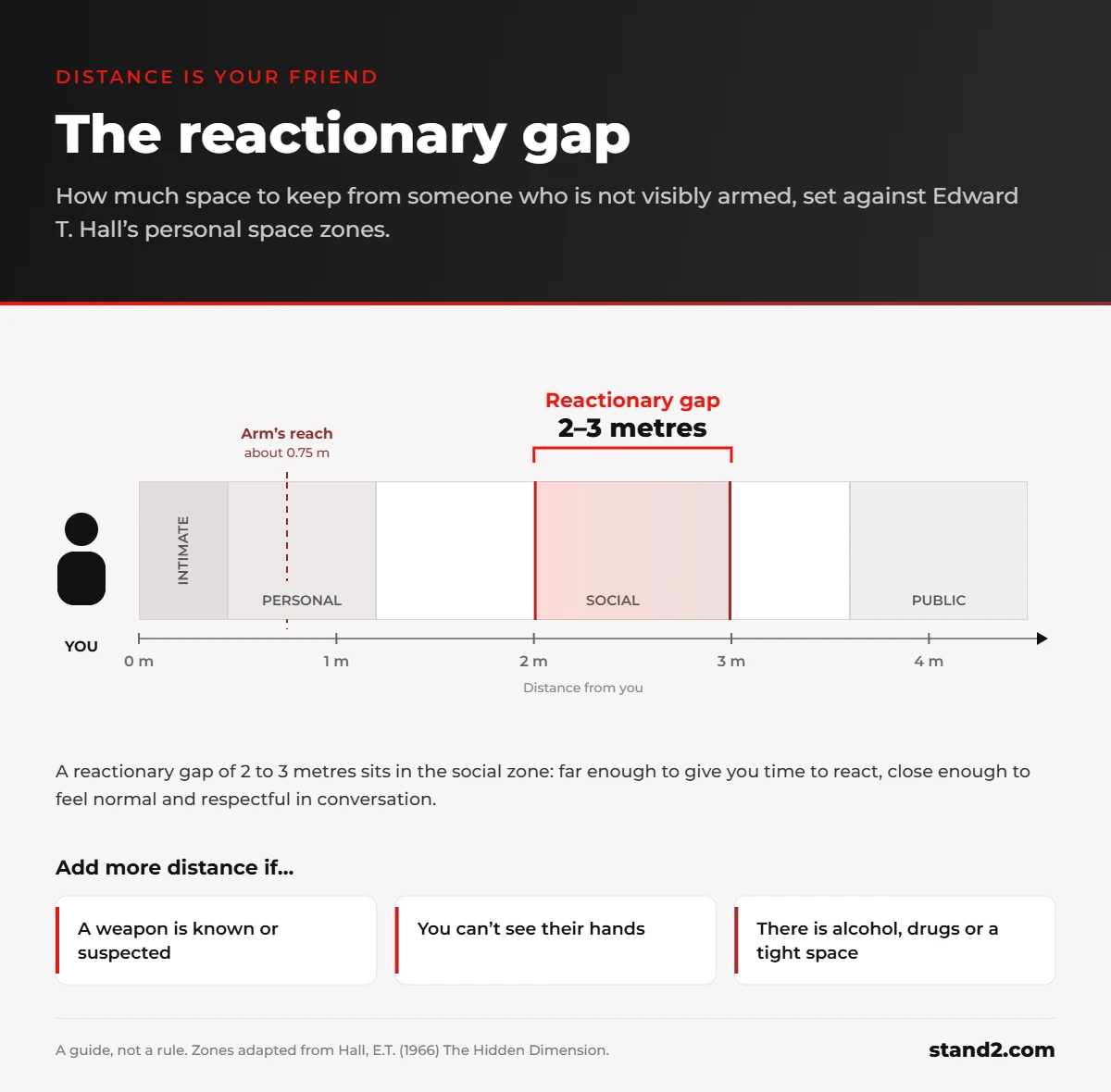
Distance is your friend. Keeping a safe reactionary gap, with two arm lengths as a useful starting point, gives you the time a dynamic risk assessment needs. Position yourself so the person isn't between you and the door, and avoid being cornered. Be aware of your own body language and tone, too. Keep your phone on you, not in your bag. Check in with yourself too: if something feels wrong, you don't need proof to step back.
Decide: continue, adapt or withdraw
- Continue when the risk is low and stable, and keep watching.
- Adapt when something has changed: increase your distance, change position, change the task, or call for a colleague.
- Withdraw when the risk is rising or you feel unsafe. Make a calm excuse, leave immediately, get somewhere safe and then call for help. If anyone is in immediate danger, call 999.
Leaving early is a professional decision, not a failure.
You can always come back another day, with a colleague or somewhere safer.
Dynamic risk assessment and the use of force
A dynamic risk assessment is also how a trained person decides, in the moment, whether any use of force is necessary and proportionate. For roles where physical intervention or restraint may be needed, it's the judgement that comes before any technique, and the reasoning you'll need to explain afterwards.
A dynamic risk assessment example
A housing officer arrives for a planned visit. The written assessment says the tenant has been polite on the phone. At the door, the officer smells alcohol, hears a raised male voice inside and sees the tenant is tearful and keeps glancing behind her.
Nothing on the written assessment covered this. The officer stays on the doorstep rather than going in, keeps their distance and asks if now is still a good time. The tenant says it isn't. The officer rearranges the visit, leaves, checks in with the office, and records what they saw, including a possible safeguarding concern. That whole decision took about a minute, and it's a dynamic risk assessment done well.
Benefits of a dynamic risk assessment
The main benefits of dynamic risk assessment are that it:
- Lets staff respond quickly to risks the written assessment couldn't foresee.
- Helps prevent workplace assaults, injuries and accidents by spotting escalation early.
- Gives staff a clear basis for deciding to continue, adapt or withdraw, especially when working alone.
- Feeds what staff see on the ground back into the written assessment, so the plan improves.
Who is responsible for a dynamic risk assessment?
The person doing the work carries out the dynamic risk assessment, because they're the only one who can see what's happening. The employer remains responsible for the written risk assessment, the training and the support behind it.
That support matters. TUC guidance for safety representatives makes the point that lone workers expected to make dynamic risk assessments must be properly trained and supported in their decisions. In practice, staff need to know they won't be criticised for withdrawing from a visit that felt unsafe, and they need any known risks passed on before they go. For lone workers, lone working guidance from the Health and Safety Executive sets out what employers should have in place.
Does a dynamic risk assessment need to be written down?
There's no legal form for a dynamic risk assessment, but you should record significant decisions and any incident afterwards so the written assessment can be reviewed. In a fast-moving situation, that record is made once you're safe, not before you act.
A short, accurate note of what changed, what you decided and why, what you did, who you told and any incident reference is usually enough. A debrief with your manager and colleagues then turns one person's experience into a better plan for everyone, and an unexpected risk today becomes a foreseeable one in the written assessment tomorrow.
Why dynamic risk assessment takes training

A dynamic risk assessment is a trained skill, not just common sense. Under stress, the body's fight, flight or freeze response narrows attention and slows clear thinking, which is exactly when the assessment is needed. People who have practised in realistic scenarios recognise warning signs sooner, and their decision making under pressure is calmer.
That's why our courses build it in from the start. At Level 1, staff learn the foundations of dynamic risk assessment. From Level 2 upwards, they practise it before and during realistic encounters, alongside communication, de-escalation and personal safety skills. Our Conflict Management and Personal Safety Training covers it for teams, and you can see where it fits across all our conflict management training.
For staff who work alone, our lone worker safety training practises dynamic risk assessment at the door and throughout a visit, so it becomes a habit rather than a checklist.
For Lone Workers
Lone Worker Safety Training
Teaches lone workers to assess risk, stay safe on visits and know when to leave. See what’s covered and how to book.
- 6 hours
- Up to 12 per trainer
- Delivered at your site
- Refresh every 2 years
Dynamic risk assessment: frequently asked questions
What are the 3 A's in a dynamic risk assessment?
The 3 A's are Assess the person, Assess the surroundings, and Act. They're a common mnemonic in conflict management and lone working for remembering that risk comes from both the people and the place, and that every assessment should end in a decision.
What are the 5 key areas of a dynamic risk assessment?
Most approaches cover five areas: evaluate the situation, identify the hazards, decide and act, monitor whether your action is working, then review and record what happened. In practice they run as a loop that repeats until the task ends.
What is the purpose of a dynamic risk assessment?
The purpose of a dynamic risk assessment is to keep people safe when a situation changes in ways the written risk assessment couldn't predict. For lone workers, its main personal safety benefit is spotting rising risk early enough to adapt or leave before harm happens.
What could trigger a dynamic risk assessment?
Anything that makes the situation different from what was planned: arriving somewhere new, a change in someone's behaviour, another person arriving, new information, a plan that isn't working, or finding yourself alone without support.
What factors may lead to a dynamic risk assessment in the NHS?
In healthcare, common factors include a patient or relative becoming distressed or aggressive, intoxication, a mental health crisis, home visits to unfamiliar addresses, and community or ambulance staff working alone. Each needs an on-the-spot judgement about whether to continue, adapt or withdraw.
Are "dynamic risk factors" the same as a dynamic risk assessment?
No. Dynamic risk factors are a probation and criminal justice term for changeable factors linked to reoffending, such as substance misuse or associates. A dynamic risk assessment is the on-the-spot safety judgement described in this guide.
Do I need a written risk assessment if I have fewer than 5 employees?
Yes, you still need to carry out a risk assessment. The difference is that employers with fewer than five employees don't have to write down the significant findings, though it's good practice to do so.




 01952 928134
