

News & Resources
Restrictive Practice: What It Is, Examples and How to Reduce It
TL;DR
Restrictive practice is anything that makes a person do something they don't want to do, or stops them doing something they want to do. It ranges from physical restraint and sedation to locked doors, blanket rules and quiet pressure to comply.
It's only lawful as a last resort: the least restrictive option, for the shortest time, and never as punishment. The services that use it least are the ones that spot distress early and train staff to de-escalate before restriction is ever needed.
Most people picture restraint when they hear the term restrictive practice. Someone being held, or taken to a seclusion room.
That's part of it. But restrictive practice is much wider, and most of it is quieter. A kitchen that's locked after 9pm. A resident told they can't go out because there's no one free to go with them. A pupil kept in at break as a consequence. A tablet given to settle someone down rather than to treat anything.
If you work in care, health, education, housing or any service supporting people in distress, restrictive practice is part of your job, whether you call it that or not. This guide covers what it is, the main types with examples, when it's lawful, and what organisations can do to reduce it.
What is restrictive practice?
Restrictive practice is any action, rule or approach that makes a person do something they don't want to do, or stops them doing something they want to do. The Restraint Reduction Network adds an important detail: restraint happens when a person feels they have no choice but to comply. So it isn't only about physical force. Pressure, rules and the environment can restrict someone just as effectively.
Restrictive practices are usually used to manage risk: to stop someone harming themselves or others. Sometimes that's justified. Often it isn't, and the restriction has quietly become routine.
The Care Quality Commission makes exactly this point. Restraint, seclusion and segregation are the extreme forms everyone recognises. But subtler restrictions easily become normal responses to risk or a shortage of time. CQC's examples include people not being allowed to make a hot drink after a set time, or being denied visitors or food because there aren't enough staff (CQC, Monitoring the Mental Health Act 2022/23).
That's the real test. Not "did we hold anyone?" but "what are we stopping people doing, and why?"
What are the main types of restrictive practice?
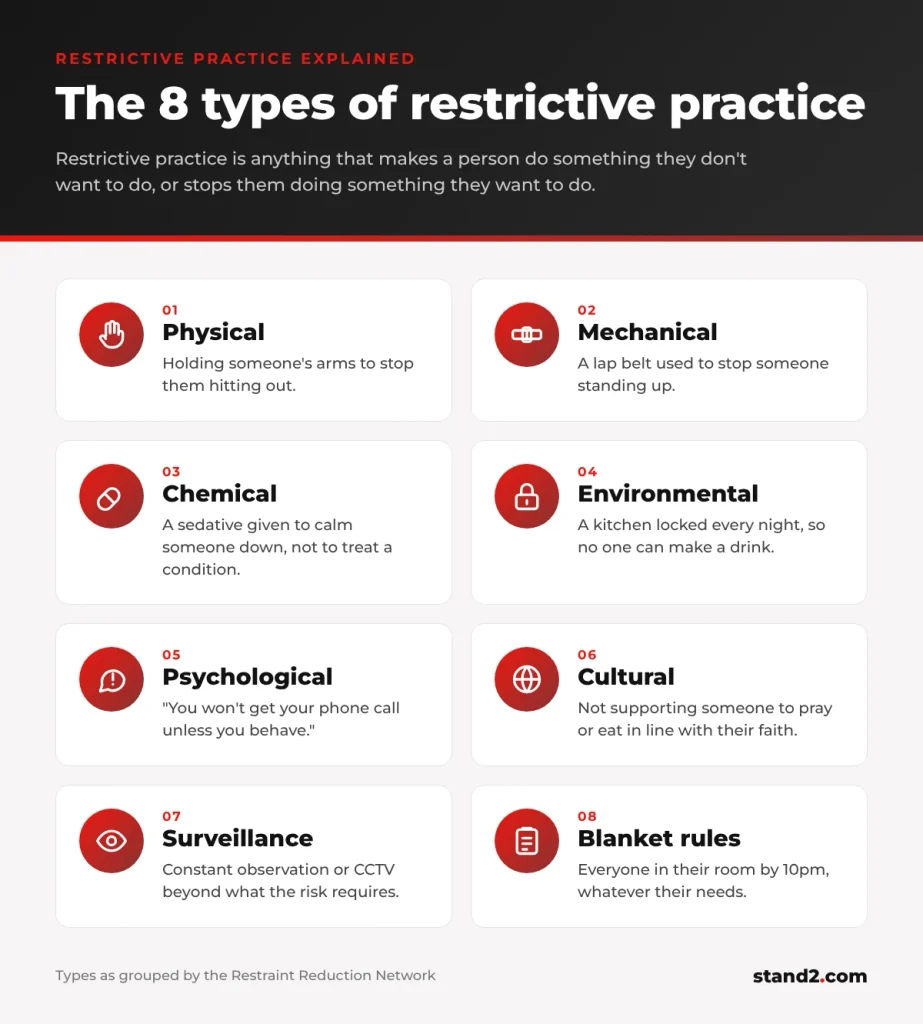
The Restraint Reduction Network groups restrictive practice into eight types. Other organisations group them slightly differently, but these cover everything you're likely to come across.
1. Physical restraint
Using physical contact to restrict someone's movement. Holding a person's arms to stop them hitting out, or guiding someone firmly away from a door, are both physical restraint. It carries the highest risk of injury to everyone involved.
2. Mechanical restraint
Using equipment to restrict movement. Examples include belts or cuffs during a secure transfer, or a lap strap fitted to stop someone getting out of a wheelchair rather than for their posture or safety in transit.
3. Chemical restraint
Using medication to control behaviour rather than to treat a diagnosed condition. Giving a sedative to settle someone who is distressed, instead of finding out why they're distressed, is chemical restraint. So is rapid tranquillisation.
4. Environmental restraint
Restricting access to places or things. Locked kitchens, locked front doors, keypads with codes residents aren't given, or removing items from a room "just in case" all restrict a person through their surroundings.
5. Psychological restraint
Using words, tone or consequences to pressure someone into complying. Threats, telling someone they'll lose a trip or a phone call unless they behave, or repeatedly telling a person they're not allowed to do something they could safely do, are all psychological restraint.
6. Cultural restraint
Preventing someone from following their culture, faith or identity. Not supporting a person to pray at certain times, to eat food that fits their beliefs, or to dress in a way that matters to them restricts them as surely as a locked door.
7. Surveillance
Monitoring that goes further than a person's needs justify. CCTV in private spaces, constant one-to-one observation, door sensors or GPS trackers can all be restrictive. They take away privacy, and people often change how they act when they know they're watched.
8. Blanket rules
Rules applied to everyone, regardless of individual risk. "Everyone's in their room by 10pm." "No one has their own phone charger." "No hot drinks after 9pm." Blanket rules are often the easiest restrictions to miss because they feel like simple house rules. They're also the easiest to remove.
When can restrictive practice be used?
Restrictive practice is sometimes necessary, but only within tight limits. CQC's position is that any restriction must be:
- lawful
- for a legitimate aim
- the least restrictive way of meeting that aim.
In practice, that means a restriction should only be used when:
- there's a real risk of harm to the person or others
- less restrictive options have been tried or properly considered first
- it's proportionate to the risk, and used for the shortest time possible
- it's never used as punishment, for convenience, or to cause pain or humiliation
- it's recorded, reviewed and written into the person's plan where it's planned.
The law behind it
Several pieces of UK law set those limits:
- Human Rights Act 1998. Restrictive practice can engage the right to freedom from inhuman or degrading treatment (Article 3), the right to liberty (Article 5) and the right to private and family life (Article 8).
- Mental Capacity Act 2005. Where a person lacks capacity, any decision made for them must consider whether the same aim could be achieved in a less restrictive way. Restraint is only permitted if it's necessary to prevent harm and proportionate to it.
- Mental Health Act 1983 and its Code of Practice. Sets out the least restrictive principle for mental health services and says blanket restrictions should be avoided.
- Mental Health Units (Use of Force) Act 2018. Often called Seni's Law. Requires mental health units in England to have a policy on reducing force, train staff, and record every use of force.
The common thread is simple. Restriction is a last resort that has to be justified each time, not a tool to reach for first.

What does restrictive practice look like in care settings?
In care homes and supported living, restrictive practice is rarely dramatic. It tends to build up in routines. Common examples of restrictive practices in care include:
- front doors kept locked with no individual assessment of who's at risk of leaving
- set times for getting up, going to bed, eating and bathing
- snacks, drinks or personal items kept out of reach and handed out by staff
- bed rails or chair belts used to stop someone moving, rather than to keep them safe
- "as required" medication given to calm someone down before other approaches are tried
- visits or trips limited because of staffing rather than the person's needs
- sensor mats and door alarms used for everyone by default.
None of these is automatically wrong. A locked door can be the right decision for one person and an unlawful restriction for the next. The difference is whether it's based on that individual's assessed risk, agreed in their plan, and reviewed.
What CQC expects
CQC expects care to be person-centred, with staff who listen to people and understand how they communicate distress. In August 2023 it published a cross-sector policy position on reducing restrictive practice. It now builds that expectation into how it inspects services, and asks providers to record and analyse incidents at board level or equivalent and work to reduce them.
For a care provider, that means being able to show three things: what restrictions are in place, why each one is needed, and what you're doing to reduce them.
Restrictive practice in mental health services
Mental health inpatient settings use the most intensive forms of restrictive practice: physical restraint, rapid tranquillisation, seclusion and long-term segregation. They're also where the law is most specific.
The Mental Health Act Code of Practice builds care around the least restrictive principle. Under the Mental Health Act, least restrictive practice means care is provided in the way that limits a person's freedom as little as possible while still keeping them and others safe. The Code is also clear that blanket restrictions should be avoided and never used for the convenience of the service.
CQC's monitoring reports show what this looks like on the ground. Examples of least restrictive practice in mental health include:
- an acute ward running an open-door policy, with patients noting on a whiteboard when they leave and when they expect to return
- patients keeping their own mobile phones, with a ward tablet available for those without one
- weekly patient forums where staff and patients review the ward's blanket restrictions together
- quiet sensory spaces designed with patients, so people have somewhere to calm down without being secluded.
CQC also found the opposite: fresh air limited to set times, and leave used as a reward or punishment. Both are clear breaches of the Code.
Reducing restrictive practice in mental health comes down to the same principle as everywhere else. The better staff understand a person and the earlier they respond to distress, the less often restriction is needed at all.
How can organisations reduce restrictive practice?
Reducing restrictive practice isn't about telling staff "don't restrain". Take restraint away without giving people better options and you just move the risk onto staff. It works when an organisation changes what happens before a situation reaches crisis point.
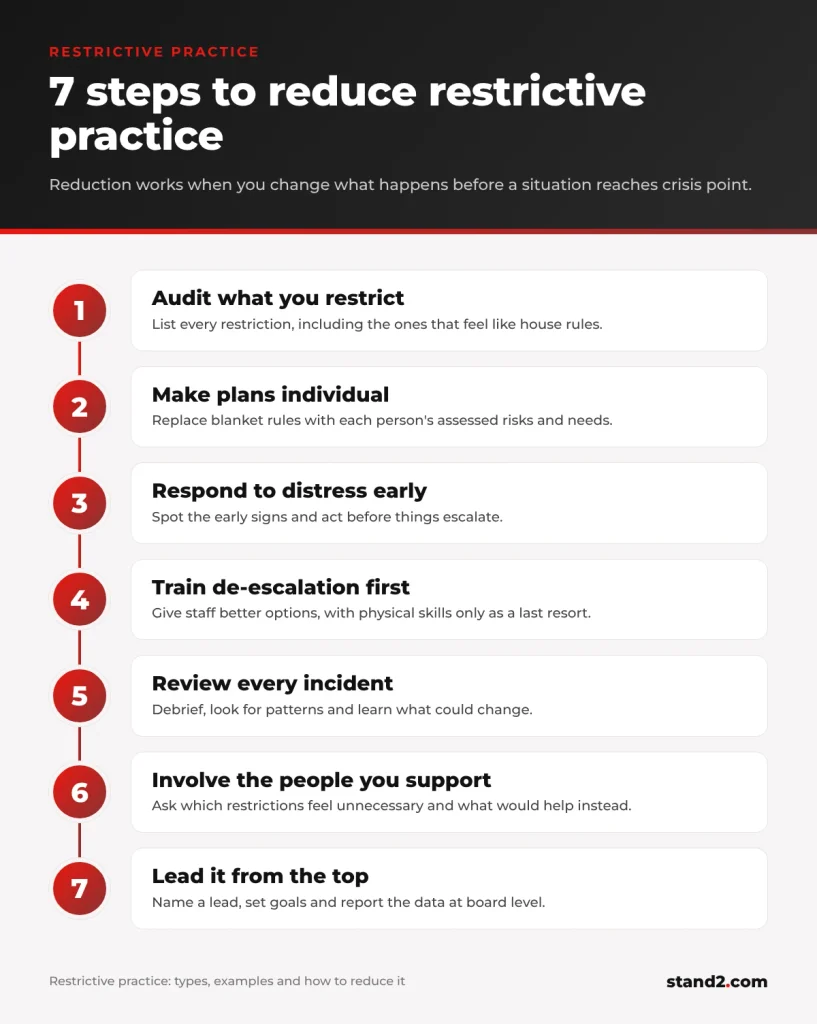
1. Find out what restrictions you actually use
Start with an honest audit. List every restriction in the service, including the ones that feel like house rules: locked doors, set mealtimes, kept-back items, default sensors, "as required" medication. For each one, ask: who is this for, what risk does it manage, and when was it last reviewed? Many blanket rules disappear at this stage simply because nobody can explain why they exist.
2. Make plans individual
Replace blanket rules with individual assessments. If one person is at risk of leaving unsafely, plan for that person rather than locking the door for everyone. Good plans also record what helps each person feel calm, what their early signs of distress look like, and how they prefer to be supported.
3. Respond to distress early
Most incidents that end in restraint start with something smaller: noise, pain, boredom, a change in routine, a request turned down. Staff who can spot early signs and respond calmly prevent far more incidents than they ever have to manage. That's why de-escalation sits at the centre of every serious restraint reduction approach.
4. Train staff in de-escalation first, physical skills second
Staff can only use the least restrictive option if they have options to choose from. Training should build confidence in communication, reading behaviour and de-escalation, with physical intervention taught as a last resort within that framework. The Restraint Reduction Network Training Standards set out what good training looks like, and many commissioners now expect them.
5. Review every incident and learn from it
After any restrictive intervention, ask what happened before it, what could have been done differently, and how the person and staff are doing. A quick, supportive debrief is worth more than a long form nobody reads. Then look for patterns: the same time of day, the same trigger, the same person. Patterns are where reduction happens.
6. Involve the people you support
People who experience restrictions are best placed to say which ones feel unnecessary and what would help instead. Patient and resident forums, like the ones CQC highlights on mental health wards, give people a real say in the rules they live under.
7. Lead it from the top
Reduction doesn't stick if it's left to frontline staff. CQC asks providers to look at restrictive practice data at board level or equivalent. A named lead, clear goals and regular reporting keep it from slipping back into old habits.
Bottom line
Restrictive practice covers far more than restraint. Every locked door, blanket rule and "as required" tablet is a restriction that needs a reason. The services that use the least are the ones that know exactly what they restrict and why, plan around individuals, and give their staff the skills to calm situations before restriction is ever on the table.
That starts with training. Our De-Escalation Training gives staff practical ways to spot distress early and bring situations down. Where physical skills are needed, our physical intervention training teaches them as a last resort, within a restraint reduction approach.
For Care, Health and Education Teams
De-escalation Training
Teaches staff to spot distress early and calm situations down, so restrictive practice stays a last resort. See what's covered and how to book.
Restrictive practice: frequently asked questions
What is the meaning of restrictive practice?
Restrictive practice means making someone do something they don't want to do, or stopping them doing something they want to do. It includes physical restraint, but also medication, locked doors, rules, surveillance and verbal pressure.
What are the five types of restrictive practices?
Different organisations group them differently, which is why you'll see lists of five, six, eight or more. The five most commonly named are physical, mechanical, chemical, environmental and psychological restraint. The Restraint Reduction Network adds cultural restraint, surveillance and blanket rules, making eight.
What are examples of restrictive interventions?
Restrictive interventions are the deliberate actions staff take to restrict someone in the moment. Examples include holding a person, rapid tranquillisation, seclusion, long-term segregation and mechanical restraint during a transfer.
What are some examples of restrictive practices in care?
Common examples in care settings include locked front doors, set times for meals and bed, bed rails used to stop someone moving, snacks and drinks kept out of reach, and "as required" medication used to calm someone rather than treat a condition.
Is restrictive practice illegal?
No, but it's only lawful when it's necessary to prevent harm, proportionate, the least restrictive option available, and used for the shortest time possible. Used as punishment, for convenience, or without proper assessment, it can breach a person's human rights.




 01952 928134
