

News & Resources
Everything You Were Taught About Betari’s Box Is Wrong (Except the Part That Matters)
TL;DR
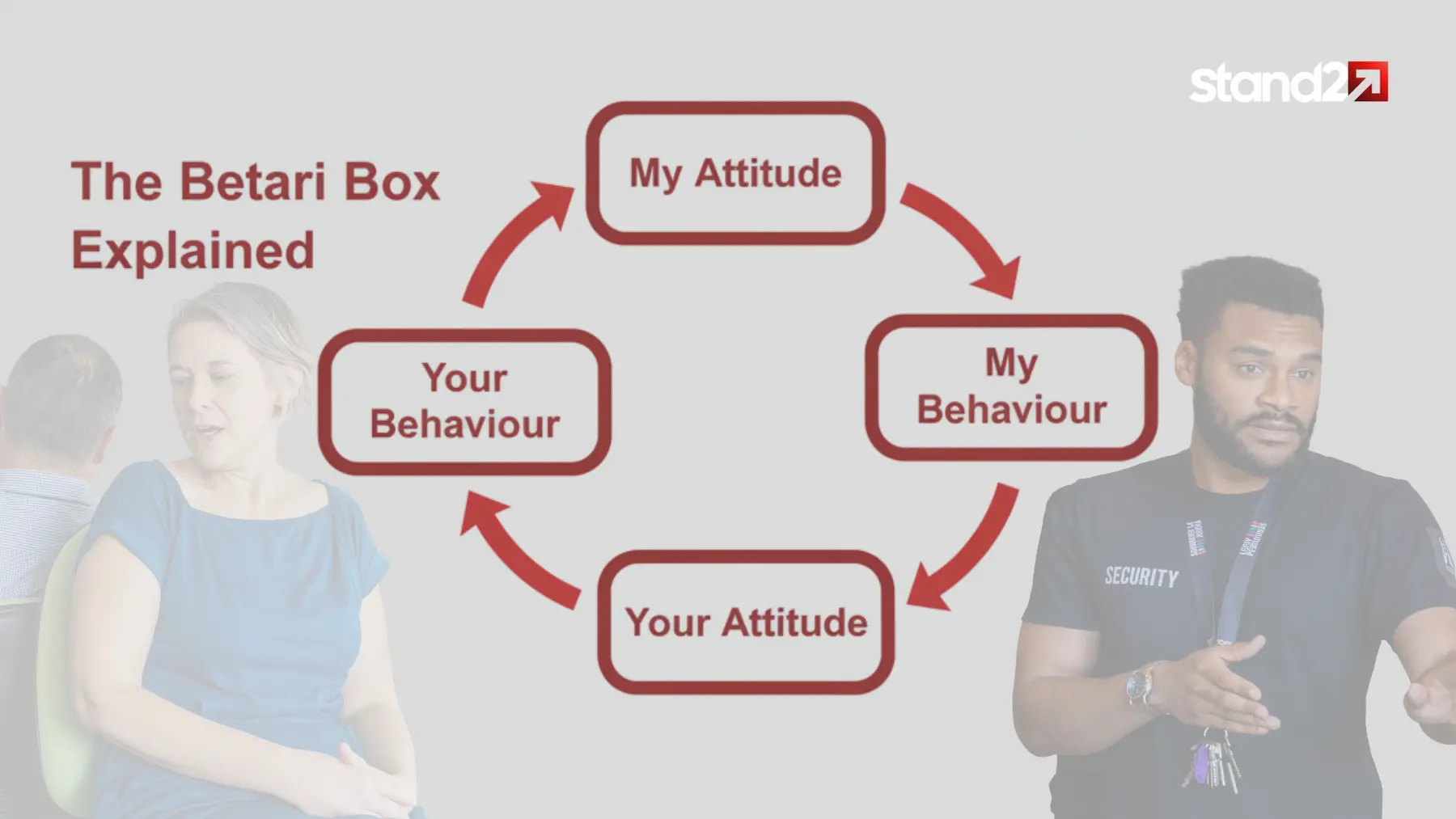
Betari's Box is a training model showing how your attitude shapes your behaviour, which shapes the other person's attitude, and so on - a cycle that can move in either direction. Its author is unverified, and several "facts" about its origin online are fabricated.
But the mechanism it describes is real, backed by research on emotional contagion, synchrony, and threat response, and it's the principle behind NICE guidance and the UK's restraint reduction training standards.
You might be wondering, "What exactly is the Betari box"?
To understand what it is and how it works, imagine the following scene.
It's 2-o-clock in the morning and an ambulance crew arrives at a property to treat a patient who is in pain, scared, and been left waiting for more than an hour.
The paramedic whose there to treat them is physically and emotionally exhausted; their shift should have ended three hours ago and they're still carrying the trauma of their last call to a young woman who'd been badly assaulted by her ex-boyfriend.
What happens in the next ten seconds, before a single clinical decision is made, often decides whether this call goes smoothly, or whether it escalates into something much harder to deal with.
This is the situation that a well-known training model called Betari's Box is supposed to explain.
It's a model that's taught widely on conflict management and de-escalation courses across the UK, reproduced on numerous HR and leadership websites (often labelled the Betari Box model), and even referenced in official policing guidance.
There's only one problem: it appears that nobody actually knows where it comes from, and when we researched the origin story ourselves we found that some of what's currently published is simply made up.
Here's what the model really says, where it actually came from, and - more usefully - the research that explains why it works.
What Is Betari's Box (And More Importantly, What Does It Actually Suggest)?
Betari's Box, sometimes referred to as Betari Box, Betaris Box, Betari's Box theory, or the Attitude and Behaviour Cycle - occasionally misspelled as Batari's Box - is a very simple modelused to explain how our attitudes and behaviour can affect our interactions with others.
When taken back to basics, the attitude and behaviour cycle looks something like this:
Stage 1: Your attitude shapes your behaviour - how you're feeling going into an interaction affects your tone, posture, and the words you choose to speak.
Stage 2: Your behaviour shapes the other person's attitude - they read your tone and body language and form an impression, consciously or not, within seconds.
Stage 3: Their attitude shapes their behaviour - how they're now feeling toward you comes out in what they say and do next.
Stage 4: Their behaviour shapes your attitude - and we're straight back to Stage 1, onto Stage 2, then Stage 3, then Stage 4, and so on.
Until something happens to break the cycle, the loop will continue, for better or for worse. Calm, measured behaviour tends to invite a calmer response, while aggression or defensiveness invites more of the same.
That exhausted paramedic who sighs and speaks sharply is, without meaning to, feeding the cycle.
It's a helpful way to visualise something every experienced frontline worker already knows intuitively. The question is: where did it come from, and does it hold up?
Where Does Betari's Box Actually Come From?
As ridiculous as it might sound the honest answer is...nobody knows!
While researching this article, the earliest trace we could find in any literature is a UK trainer discussion from 24 November 2000, on the industry forum TrainingZone, where a 'Geoff Williams' asked where the model came from and described it as something that "seems to have been around for years but no-one knows where it came from."
A couple of people replied to say they were also trying to find the origin - one suggested it originated in Israel - but they weren't sure.
Elsewhere, a training consultant's blog post recalls first meeting the model on a conflict resolution course "over 20 years ago", putting its use somewhere in the late-1990s training circuit, with nothing documented earlier.
MindTools and Toolshero, two of the more careful reference sources on this topic, both say the same thing plainly: the originator is unknown. MindTools even invites readers to get in touch if they know.
The reference book Key Management Development Models puts it simply: it's uncertain who "Betari" ever was.
Unfortunately, several other sources on this topic weren't quite as honest and they seem to have invented answers instead:
| The Claim | The Verdict |
|---|---|
| Created by psychologist Icek Ajzen in the 1980s | False - Ajzen is a real and well-respected psychologist known for the Theory of Planned Behavior. This is a completely different, unrelated model. The two are often confused because they both involve the words "attitude" and "behaviour." |
| Created by safety expert Frank E. Bird Jr, originally called the "Bayesian Box Model" | False - Bird was a real and influential figure in industrial safety, best known for a landmark 1969 accident-ratio study. He never created anything resembling Betari's Box, and the name "Bayesian Box" appears to be a fabrication that also misuses an unrelated statistical term. |
| Created by "Rolf Betari," a German management consultant | Fabricated - This claim appears on a single blog post with no supporting evidence anywhere else: a classic sign of invented content rather than documented history. |
| Named after a Persian city, or referenced in the Bible | Unsupported - No city called Betari exists in Iran. The nearest real name, "Betar," refers to an ancient Judaean town and a 20th-century youth movement; a different word, in a different country, with no credible connection to this model. |
So essentially then, Betari's Box is what's known in the training world as an orphan model, which means it's a fairly useful idea that's been handed down without anybody keeping track of where it actually started.
Fair enough, but let's not pretend we know where it comes from or invent fake sources.
The Science Behind the Cycle
Even though "Betari's Box" itself has no traceable author, the mechanism that it describes with attitudes and behaviours reinforcing each other between two people, is genuinely well studied, albeit under a host of different names.
Anyone who's been taught Betari's box will have heard that line.
The psychologist who actually did the work behind it is Icek Ajzen, a Polish social psychologist and professor emeritus at the University of Massachusetts. As we found above, it's often his name that gets wrongly attached to Betari's Box itself.
His real contribution was the Theory of Planned Behaviour (1991), now one of the most tested models in social psychology. It says your intention to act comes down to three things: how you feel about the action, how much you think the people around you expect you to do it, and how much control you feel you actually have over doing it.
That third ingredient, perceived control, wasn't in Ajzen's original model. He added it later because his first attempt kept failing to predict behaviours people don't fully choose freely, things like losing weight, or staying calm under pressure.
Even with that fix, intention still has a limit.
Once attitude, social pressure and perceived control combine into an intention, how well does that intention actually predict what someone does? A landmark 2002 review pooled ten earlier meta-analyses - 422 studies, over 82,000 people - and found the answer: 28%.
Intention only accounts for about a quarter of the variance in what people actually go on to do.
What does that mean in practice?
It means knowing someone's attitude, and even knowing what they genuinely intend to do, only gets you so far in predicting how they'll behave in the moment.
Researchers have a name for the people who fall into that gap. They're called "inclined abstainers" - people who fully intend to do the sensible thing and then, in the moment, don't. The same review found people only follow through on their own good intentions about 53% of the time. Barely better than a coin flip.
For anyone working in conflict management, that's not a depressing statistic. It's the whole point of what we teach. It's exactly why "just stay calm" falls apart under real pressure, because intention alone was never going to be enough.
Attitude and intention aren't enough on their own. Which is where the next three pieces of research come in.
Emotions really are contagious.
The closest genuine scientific match for the Betari cycle is a well-established phenomenon called emotional contagion.
This is the tendency to unconsciously mirror another person's expressions, tone, and posture, and, as a result, we start to feel what they're feeling.
The concept of emotional contagion was first formally described by psychologists Elaine Hatfield, John Cacioppo, and Richard Rapson in the early 1990s. Since then, it's become a mature area of research, with a 2025 review examining nearly 300 studies published on the topic since 1992.
And it's because of that body of research that we've been able to measure how fast emotional contagion happens - and it's faster than you'd think possible.
In one well-known study, participants were shown photos of angry and happy faces for just 30 milliseconds each, faster than the blink of an eye, before the image was immediately swapped for a neutral one.
That's nowhere near enough time to consciously register what they'd seen. Yet sensors attached to their faces picked up their own muscles mimicking the expression. Their conscious mind had no idea what it had just looked at but their face reacted to it regardless.
This is arguably the real science behind Betari's Box. The paramedic's tension can transfer to the patient without either person choosing it, and it can happen faster than either of them can consciously control.
This works both ways of course.
Calm emotions transfer the same way anxious emotions do, which is why its so important to regulate yourself.
This isn't just good advice, the science shows it has a measurable effect on the person standing in front of you.
We synchronise with the people around us.
Related research on interpersonal mimicry and synchrony shows that when two people's movements, pace, or tone either naturally align or are deliberately matched, it tends to increase trust, rapport and cooperation.
Some of the evidence for this is a bit strange.
In one well-cited study, researchers had complete strangers either walk in step together, or walk normally, then they measured how cooperative they were straight afterwards in an unrelated task that came with a personal cost.
It turned out that the pairs who'd walked in synchrony cooperated more, even when it meant sacrificing something of their own, and the effect was observed even when the synchrony hadn't made anyone feel any happier about it.
That shared rhythm impacted behaviours without anyone consciously deciding to trust the other person more.
In conflict management, it's important to understand that synchrony can have negative effects as well as positive.
For example, by bonding people together, it can increase obedience to a leader or create hostility toward outsiders. For de-escalation specifically, this is why deliberately slowing your own pace and lowering your voice in a tense interaction is an important mechanism, because there's real evidence behind it.
And, as the research shows, it appears to work even when the other person has no idea you're doing it.
Threat changes how the brain processes a situation.
There's also an interesting neuroscience angle to Betari's box, although we often see it being oversimplified a lot in training.
At the heart of it are two brain structures that help to explain why a tense interaction can escalate so quickly, and why calm can spread just as quickly once it takes hold.
In simple terms, one structure sounds the alarm, while the other decides how much say that alarm actually gets.
The first of these is the amygdala; a small, almond-shaped structure buried deep in the temporal lobe, roughly level with each ear. The name actually comes from the Greek word for almond, after its shape, and you've got two of them, one in each hemisphere.
Their job is to act as our early-warning system.
They scan incoming sensory information for anything that might signal danger, and when something looks threatening, they trigger the body's fight-or-flight response, releasing stress hormones like adrenaline and cortisol before you've had time to consciously think about what's happening.
The amygdala plays a central role in detecting threat, and when it's highly active, it becomes harder to think clearly or listen well.
The second is the prefrontal cortex, which sits right at the front of the brain, roughly behind your forehead. It's responsible for what psychologists call "executive function", like reasoning, planning, weighing up consequences and reining in impulsive reactions.
A specific part of it, sitting just above and behind the eyes, has direct connections down into the amygdala and can act a bit like a brake pedal, calming that threat response back down.
Among its many other tasks, the prefrontal cortex is the part of the brain responsible for reasoning and self-control and it works to keep that threat response in check. However, it needs a sense of safety to do its job properly, and feeling respected and heard supports that regulation, while feeling judged or dismissed undermines it.
This brake-pedal relationship is often simplified in training into a single catchy phrase: the "amygdala hijack".
The idea advanced in some training circles is that the amygdala simply takes over and switches off rational thought altogether. The history of this simple idea follows the same pattern as everything else in this article. It was coined in 1995 by Daniel Goleman, a psychologist and journalist, not a neuroscientist, who built it on the early work of neuroscientist Joseph LeDoux.
Then, as it began to spread, the underlying research moved on.
LeDoux later distanced himself from the idea that the amygdala single-handedly "hijacks" an otherwise rational brain, and in 2021 Goleman published a piece of his own titled "Let's Retire the 'Amygdala Hijack'", acknowledging that the neuroscience it was built on had been updated.
To be clear, the underlying mechanism is genuine.
Under acute stress, the brain releases a surge of chemicals called catecholamines, including noradrenaline and dopamine. These chemical messengers are close relatives of adrenaline.
At the low-to-moderate levels you get in everyday life, these chemicals actually help the prefrontal cortex do its job.
But under high stress, the surge gets big enough to tip into the opposite effect: it disrupts the firing patterns that prefrontal cortex neurons need to sustain calm, effortful thinking, effectively turning that part of the brain down. At the very same time, and through the very same chemicals, the amygdala's activity gets turned up, making it faster and more dominant.
So it's not that one part of the brain mysteriously "switches off" while another "takes over", rather it's a specific, measurable chemical process, where a single chemical surge simultaneously weakens your capacity for deliberate thought and sharpens your capacity for fast threat detection.
And it can happen within seconds of feeling threatened.
The "total takeover" story is the part that's inaccurate, not the underlying science, and that distinction actually matters in a real tense moment. Your prefrontal cortex isn't offline. It's working under load and in a high stress conflict situation simply giving someone a bit of time, fewer decisions to make, and a sense of safety helps bring it back online.
Put all this together, and it really doesn't matter whether "Betari" was ever a real person because the underlying psychology stands on its own.
Why This Actually Matters
Everything we covered above, contagion, synchrony, the amygdala and prefrontal cortex, isn't just interesting psychology.
It's the reason the UK's entire approach to managing violence and aggression is built around getting in early, before a situation becomes physical.
NICE guidance on managing violence and aggression in health and care settings (NG10) makes this the first-line response: verbal and non-verbal de-escalation before anything else, with organisations required to actually train their staff in it, not just have a policy that says they should.
The strongest evidence that this works comes from the Safewards model, developed by Professor Len Bowers at King's College London.
A cluster randomised controlled trial across 31 mental health wards found that implementing Safewards reduced conflict events by around 15% and the use of containment measures by over 23%.
It's one of the few genuinely rigorous trials in this field, and what it proves is exactly the Betari cycle in practice: conflict and coercion feed each other, and interrupting staff behaviour, not the patient's, is consistently the most effective place to break that loop.
That evidence is why the principle is no longer just good practice, it's now law.
Since April 2020, under what's known as Seni's Law (the Mental Health Units (Use of Force) Act 2018), any training used in England's NHS mental health inpatient units has to meet the BILD Restraint Reduction Network Training Standards; prevention and de-escalation before reactive physical technique, not the other way around.
Further UK trials add weight to the same picture.
The EDITION feasibility study and the REsTRAIN YOURSELF programme, run across hospitals in North-West England, both found measurable reductions in restraint following de-escalation-focused training, although the evidence base is still developing and results vary a lot depending on how well a programme is actually delivered on the ground.
And importantly, the College of Policing also references Betari's Box in its official conflict management guidance for UK forces, alongside other communication frameworks.
Whatever its murky beginnings, it's earned a legitimate place in serious operational training. We think it just deserves to be taught with an accurate history behind it, not an invented one.
The Same Ten Seconds, Two Ways
Back to that ambulance call from the start of this piece.
Both versions of this paramedic want the same outcome. Nobody arrives at a callout hoping to make it worse. But as we've just covered, wanting to stay calm only predicts about 28% of what actually happens next. Everything from the moment they reach the door onward relies on their training and how they put it into practice.
Response one
The paramedic, running on empty, walks in briskly, doesn't fully make eye contact, and opens with, "Right, what's going on then?" in a clipped tone.
That tone isn't a decision, it's fatigue leaking out before the prefrontal cortex has had a say.
The patient, already anxious, doesn't consciously register "impatience" so much as pick it up the way the 30-millisecond face studies describe: their own expression starts mirroring the tension in front of them before they've had time to think about it.
They become more agitated, repeat themselves louder, and the crew now has a harder job than the one they arrived to do.
Betari's cycle is running, but it's running in the wrong direction.
Response two
Same paramedic, same fatigue, same time pressure.
But they take two seconds at the door - a breath, a slight drop of the shoulders - before starting with, "I can see you've been in a lot of discomfort. Let's get you sorted."
That two-second pause is the brake pedal doing its job: giving the prefrontal cortex a moment to catch up before the catecholamine surge tips into a rushed, clipped opening.
The slower pace and dropped shoulders aren't just "seeming calm" either, they're the synchrony effect at work, giving the patient's nervous system a slower rhythm to fall into rather than a tenser one to match.
Nothing about the clinical situation changed between the two versions.
What changed was one opening, and three separate mechanisms, contagion, synchrony, and a two-second pause for the brake pedal to engage, are what decided which direction the next ten minutes went in.
The Cycle in Five Everyday Moments
Betari's Box isn't only useful in an ambulance callout. The same loop plays out numerous times a day, in situations far more mundane than a frontline emergency. Here's what it looks like in five of them, and the science sitting underneath each one.
1. Walking through the door after a bad day
You get home shattered after a long and hard shift at work. Your partner, entirely reasonably, asks you to take the bins out. Your instinct is to sigh, snap something short, and stomp off to do it.
That sigh isn't really about the bins. Under sustained stress, your catecholamine levels are still elevated, and the prefrontal cortex doing the job of staying measured and patient is running on less than it needs. Your attitude (frazzled and depleted) leaks straight into your behaviour (curt and short), and your partner reads that behaviour and forms an attitude of their own within seconds. They're hurt, or annoyed right back. Their reply lands with an edge, and now you're both irritated over bin day.
Naming the actual feeling before you speak - "sorry, today wrecked me, give me five minutes" - can help to break the loop at Stage 1, before your depleted attitude gets the chance to shape a behaviour your partner has to react to.
2. A toddler mid-meltdown
Your three-year-old is screaming on the supermarket floor. Your own heart rate spikes, your voice sharpens, and you find yourself matching their volume before you've decided to.
This is emotional contagion doing exactly what the research describes. The distress is genuinely, physiologically catching, and a raised child's voice can pull a raised response out of you faster than you can consciously stop it. The trouble is, your child is picking up your rising tension the same way, which is what keeps the meltdown going rather than winding it down.
Dropping your own volume and slowing your movements, even though everything in you wants to match their energy, gives the child something calmer to attach with instead of something more heightened.

3. Giving a colleague difficult feedback
You've planned exactly how this conversation will go. You want it to be calm, constructive, fair. Then you're two sentences in, you tense up, your tone sharpens slightly, and the conversation you'd intended to have isn't the one that's actually happening.
This is the gap between intention and behaviour from earlier in this article; good intentions only predict what you'll actually do a fraction of the time, especially under social pressure. Planning what you'll say isn't enough on its own; your tone, pace, and posture are doing their own independent work on the other person's attitude, regardless of how well-intentioned your opening line was.
Slowing your pace deliberately, rather than trusting the plan to hold under pressure, is what actually keeps the loop from tipping the wrong way.
4. An impatient customer at the counter
Someone's waited too long and arrives at the till already annoyed, arms crossed, voice clipped. The easy response is to match that energy back; clipped answers, a slightly defensive tone of your own.
This is where the synchrony research comes in. Two people don't need to agree on anything for a calmer pace and softer tone to start pulling an interaction toward cooperation rather than confrontation. The shared rhythm we covered earlier can work on its own, separate from anything either person actually says.
Slowing down and lowering your own tone, even slightly, gives the other person's attitude somewhere calmer to land rather than something to bounce off.
5. Someone cuts you off in traffic
Your body reacts before your mind does. You clenched your jaw and move your hand over the horn, over something that, five minutes later, won't matter at all.
That's the amygdala's fast pathway doing exactly what it evolved to do: reacting to a perceived threat before the prefrontal cortex has had a chance to weigh in. It's not a character flaw, it's a few hundred milliseconds of biology. The loop here isn't even between two people yet, it's the first link in the chain, your attitude shaping your own next behaviour, before anyone else is even involved.
The moment you notice the reaction rather than act on it - a breath, a beat before the horn - is the same brake-pedal mechanism from earlier doing its job, buying just enough time for the rest of the loop to run in a better direction.
Where This Leaves Us
Betari's Box has no verified author, and several of the "facts" currently published about it online are simply invented, namely, a psychologist who never created it, a safety expert who never named it, and a consultant who doesn't appear to exist outside of a single uncorroborated blog post.
In spite of all this, the mechanisms it points to are sound.
Attitudes and behaviour genuinely do ripple between people, and that's backed by real, citable research on emotional contagion, interpersonal synchrony, and how the brain processes threat versus safety.
That mechanism isn't just an interesting bit of psychology, it's the same principle underpinning NICE's guidance on managing violence and aggression, the Safewards model that measurably reduced conflict and containment across UK psychiatric wards, and the BILD Restraint Reduction Network Training Standards that now govern restraint training across England's NHS mental health units. Even the College of Policing cites it in official conflict management guidance for UK forces, proof that, whatever its murky beginnings, the underlying idea has earned a genuine place in serious frontline practice.
It's the same lever at work whether you're managing a lone working visit safely or supporting a call handler through a difficult interaction: you can't control the other person's attitude directly, but your own behaviour is consistently the strongest lever you have over which direction the interaction moves in.
Knowing the mechanism is one thing.
Being able to use it under real pressure, when your own catecholamines are already rising and the two-second pause is the hardest thing in the world to find, is another.
That's what our De-Escalation Training is built around: turning the theory in this article into something your team can actually reach for in the moment, not just recognise afterwards.
For staff who face this cycle as a regular part of the job rather than an occasional one, our Managing Challenging Behaviour Training builds the skills to recognise the loop early and consistently break it before it escalates.
Betari's Box: frequently asked questions
What does Betari's Box suggest?
Betari's Box suggests that attitude and behaviour move in a continuous loop between two people: your attitude shapes your behaviour, your behaviour shapes the other person's attitude, and their resulting behaviour loops back to affect you again - in either a positive or negative direction.
Who created Betari's Box?
Nobody knows. The earliest documented reference dates to a UK trainer discussion in 2000, where it was already described as an untraceable, long-circulating idea. Claims that it was created by Icek Ajzen, by Frank E. Bird Jr, or by a consultant named "Rolf Betari" are all false or unsupported.
Is Betari's Box a real, scientifically validated psychological theory?
Not as a formally tested model in its own right - it's best understood as a training heuristic rather than an academically sourced theory. The mechanism it describes is, however, well supported by genuine research on emotional contagion, interpersonal synchrony, and threat neuroscience.
Does the College of Policing actually use Betari's Box?
Yes. It's referenced in the College of Policing's official conflict management guidance for UK police forces, alongside other communication models used in frontline training.
Why does Betari's Box matter for conflict management and restraint reduction training?
Because the same cycle it describes sits behind the UK's evidence-based approach to reducing physical restraint: NICE guidance, the Safewards model, and the BILD Restraint Reduction Network standards are all built on the principle that staff behaviour is often the most effective lever for interrupting escalation before it reaches the point of physical intervention.




 01952 928134