























































Level 01 – De-Escalation
De-escalation Training
for Schools
De-escalation training for schools that gives teachers, teaching assistants and support staff a shared, calm way to respond when a pupil or parent starts to escalate. A practical half-day session, delivered face to face in your school and timed around your timetable or an INSET day.
- In person
- Standpoint
- Affiliated Trainer Programme
- OBSERVATION
- PARTICIPATION
- DISCUSSION

•01COURSE OVERVIEW
What our de-escalation training for schools covers

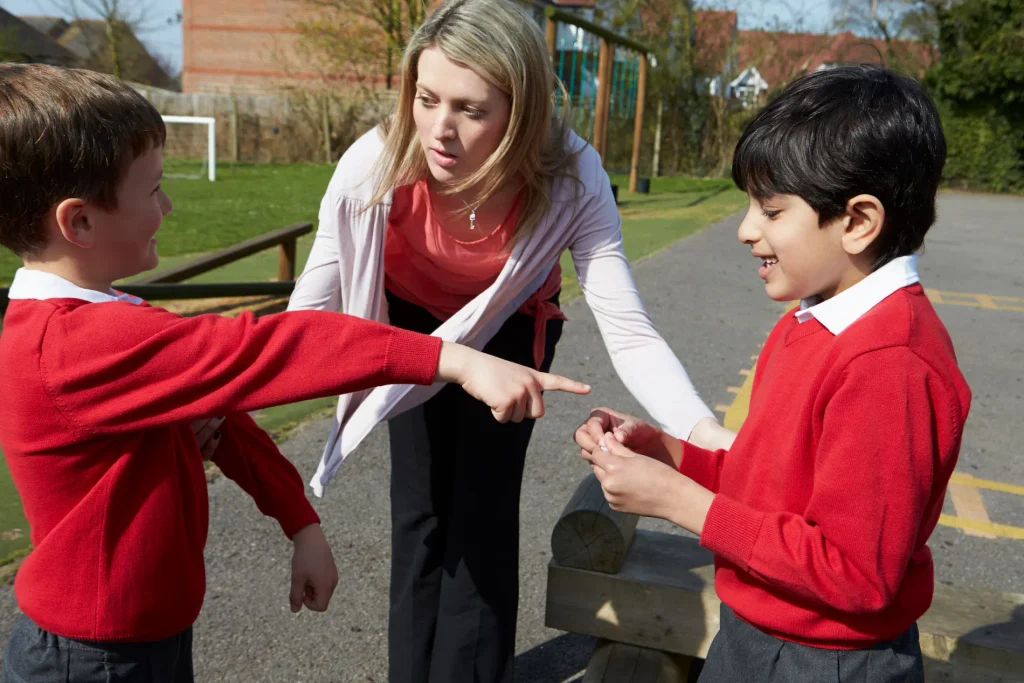
Most incidents in school don’t begin as a crisis. A pupil is asked to put a phone away, moved seats or kept behind, or a parent hears their child has been sanctioned. What the adult says and does in the next minute often decides whether it settles or escalates.
It works as de-escalation training for teachers and for every other adult in school. Staff learn to notice the early signs that a pupil is struggling, adjust their tone, words and body language, and offer a clear choice instead of a confrontation. They practise classroom and corridor flashpoints, angry parents at the gate or reception, and abusive calls and emails to the school office. Every session is built around your behaviour policy, your age range and your pupils, from a primary school to a secondary academy or alternative provision.
This is a verbal course and does not cover physical intervention. For staff who may need to physically intervene with a pupil, we offer Positive Handling for Schools Essentials (one day) and Positive Handling for Schools Intervention (two days). Many schools train every adult in de-escalation, then add the longer courses for the staff who need them.
How this training helps your school, your staff and your pupils
-
One approach across the school.
-
Fewer incidents that escalate.
-
A clear record for governors.
-
Better support for pupils with additional needs.
-
Incidents recorded properly.
-
Confident new and support staff.
•03.RISKS ADDRESSED
Where a school day turns difficult
School staff manage behaviour all day, often with thirty pupils watching and seconds to decide. Without training, staff may:
The good news is that this is entirely preventable. That’s what this course is for.
Learning outcomes: what your team will be able to do
- 01 Recognise the three types of risk in school.

- 02 Spot the early signs that a pupil is anxious, frustrated or close to crisis.
- 03 Understand common causes of distressed behaviour, including unmet needs, SEND and difficult experiences at home.
- 04 Check their own assumptions so their responses to pupils stay fair and consistent.
- 05 Use tone, body language and where they stand to lower tension instead of raising it.
- 06 Offer clear, limited choices that let a pupil back down without losing face.
- 07 Give instructions and sanctions calmly, in line with the school's behaviour policy.
- 08 Manage a refusal or outburst in class while keeping the rest of the group settled.
- 09 Handle corridor, playground and lunchtime flashpoints between pupils.
- 10 Calm an angry or upset parent at the gate, at reception or in a meeting.
- 11 Manage abusive phone calls and emails, and know when and how to end them.
- 12 Know when to step back, hand over to a colleague or call for senior support.
- 13 Record and report incidents accurately for pastoral and safeguarding follow-up.
- 14 Recognise the impact of difficult incidents on themselves and colleagues, and know where to get support.
FUEL Independent School – Alternative Provision, Nottingham
FUEL teaches young people who have been excluded from mainstream school, or are close to it, across two sites in Nottingham. Classes are small and often take place in workshops or out in the community, and many pupils arrive having already had school break down for them once.
Stand2 trains FUEL’s teaching and support staff on an ongoing basis, with refreshers as new staff join. De-escalation sits at the centre of every session: noticing early when a pupil is starting to struggle, and calming things down before they reach a crisis. That keeps physical intervention for the rare moments it is genuinely needed.
Delivered in your school, around your behaviour policy
Delivery: Face to face in your school, through discussion, short communication exercises and scenarios drawn from your own pupils and spaces. Up to 12 staff per trainer, with supporting materials on StandPoint, our online learning platform.
Assessment: No written exams. Trainers assess each delegate through observation, participation and discussion during the exercises.
Certification: Each delegate who completes the course receives a uniquely numbered Stand2 certificate and is added to the Stand2 Training Register, so the school can see who is trained and when a refresher is due.
Training environment: Trauma-informed, with clear opt-outs and no physical activity. No one is asked to do anything they’re uncomfortable with.
Can’t find what you’re looking for? Call us or drop us a message.
Is de-escalation training for schools a legal requirement?
Who should attend?
Does the course cover physical intervention?
Is this de-escalation training for teachers only?
Can you run it on an INSET day?
How many staff can attend?
Is it suitable for primary, secondary, special schools and alternative provision?
Do your trainers have DBS checks?
How often should staff refresh this training?
Do staff get a certificate?
Tell us about your school, how many staff you’d like to train and the behaviour they’re dealing with, and we’ll recommend the right course and send you a quote.
If you’re responsible for staff safety, service quality, or organisational compliance, we can help.
"*" indicates required fields