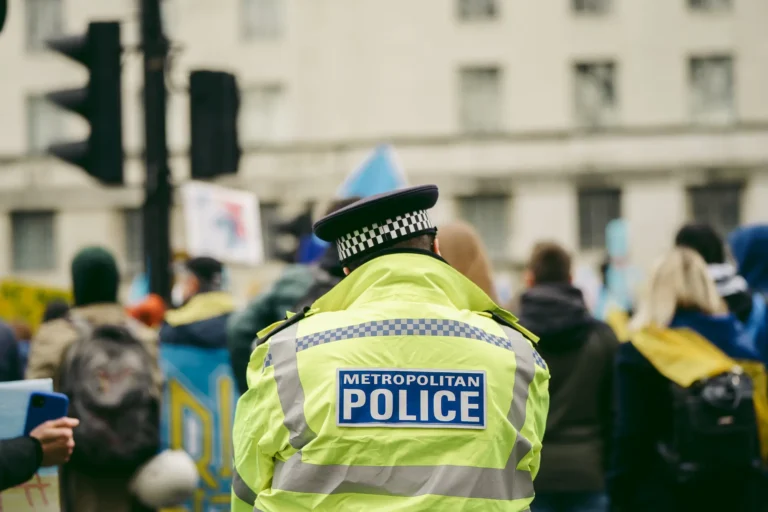

level 04 – protest management & safety
Advanced Protest Management
for Housing, Local Authority & Community Services
(2 Day)

Practical, two-day training for local authority and community teams whose sites may require safe physical options during protest activity. Built for facilities, security and front-of-house staff working across council premises and community buildings, it builds safe positioning, coordinated movement and defensible decision-making – without escalating risk.
- In person
- Standpoint
- Affiliate Trainer Programme
- OBSERVATION
- PARTICIPATION
- SCENARIO DISCUSSION
- REFLECTION
•01COURSE OVERVIEW
Building on the foundations of the 1-day programme to add safe, non-harmful physical safety options for local authority, housing and community teams operating in premises and public-facing sites affected by protest activity.

This two-day programme extends the awareness, communication, and decision-making skills developed at Level 4 to include non-harmful physical safety manoeuvres and coordinated team movement for use in exceptional circumstances – such as safely managing entry, exit or crowd pressure at council premises, community centres, or high-profile public buildings. Participants learn safe positioning, controlled withdrawal, and team coordination techniques – not enforcement tactics – aligned with legal, ethical, and organisational boundaries.
The course is suitable for local authority and community service teams whose staff may face situations where physical safety options are necessary to protect themselves, colleagues, or the public at council-run sites, civic buildings, or high-profile community venues.
Every programme is preceded by a Training Needs Analysis to confirm the physical elements are appropriate, proportionate, and defensible for your specific environment. All physical techniques are independently medically reviewed and risk assessed.
How this training helps your organisation
-
Provides safe, non-harmful options for council and community staff where withdrawal, positioning, or movement is required at protest-affected sites
-
Improves coordination and role clarity for local authority teams during higher-pressure moments
-
Reduces risk of injury and reputational exposure for councils and housing providers
-
Strengthens defensibility, safeguarding, and auditability for governance and regulatory scrutiny
-
Enhances scenario-based readiness for complex council premises and community sites
•03RISKS ADDRESSED
Without specialist preparation, staff may:
The good news is that this is entirely preventable. That’s what this course is for.
Here’s what your staff will be able to do differently:
- 01 Explain the legal, ethical, and organisational frameworks that govern staff actions in protest environments.

- 02 Describe the roles, responsibilities, and limitations of personnel operating within protest‑affected areas.
- 03 Identify behavioural, environmental, crowd‑related, and medical indicators that influence risk levels.
- 04 Maintain situational awareness and conduct dynamic risk assessments before and during protest activity.
- 05 Recognise likely protestor tactics and assess how they may affect safety and decision‑making.
- 06 Use structured communication and engagement strategies to support safety and reduce tension.
- 07 Maintain professional boundaries while managing challenging or emotionally charged interactions.
- 08 Regulate personal stress and emotional responses to remain effective under pressure.
- 09 Make proportionate, defensible decisions that remain within organisational role boundaries when facing uncertainty or escalating conditions.
- 10 Work effectively as part of a team to enhance safety and operational effectiveness.
- 11 Coordinate team positioning, movement, and withdrawal in a manner that prioritises safety and least‑restrictive practice.
- 12 Apply non‑harmful physical safety options consistent with least‑restrictive principles.
- 13 Use safe disengagement methods when appropriate.
- 14 Follow organisational procedures for escalation, safeguarding, and incident reporting.
- 15 Record information accurately to support accountability, safeguarding, and governance requirements.
- 16 Reflect on personal performance and identify opportunities to improve practice in protest‑related operations.
Global Technology Leader – Multi-Region Corporate Campuses
Stand2 delivered a 2-day programme to security staff operating across multiple high-profile technology campuses worldwide. Sites included research and development facilities, critical data infrastructure, and large public-facing offices supporting digital services such as global search, cloud computing, and AI applications, with substantial visitor and employee traffic.Â
Training focused on proportionate, non-harmful movement, safe positioning, and controlled withdrawal within organisational policy boundaries. Teams reported improved coordination during complex scenarios, clearer decision-making under pressure, and stronger alignment with global standards for safety, ethics, and least restrictive practice – supporting consistent protection of staff, visitors, and critical organisational assets across multiple regions.
Two days of structured training – combining protest awareness, physical safety options, and scenario-based application built around your environment.
Delivery
This two-day programme is delivered in person through structured theoretical input, supervised practical work, and scenario-based application relevant to protest-affected operations. Every programme is preceded by a Training Needs Analysis to ensure the physical elements are appropriate, proportionate, and directly relevant to your sites, operational risks, and partner agency requirements. StandPoint, our online learning platform, supports the programme with additional resources and materials.
Medical review
All physical safety techniques taught on this programme are independently medically reviewed and fully risk assessed before delivery. This ensures every technique is safe, proportionate, and appropriate for the civilian and corporate environments this programme serves.
Assessment
Learning is assessed through observation, participation, and demonstration of techniques in controlled conditions. Assessment is continuous and practical – based on how staff apply what they’ve learned in realistic scenario exercises.
Certification
Every participant who successfully completes the programme is formally certified by Stand2, receiving a uniquely numbered certificate that confirms they have met the programme’s assessed standards. Each delegate is entered onto the Stand2 Training Register, which we maintain on your behalf – giving your organisation a clear, auditable record of who has been trained and when refresher training is due.
Training environment
All practical elements are delivered with clear consent, opt-out options, and trauma-informed facilitation throughout. Psychological and physical safety are prioritised at every stage of delivery.
Can’t find what you’re looking for? Call us or drop us a message.
Are enforcement or public order tactics taught?
What physical skills are included and how do you ensure they remain non-harmful?
Is a Training Needs Analysis required for this course?
Do participants need to complete the 1-day course first?
Can the physical elements be built around our specific site layout and operational challenges?
Will this training help us meet our legal responsibilities if movement or withdrawal is required?
How do we know the physical techniques won't conflict with our policies or partner agency instructions?
What sectors is this course suitable for?
Does Stand2 training come with a certificate?
How often should staff refresh this training?
If your sites require safe, non-harmful options for protest-affected operations – delivered to a consistent, defensible standard – we can help.
"*" indicates required fields