
Level 02 – Conflict Management

Conflict Management & Personal Safety Training for Councils

Conflict management training for councils that gives your public-facing staff the skills to calm difficult situations and keep themselves safe. Delivered at your council offices, built around the people your staff deal with every day.

Stand2’s most popular programme.

Duration 6 Hours
Delivery Methods
  • In person
  • Standpoint
  • Affiliate Trainer Programme
Assessments
  • OBSERVATION
  • PARTICIPATION
  • DISCUSSION
  • COACHING
Smiling during training

•01COURSE OVERVIEW

What our conflict management training for councils covers

Council staff are often the first point of contact when residents are frustrated. A complaint about bins at the town hall counter, a dispute over a parking ticket, an argument in the park or a heated public meeting can all turn quickly. This course gives staff a clear, practised way to handle those moments.

The focus is on the public, not internal disputes. Staff learn to spot the early signs of escalation, use calm and structured communication, and set clear boundaries. Where there is a risk of physical harm, they also learn safe positioning, how to withdraw and simple breakaway skills. Everything is built around your council’s roles, buildings and policies, from a small town council team to a district council’s frontline services.

• 02 THE IMPACT

How this training helps your council

  • Staff who know what to do. Office, outdoor and lone-working staff follow the same approach, so residents get a consistent response.
  • Fewer incidents that escalate. Most situations are calmed at the counter, on the phone or on site, before they need police or a formal complaint.
  • Evidence of your duty of care. Trained staff and a recorded approach to conflict support your health and safety risk assessment, and give councillors and auditors a clear record.
  • Safer lone working. Groundstaff, rangers and tourist information staff learn to judge risk when no one else is around.
  • Better incident records. Staff know what to record and how, so incidents can be reviewed, reported and acted on.
  • Confidence for part-time and small teams. Practical skills that stick, even for staff who only face conflict now and then.
Wrist grabbing training

•03.RISKS ADDRESSED

Where council work turns difficult

Council staff deal with people at their most frustrated, often in public and sometimes alone. Without training, staff may:

Checklist icon Argue back with an angry resident at the counter and make it worse
Checklist icon Feel unsure how to end an abusive phone call or email exchange
Checklist icon Be caught off guard by aggression in a park, cemetery or market
Checklist icon Struggle to keep control when a member of the public disrupts a meeting
Checklist icon Work alone at a tourist information point or outdoor site with no plan if things go wrong
Checklist icon Leave incidents unrecorded, so the council can’t spot patterns or support staff

The good news is that this is entirely preventable. That’s what this course is for.

• 04 LEARNING OUTCOMES

Here’s what your staff will be able to do differently:

Recognise the three types of risk council staff face
• 04 LEARNING OUTCOMES

Here’s what your staff will be able to do differently:

  1. 01 Recognise the three types of risk council staff face
  2. 02 Spot the early signs that a resident’s frustration is turning into aggression.
  3. 03 Assess risk before and during contact, at the counter, on a site visit or out in a park.
  4. 04 Apply structured, evidence-based communication techniques to reduce tension and maintain control of interactions.
  5. 05 Set and maintain professional boundaries that support safety and reduce the likelihood of escalation.
  6. 06 Describe the hierarchy of responses, emphasising prevention, deescalation, and last resort physical contact.
  7. 07 Maintain professional standards during conflict.
  8. 08 Make proportionate, defensible decisions when faced with challenging or aggressive behaviour.
  9. 09 Understand the legal, ethical, and organisational frameworks that guide safe and appropriate responses.
  10. 10 Perform low-level breakaway skills designed to release from common, low risk grabs or holds and create safe space to withdraw.
  11. 11 Use physical skills in a controlled, proportionate manner consistent with training, policy, and the principles of least restrictive practice.
  12. 12 Implement safe withdrawal strategies and know when to disengage or seek support.
  13. 13 Work effectively as part of a team.
  14. 14 Record and report incidents accurately to support safeguarding, organisational learning, and risk management.
  15. 15 Reflect on their own responses and identify opportunities for continuous improvement in both communication and personal safety practice.
05 CASE STUDY

Wymondham Town Council: Public Facing Staff

Wymondham Town Council asked Stand2 to train its team. That covered office staff, groundsmen and tourist information assistants who often work alone. Several staff work part time, so the session was built as a half-day course delivered in the council chamber, around the situations each role faces: complaints at the front desk, encounters on open spaces, and lone working at the tourist information point.

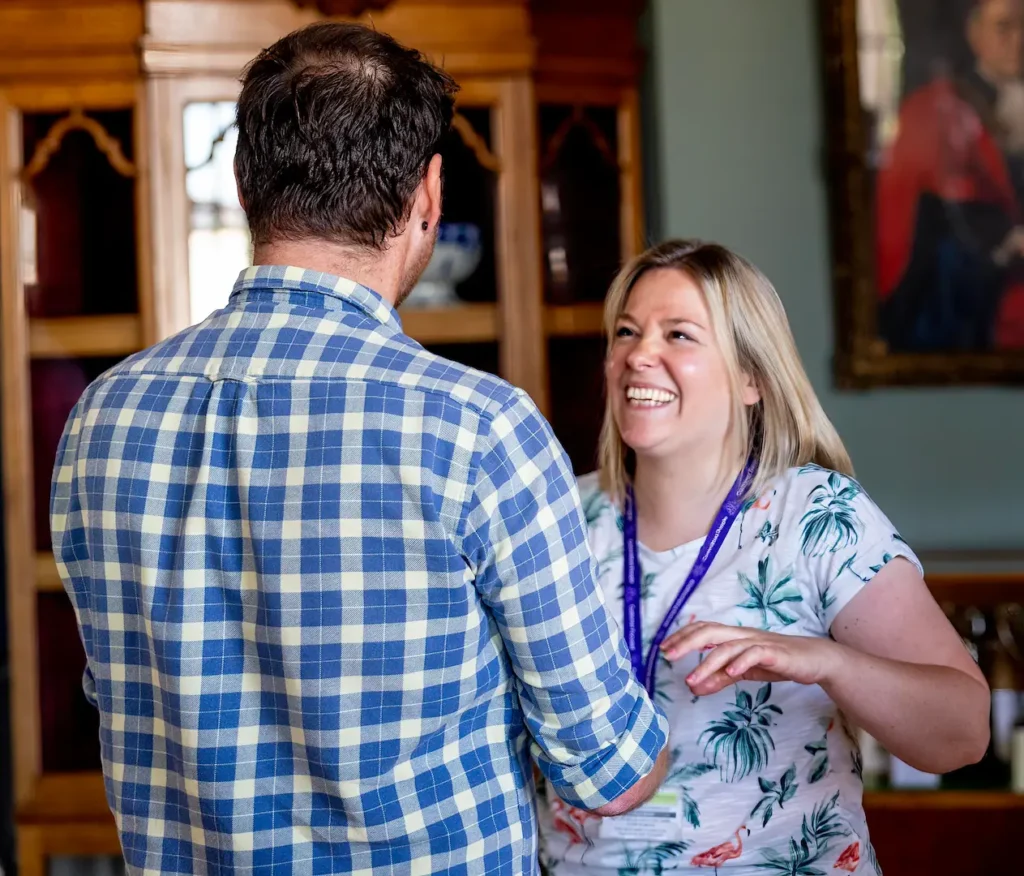
Woman laughing
• 06 Course Delivery & Assessment

Training built around your council’s buildings, roles and residents.

Delivery: Delivered face to face at your council offices, using realistic scenarios from council work: the counter, phone lines, parks and public meetings. StandPoint gives staff access to resources after the course.

Assessment: Through observation, participation and practical demonstration. No written exams.

Certification: Every delegate receives a uniquely numbered Stand2 certificate and is added to the Stand2 Training Register, giving you a clear record of who has been trained and when refreshers are due.

Training environment: Trauma-informed, with clear opt-outs. Physical elements are low-risk and suitable for all ages and fitness levels.

•07.Frequently asked questions

This course is for councils of every size, from town and parish councils to district, borough and county councils, whose staff deal with challenging members of the public.


Is this course about conflict with the public or between staff?
With the public. It is designed for council staff dealing with residents, visitors and service users. It does not cover internal disputes, grievances or councillor conduct.
Does this course include physical intervention?
No. Staff learn simple breakaway skills to release from a grab and create space to leave. There is no restraint or holding.
What is the difference between this course and Level 1?
Level 1 is a half-day course focused on communication and de-escalation, suited to office-based teams with a low risk of physical harm. This full-day Level 2 course adds personal safety, lone working and breakaway skills for outdoor, lone-working and enforcement roles.
Is conflict management training a legal requirement for council staff?
No law names it specifically. But councils must protect staff from foreseeable risks, including violence and aggression from the public, under the Health and Safety at Work etc. Act 1974. They must also assess those risks under the Management of Health and Safety at Work Regulations 1999. Training is one of the clearest ways to show those duties are being met.

Is this suitable for town and parish councils as well as larger councils?


Yes. We train small town and parish council teams as well as district, borough and county council services.
How many staff can attend each session?
Up to 12 per trainer. For larger teams, we can run two sessions on the same day or add a second trainer.
Does Stand2 training come with a certificate?
Yes. Every participant who successfully completes the programme is formally certified by Stand2 and issued with a uniquely numbered completion certificate. Each delegate is also entered onto the Stand2 Training Register, which we maintain on your behalf — providing your organisation with a clear, auditable record of who has been trained and when refresher training is due.
Can the training be delivered in our council building?
Yes. All training is delivered on site, and most councils use their chamber or largest meeting room.
Can we get a quote for committee approval?
Yes. We provide a written quote you can take to your personnel committee or full council, and can invoice ahead of the training.
How soon can you deliver?
We usually need four to six weeks’ notice from booking.
How often should staff refresh this training?
We recommend every two years, and training new starters as they join.
•08.Start the conversation

Can’t find what you’re looking for? Get in touch and we’ll get back to you as soon as possible.

If you’re responsible for staff safety, operational risk, or service delivery, we can  help.

"*" indicates required fields

It helps to know your sector, roughly how many staff, and the kinds of situations they face – but as much or as little as you like.
We do not use your personal information for any reason other than to contact you back. You can find our privacy policy by clicking here.

Google Reviews

At Stand2 we go above and beyond to understand and meet your expectations. Here are some of our recent reviews.

As the trusted leader in conflict management, personal safety, and physical intervention training, we aim to elevate standards across the UK and beyond by bringing evidence-based practice, operational credibility, and expert instruction to every sector we serve.
View All Reviews
Great session on conflict resolution. Session was informative and helpful for managing situations of conflict. Would highly recommend.

Brilliant course! Instructors (Steve and Dave) friendly and knowledgeable, made everyone feel really comfortable. Wonderful overall experience and know have a better knowledge of conflict resolution techniques.

Good training, helpful for increasing awareness of threats and process for justifying and processing conflict resolution.

Great experience practical elements really helped consolidate my knowledge.

The instructors were very knowledgeable, approachable and supportive. Great and informative session, thank you!


Excellent delivery, really informative & engaging, cannot fault the whole package. Thank you

Great training and was delivered to a high standard. Paul was very friendly and made me feel at ease

Very useful in practical life, specifically in my workplace.