
Level 01 – De-Escalation
Managing Challenging Behaviour for Housing, Local Authority & Community Services

Housing officers, ASB caseworkers, and community services staff all face frustration, distress, and challenging behaviour – often with a low risk of physical harm, but a real impact on confidence and wellbeing. This introductory programme builds the core communication and de-escalation skills to manage these encounters safely and professionally.

- In person
- Standpoint
- Affiliated Trainer Programme
- OBSERVATION
- PARTICIPATION
- DISCUSSION
•01COURSE OVERVIEW
Building the core communication and decision-making skills housing, local authority, and community services staff need to recognise, reduce, and safely manage emerging conflict – with tenants, service users, and members of the public.

Learners explore early behavioural indicators, structured de-escalation methods, and the foundations of dynamic risk assessment. The course emphasises proportionate, ethical responses aligned with organisational policy, helping staff maintain professionalism, reduce escalation, and support safer, more consistent outcomes across housing, casework, and community settings.
How this training helps your organisation
-
Builds consistent, professional responses to challenging tenants, service users, and members of the public across teams
-
Improves staff confidence and communication under pressure, whether at reception, on a call, or during outreach
-
Reduces avoidable escalation and disruption to housing, casework, and community services

-
Strengthens proportionate, defensible decision-making across teams
-
Enhances quality of incident reporting to support safeguarding, learning, and Housing Ombudsman complaint handling standards
-
Supports staff wellbeing through clearer boundaries and structured approaches to difficult interactions
•03.RISKS ADDRESSED
In lower-risk environments, the dangers are easy to underestimate. Without the right training, your staff may:
The good news is that this is entirely preventable. That’s what this course is for.
Here’s what your staff will be able to do differently:
- 01 Recognise and manage the three types of risk.Â
- 02 Avoid common causes of bias.
- 03 Recognise early indicators of distress, frustration, and escalating behaviour.
- 04 Assess risk dynamically and make proportionate, defensible decisions during challenging encounters.
- 05 Apply structured communication techniques to reduce tension and maintain control of interactions.
- 06 Use clear, professional language that supports deescalation and reduces ambiguity.
- 07 Apply ‘transactional analysis’ principles to communicate effectively under pressure.
- 08 Set boundaries and deliver difficult messages without increasing conflict.
- 09 Adapt their approach to suit different behavioural presentations, contexts, and service environments.
- 10 Implement safe, ethical, and organisation aligned strategies for managing aggression.
- 11 Recognise the potential emotional impact of challenging interactions and access appropriate post incident support
- 12 Record and report incidents accurately to support organisational learning and safeguarding.
- 13 Reflect on their own responses and identify opportunities for continuous improvement.
- 14 Maintain personal composure and emotional regulation under pressure.
Stevenage Borough Council – Housing and Antisocial Behaviour Teams
Stand2 delivered Conflict Management & Personal Safety training to Stevenage Borough Council’s Housing and Antisocial Behaviour teams. These staff work in community environments where frustration, service pressures, and complex behavioural issues can lead to challenging encounters, both in person and during property visits.
Training strengthened staff confidence in risk assessment, proportionate decision-making, and personal safety strategies when managing escalating behaviour. Officers reported clearer communication during difficult conversations, improved boundary setting when enforcing tenancy conditions or safety requirements, and more consistent use of deescalation approaches.
Training that’s built around how people actually learn – not just what they need to know.
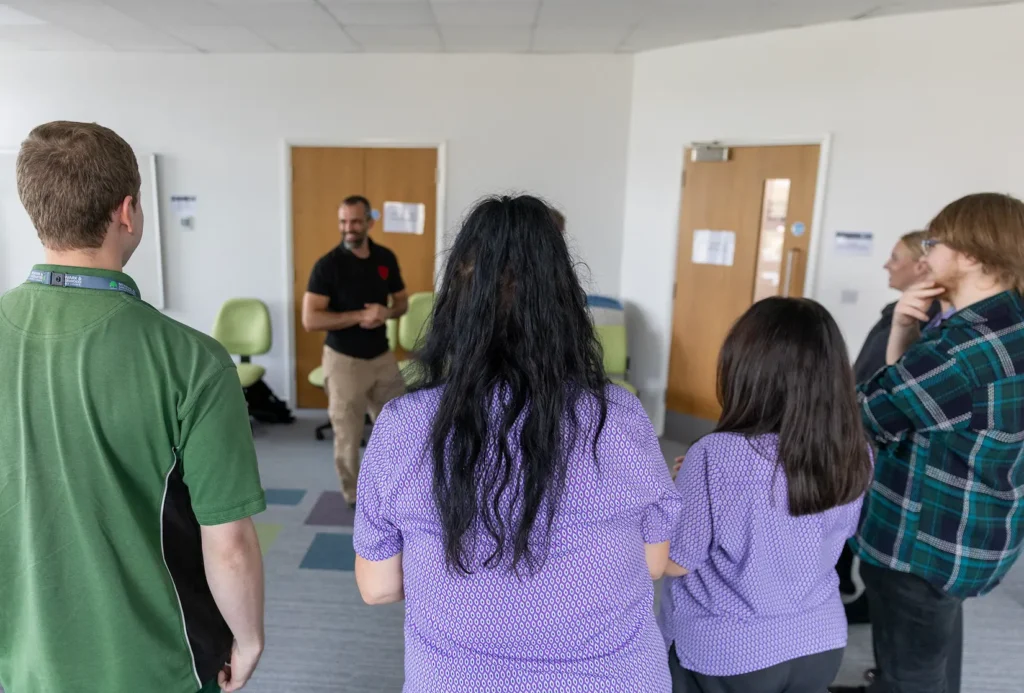
Delivery: This course is delivered in person through a blend of structured discussion, scenario-based examples, and supported reflective practice. Every session is adapted to reflect your organisation’s environment, policies, and the real situations your staff face. StandPoint, our online learning platform, supports the programme with additional resources and materials.
Assessment: Learning is assessed through observation, participation, and engagement in practical communication exercises. There are no formal written exams – assessment is continuous, realistic, and based on how staff apply what they’ve learned.
Certification: Every participant who successfully completes the programme is formally certified by Stand2, receiving a uniquely numbered certificate that confirms they have met the programme’s assessed standards. Each delegate is entered onto the Stand2 Training Register, which we maintain on your behalf – giving your organisation a clear, auditable record of who has been trained and when refresher training is due.
Training environment: All sessions are delivered using trauma-informed practice, ensuring psychological safety throughout. No participant is asked to take part in any activity they are uncomfortable with. The course is suitable for staff with varying levels of prior experience.
Can’t find what you’re looking for? Call us or drop us a message.
Is this course suitable for staff with no previous conflict management training?
Does the course include any physical intervention skills?
Is conflict management training a legal requirement for housing and local authority staff?
Is this course suitable for councils, housing associations, and community services alike?

How does this training help organisations meet their duty of care?
Can this course be built around our specific service environment?
Does Stand2 training come with a certificate?
How do you ensure the training is psychologically safe for participants?
Is this course aligned with our safeguarding and organisational procedures?
How often should staff refresh this training?
This course is ideal for local authorities, housing associations, and community or youth services where staff encounter challenging, distressed, or emotionally charged interactions but where the physical risk of harm is low.

If you’re responsible for staff safety, service quality, or organisational compliance, we can help.
"*" indicates required fields