
Level 03 – Physical Intervention

Advanced Conflict Management & Physical Intervention Training

A two-day programme for staff who may need to use physical intervention as a last resort to prevent harm, combining sound decision-making with safe, proportionate physical skills.

Duration 2 days
Delivery Methods
  • In person
  • Standpoint
  • Affiliate Trainer Programme
Assessments
  • OBSERVATION
  • PARTICIPATION
  • SUPERVISED PRACTICAL DEMONSTRATION
  • FORMATIVE ASSESSMENT
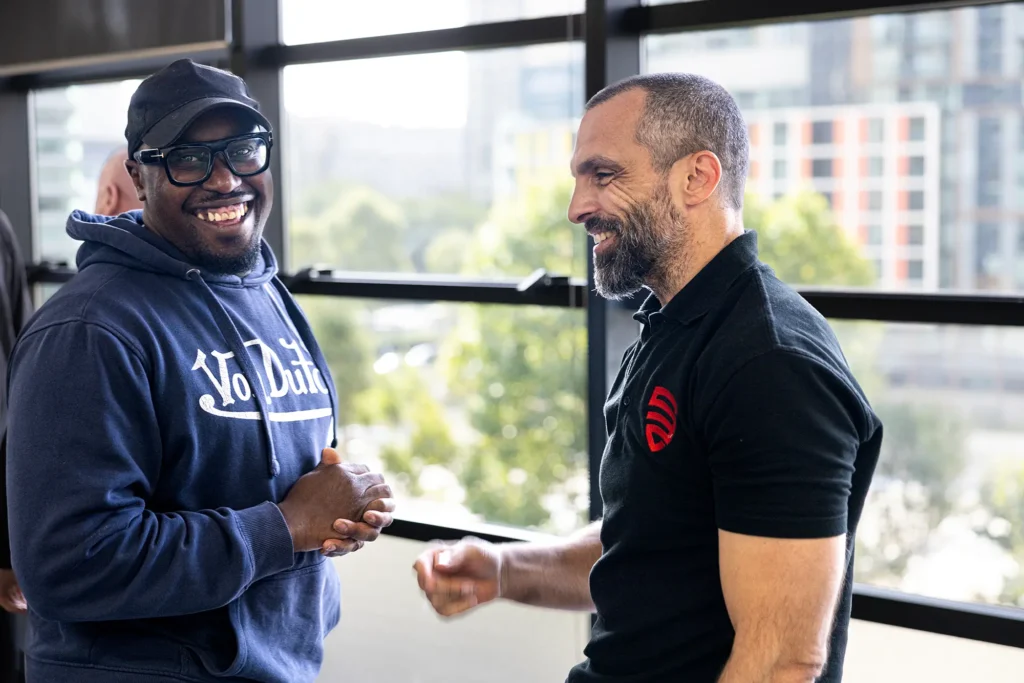
Stand2 trainer and client smiling

•01COURSE OVERVIEW

Safe physical intervention, only as a last resort.

Staff learn the legal and ethical framework for physical intervention, strong communication and de-escalation skills, and a set of safe, non-harmful techniques used only when necessary and proportionate.

The course is AIM accredited, and every technique is independently reviewed by a consultant in emergency medicine, so staff can act decisively while protecting everyone’s safety and dignity.

• 02 HOW THIS TRAINING HELPS

How this training helps your organisation

  • More confident, consistent responses to higher-risk behaviour
  • Fewer injuries and safer incident management
  • Stronger legal and professional defensibility
  • Clearer team communication under pressure
  • Least restrictive practice in line with your policies
  • Better incident reporting for governance and safeguarding
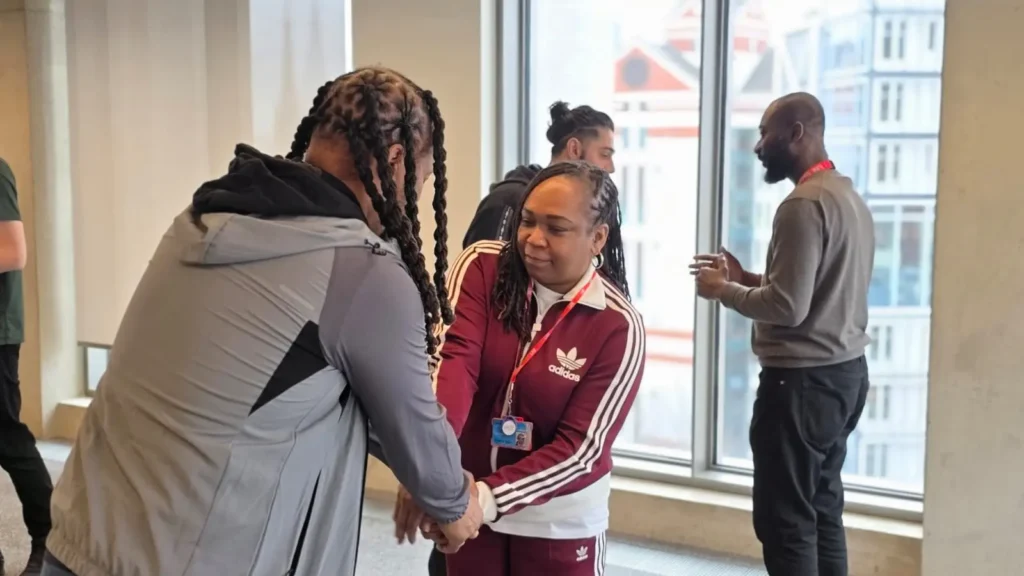
Conflict management training

•03.RISKS ADDRESSED

When intervention may be needed, untrained staff may:

Checklist icon Use unsafe or indefensible physical responses
Checklist icon Make impulsive or inconsistent decisions
Checklist icon Miss medical and positional risks during holds
Checklist icon Escalate situations without meaning to
Checklist icon Put themselves and others at greater risk
Checklist icon Struggle to coordinate as a team under pressure

The good news? It’s entirely preventable.

• 04 LEARNING OUTCOMES

What staff will learn.

Recognise and manage the three types of risk.
• 04 LEARNING OUTCOMES

What staff will learn.

  1. 01 Recognise and manage the three types of risk.
  2. 02 Identify risks associated with physical intervention, including medical, positional, and situational risks.
  3. 03 Explain the legal, ethical, and organisational principles governing physical intervention.
  4. 04 Recognise their duty of care and professional responsibilities.
  5. 05 Demonstrate situational awareness and early warning recognition to prevent escalation.
  6. 06 Use verbal and nonverbal communication strategies to defuse tension and reduce the need for physical intervention.
  7. 07 Describe the hierarchy of responses, emphasising prevention, deescalation, and last resort physical contact.
  8. 08 Apply decision-making models to choose the safest and most proportionate response.
  9. 09 Demonstrate self-control, emotional regulation, and professional behaviour under pressure.
  10. 10 Recognise personal limits and seek support when required.
  11. 11 Demonstrate safe, non-harmful physical skills designed to reduce risk and increase safety for all parties.
  12. 12 Apply safe positioning, movement, and team coordination principles to minimise harm.
  13. 13 Work effectively as part of a team with colleagues and external services.
  14. 14 Demonstrate safe and effective management of bystanders during high risk incidents
  15. 15 Transition away from physical contact as soon as it is safe and appropriate.
  16. 16 Describe and follow organisational procedures for incident reporting and review.
  17. 17 Contribute to post incident debriefs that prioritise dignity, safety, and continuous improvement.
  18. 18 Reflect on incidents to identify learning, reduce recurrence, and support staff wellbeing.
  19. 19 Apply the programme’s principles consistently across different environments and service users.
05 CASE STUDY

Festival Place security & customer safety teams

Festival Place is a leading shopping and leisure destination in Basingstoke, home  to over 140 retailers, more than 20 restaurants, and a 10-screen cinema. The centre  combines visible, proactive security with discreet, covert safety measures to  ensure a calm, safe environment for millions of visitors each year. 

Stand2 delivered Advanced Conflict Management & Physical Intervention training  to strengthen the centre’s already well-established commitment to safety. The  programme ensured that Festival Place staff are among the best equipped in the  sector to prevent escalation, make defensible decisions under pressure, and apply  safe, medically reviewed physical intervention only when necessary. 

Staff reported increased confidence, clearer communication during challenging  incidents, and improved coordination when working as a team. The training  supported Festival Place’s ongoing commitment to providing a safe, reassuring  experience for shoppers, visitors, and employees across this large and diverse  environment.

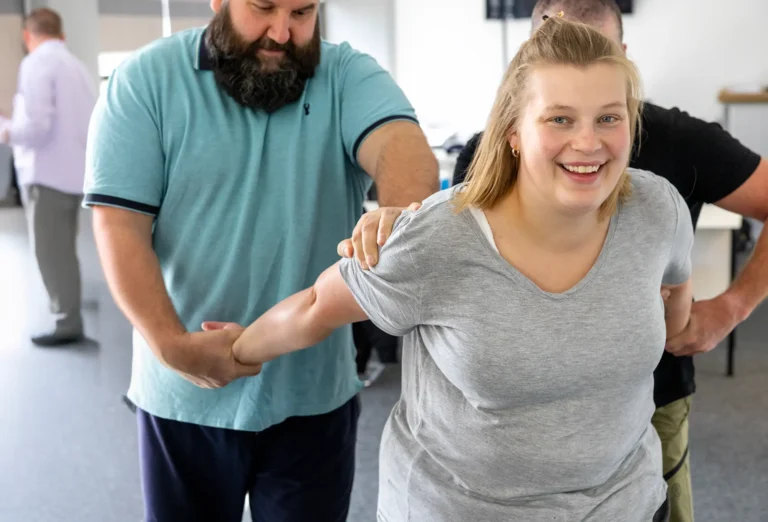
Physical intervention training
• 06 Course Delivery & Assessment

Two days of medically reviewed training, built around your risks.

Delivery: Two days in person, combining theory, scenario-based exercises and supervised physical skills practice. A Training Needs Analysis beforehand makes sure every scenario fits your environment and policies, and StandPoint, our online learning platform, provides supporting resources.

Medical review and accreditation: Every physical technique is independently reviewed by a consultant in emergency medicine and risk assessed by a NEBOSH-qualified practitioner. That level of oversight isn’t standard across the sector.

Assessment: Continuous and practical, through observation and supervised demonstration in realistic, controlled conditions.

Certification: Successful delegates receive a uniquely numbered Stand2 certificate and are added to our Training Register, giving you an auditable record of who’s trained and when refreshers are due.

Training environment: Trauma-informed, closely supervised and consent-led. No one is asked to do anything they’re uncomfortable with.

•07.Frequently asked questions

Physical intervention course: your questions answered

Is this course suitable for staff with no previous physical intervention experience?
Yes. The programme covers all foundational communication, de-escalation, and risk assessment principles before introducing physical skills. No previous physical intervention experience is needed.
Are any pain-based techniques taught?
No. Stand2 does not teach, endorse, or permit pain-based or harmful techniques under any circumstances. Every physical skill taught on this programme is designed to reduce risk and minimise harm – to staff, service users, and members of the public.
Are the physical intervention techniques medically safe?
Yes. All techniques are independently medically reviewed by a consultant in emergency medicine and fully risk assessed by a NEBOSH-qualified practitioner before they are taught. This level of independent medical oversight is not standard across the physical intervention training sector – it is Stand2’s commitment to ensuring every technique is clinically safe and defensible.

Is physical intervention training a legal requirement?

Employers have a legal duty under the Health and Safety at Work Act 1974 to assess and manage foreseeable risks to their staff. The HSE is explicit that where staff face a serious or credible risk of physical aggression, appropriate training – including physical intervention skills – is a required control measure, not an optional one. For organisations where physical risk is foreseeable and regular, this programme provides the most direct and demonstrable way to meet that obligation.


What is a Training Needs Analysis and why is it required?

A Training Needs Analysis is a structured assessment carried out by Stand2 before any Level 3 programme is delivered. It confirms that physical intervention skills are appropriate, necessary, and proportionate for your specific environment, staff group, and risk profile. It also ensures the content, scenarios, and physical techniques are directly relevant to the situations your staff face. The TNA is a professional and legal safeguard – for your organisation and for Stand2 – and is included as part of the process when you get in touch.

What sectors is this course suitable for?
This course is suitable for organisations where physical aggression is a genuine and regular occupational risk. Stand2 regularly delivers this programme to NHS trusts, ambulance services, mental health and learning disability providers, probation services, security teams, prison and custodial services, and other high-risk public and private sector environments. If you are unsure whether Level 3 is appropriate for your organisation, the Training Needs Analysis will confirm this.
How does this training support legal and professional defensibility?
Every element of this programme is designed with defensibility in mind. Staff learn the legal, ethical, and organisational frameworks that govern physical intervention – including duty of care, proportionality, and least restrictive practice. The independent medical review, the Training Needs Analysis, the assessment process, and the Stand2 Training Register all contribute to an auditable, defensible record of training that stands up to regulatory, legal, and safeguarding scrutiny.
Does Stand2 training come with a certificate?
Yes. Every participant who successfully completes the programme is formally certified by Stand2 and issued with a uniquely numbered completion certificate. Each delegate is also entered onto the Stand2 Training Register, which we maintain on your behalf – providing your organisation with a clear, auditable record of who has been trained and when annual refresher training is due.
How do you ensure psychological and physical safety during training?
All sessions are delivered with clear consent, trauma-informed facilitation, close supervision, and robust safety protocols. Physical skills are practised in a controlled, supervised environment with appropriate safety measures in place throughout. No participant is asked to take part in any activity they are uncomfortable with.
How often should staff refresh this training?
Stand2 recommends an annual refresher interval of 12 months for this programme. Physical intervention skills are among the most perishable of all workplace competencies – research consistently shows that physical and decision-making skills deteriorate significantly without regular practice. The annual refresher follows a condensed one-day format. Stand2 will proactively notify you when your staff are approaching their refresher date through the Stand2 Training Register.
•08.Start the conversation

Let’s talk about training your team.

Ideal where staff may need to intervene physically to keep themselves and others safe. Tell us about your team and we’ll recommend the right approach.

"*" indicates required fields

It helps to know your sector, roughly how many staff, and the kinds of situations they face – but as much or as little as you like.
We do not use your personal information for any reason other than to contact you back. You can find our privacy policy by clicking here.
Google Reviews

At Stand2 we go above and beyond to understand and meet your expectations. Here are some of our recent reviews.

As the trusted leader in conflict management, personal safety, and physical intervention training, we aim to elevate standards across the UK and beyond by bringing evidence-based practice, operational credibility, and expert instruction to every sector we serve.
View All Reviews
Great session on conflict resolution. Session was informative and helpful for managing situations of conflict. Would highly recommend.

Brilliant course! Instructors (Steve and Dave) friendly and knowledgeable, made everyone feel really comfortable. Wonderful overall experience and know have a better knowledge of conflict resolution techniques.

Good training, helpful for increasing awareness of threats and process for justifying and processing conflict resolution.

Great experience practical elements really helped consolidate my knowledge.

The instructors were very knowledgeable, approachable and supportive. Great and informative session, thank you!


Excellent delivery, really informative & engaging, cannot fault the whole package. Thank you

Great training and was delivered to a high standard. Paul was very friendly and made me feel at ease

Very useful in practical life, specifically in my workplace.