


























































Level 01 – De-Escalation

Managing Challenging Telephone Calls for Education

A focused, practical course for school and college reception, admissions, and attendance staff who manage distressed, frustrated, or angry callers – parents challenging a behaviour decision or exclusion, carers chasing SEND provision or EHCP updates, or families reacting to a safeguarding concern.

Designed to build confidence, clarity, and professional composure during high-emotion calls.

 
Duration 4 Hours
Delivery Methods
  • In person
  • Standpoint
  • Affiliated Trainer Programme
Assessments
  • OBSERVATION
  • PARTICIPATION
  • DISCUSSION
Call center

01COURSE OVERVIEW

Building the communication skills, clarity, and confidence school and college front-office staff need to manage distressed, frustrated, and occasionally aggressive callers safely and professionally.

Staff learn to recognise early escalation cues in parents and carers affected by worry, frustration with process, or distress about their child, apply evidence-based de-escalation techniques, and maintain clarity under pressure.

The programme reinforces proportionate, consistent decision-making, appropriate boundary setting, and alignment with your school’s complaints and safeguarding procedures – so staff know exactly when a call needs to be escalated to a leader or the Designated Safeguarding Lead.

02 THE IMPACT

How this training helps your organisation

  • Establishes clear, consistent standards for professional call handling across reception, admissions, and attendance lines
  • Reduces escalation and complaint volume from high-emotion calls about behaviour incidents, exclusions, or SEND provision
  • Improves clarity when delivering difficult messages – a suspension, an EHCP delay, a safeguarding referral – or setting boundaries with a distressed parent
  • Strengthens decision-making and call control in line with your complaints and safeguarding procedures
  • Increases staff confidence and reduces call-related stress in busy front-office and admissions teams
  • Improves incident recording to support safeguarding, complaints handling, and governor or Ofsted scrutiny
Call center

03.RISKS ADDRESSED

Telephone-based conflict is easy to underestimate. Without the right training, your staff may:

Checklist icon Misinterpret tone, emotion, or escalation cues from a worried or angry parent – without the benefit of visual context
Checklist icon Escalate calls unintentionally through unclear, inconsistent, or reactive communication during a difficult conversation
Checklist icon Deliver necessary but unwelcome messages – sanctions, exclusions, SEND decisions – in ways that increase frustration or hostility
Checklist icon Make rushed or inconsistent decisions under pressure during busy periods such as the start or end of term
Checklist icon Miss or misjudge when a call needs to be escalated to a safeguarding lead or senior leader
Checklist icon Under-report call-related incidents, limiting the school’s visibility of recurring issues and complaint patterns

The good news is that this is entirely preventable. That’s what this course is for.

04 LEARNING OUTCOMES

Here’s what your staff will be able to do differently:

Recognise and manage the three types of risk. 
04 LEARNING OUTCOMES

Here’s what your staff will be able to do differently:

  1. 01 Recognise and manage the three types of risk. 

  2. 02 Identify the early verbal and behavioural indicators of frustration, distress, and escalation during calls.
  3. 03 Use clear, concise, and professional language to reduce ambiguity and prevent misunderstandings.
  4. 04 Apply structured communication techniques that support deescalation and maintain control of the interaction.
  5. 05 Manage high emotion callers using evidence-based approaches that reduce tension and promote co-operation.
  6. 06 Apply ‘transactional analysis’ principles to communicate effectively under pressure.
  7. 07 Set and maintain appropriate boundaries while delivering difficult or unwelcome information.
  8. 08 Recognise different types of challenging caller behaviour and adapt their approach accordingly.
  9. 09 Make proportionate, defensible decisions when faced with escalating or aggressive behaviour.
  10. 10 Maintain personal composure and emotional regulation under pressure.
  11. 11 Follow organisational procedures for escalation, safeguarding, and emergency response.
  12. 12 Record and report incidents accurately to support organisational learning and risk management.
  13. 13 Reflect on their own communication style and identify opportunities for continuous improvement.
05 CASE STUDY

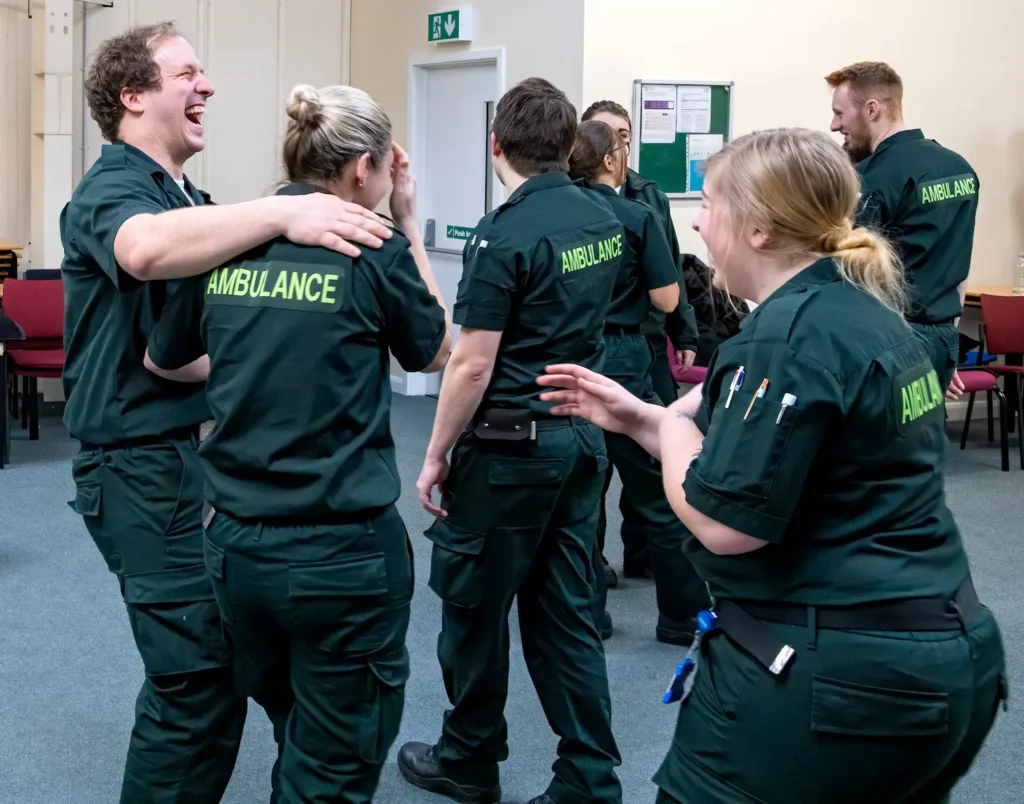
Northern Ireland Ambulance Service – Emergency and Non-Emergency Call Handling Teams

Stand2 delivered training to call handlers across the Northern Ireland Ambulance  Service, supporting staff who manage a high volume of distressing, emotionally  charged, and time critical calls. These teams frequently deal with callers  experiencing pain, fear, acute distress, or frustration linked to emergency  response times, clinical outcomes, or service pressures. 

The training focused on strengthening call control, improving clarity under  pressure, and reducing escalation during high emotion interactions. Following  the programme, staff reported increased confidence in managing complex caller  behaviours, clearer communication when delivering difficult or time sensitive information, and greater consistency across teams. 

Students raise their hands to participate in a classroom lesson led by their teacher
06 Course Delivery & Assessment

Training that’s built around how call handlers actually work – not just what they need to know.

Delivery: This course is delivered in person through a mix of structured discussion, evidence-based communication exercises, and scenario-driven call examples that reflect the real conversations your staff have. Every session is built around your school’s caller profile, complaints procedure, and safeguarding escalation routes. StandPoint, our online learning platform, supports the programme with additional resources and materials.

Assessment: Learning is assessed through observation, participation, and engagement in practical caller management tasks. There are no formal written exams – assessment is continuous, realistic, and based on how staff apply what they’ve learned in simulated call scenarios.

Certification: Every participant who successfully completes the programme is formally certified by Stand2, receiving a uniquely numbered certificate that confirms they have met the programme’s assessed standards. Each delegate is entered onto the Stand2 Training Register, which we maintain on your behalf – giving your organisation a clear, auditable record of who has been trained and when refresher training is due.

Training environment: All sessions are delivered using trauma-informed principles in a psychologically and emotionally safe environment. No participant is asked to engage in any activity they are uncomfortable with. The course is suitable for staff with varying levels of prior experience.

07.Frequently asked questions

Can’t find what you’re looking for? Call us or drop us a message.

Is this course suitable for staff who work exclusively on the phone or front desk?
Yes – it’s designed specifically for reception, admissions, attendance, and front-office roles where telephone and face-to-face contact with parents is the main point of pressure.
Does the course cover managing repeat or persistent callers?
Yes, including parents who call repeatedly about the same issue – a common pattern around exclusions, SEND provision, and safeguarding concerns.
Is this course suitable for both academic and non-teaching staff?
Yes. It’s built for the staff who actually answer the phone – typically office managers, receptionists, attendance officers, and admissions teams, though pastoral staff often attend too.
How does this training help reduce complaints and escalation to senior leaders?
By giving front-office staff the skills and confidence to resolve or contain a call at the first point of contact, rather than every difficult conversation escalating straight to a deputy head or headteacher.
Can the scenarios be built around our specific call types?
Yes. Every programme is built around the calls your team actually receives – exclusions, EHCP queries, safeguarding disclosures, admissions disputes, or day-to-day attendance and behaviour queries.
Does Stand2 training come with a certificate?
Yes. Every participant receives a uniquely numbered Stand2 certificate and is added to your school’s Stand2 Training Register.
How do you ensure the training is psychologically safe for participants?
All sessions use trauma-informed facilitation, and no one is required to take part in anything they find uncomfortable.
Will this training align with our safeguarding and complaints procedures?
Yes. We build the course around your existing procedures so staff know exactly when and how to escalate a call, rather than teaching a generic process that conflicts with your policy.
How often should call handlers refresh this training?
Stand2 recommends a refresher interval of 36 months for this programme. The refresher course follows the same 4-hour format as the initial programme. Stand2 will proactively notify you when your staff are approaching their refresher date through the Stand2 Training Register.
08.Start the conversation

This course is ideal for teams who manage challenging or high emotion callers and need a clear, defensible approach to communication and call handling safety.

If you’re responsible for staff wellbeing, service quality, or caller-related risk, we can help.

"*" indicates required fields

It helps to know your sector, roughly how many staff, and the kinds of situations they face – but as much or as little as you like.
We do not use your personal information for any reason other than to contact you back. You can find our privacy policy by clicking here.
Google Reviews

At Stand2 we go above and beyond to understand and meet your expectations. Here are some of our recent reviews.

As the trusted leader in conflict management, personal safety, and physical intervention training, we aim to elevate standards across the UK and beyond by bringing evidence-based practice, operational credibility, and expert instruction to every sector we serve.
View All Reviews
Excellent. Done a few courses over the years regarding conflict management and this was the best. Relaxed teaching and no one was afraid to make a mistake or ask any questions. Enjoyed this much more than my recent SIA renewal in all honesty.

Really thoughtful and experienced teachers. After the training I felt really confident in conflict resolution and physical intervention. Thank you now I know how to protect myself, the general public and my organisation if a situation comes up.

Very well structured course and effectively taught. Techniques and solutions were very helpful.

Very good! Other security companys should learn this Easy to learn


Fantastic course, gave a really easy to remember process for handling conflict management. Trainers were great, I thoroughly enjoyed it.

Really course, tutors were great especially Chris who made it fun and interactive

Really enjoyed the training Dave and Chris are very engaging

Engaging PowerPoint, really good instructors, time to practice techniques

I recently completed training at Stand2 and had a great experience. The course was well organised, engaging and delivered by Chris C, who explained everything clearly using practical, real-life examples. The training has given me greater confidence in managing conflict, assessing risk, and keeping myself and others safe. I would highly recommend this course to anyone looking to develop these important skills.